所屬科目:研究所、轉學考(插大)◆生物化學
3. Which of the following amino acids contains a β-branched side chain? (A) Alanine (B) Glutamate (C) Isoleucine (D) Proline(E) Tryptophan
15. The enzyme glycogen phosphorylase: (A) catalyzes a cleavage of β(1→4) bonds. (C) is a substrate for a kinase. (E) uses glucose as a substrate. (B) catalyzes a bydrolytic cleavage of a(1→4) bonds. (D) uses glucose 6-phosphate as a substrate.
17. From the abbreviated name of the compound Gal(β1→4)GIc, we know that: (A) C-4 of glucose is joined to C-1 of galactose by a glycosidic bond. (B) the compound is a D-enantiomer. (C) the galactose residue is at the reducing end. (D) the glucose is in its pyranose form. (E) the glucose residue is the B anomer.
22. The standard reduction potentials for the following half reactions are given. If you mixed succinate, fumarate, FAD, and FADH2 together, all at I M concentrations and in the presence of succinate dehydrogenase, which of the following would happen initially? (A) Fumarate and succinate would become oxidized; FAD and FADH2 would become reduced. (B) Fumarate would become reduced; FADH2 would become oxidized. (C) No reaction would occur because all reactants and products are already at their standard concentrations. (D) Succinate would become oxidized; FAD would become reduced. (E) Succinate would become oxidized; FADH2 would be unchanged because it is a cofactor.
23. Which of the following pairs is interconverted in the process of mutarotation? (A) D-glucose and D-fructose (B) D-glucose and D-galactose(C) D-glucose and D-glucosamine (D) D-glucose and L-glucose (E) o-D-glucose and β-D-glucose
32. For enzymes in which the slowest (rate-limiting) step is the reactionKm becomes equivalent to: (A) kcat. (B) the [S] where V0 = Vmax. (C) the dissociation constant, Kd, for the ES complex. (D) the maximal velocity. (E) the turnover number.
44. In the citric acid cycle, citrate is isomerized to isocitrate by aconitase. H2O was first abstracted from citrate, and then rehydrated with H– and HO–adding back in opposite positions to produce isocitrate. This reaction catalyzed by aconitase is quite stereospecific. As citrate has a total of four chemically equivalent hydrogens (labeled as H1~H4 in the figure), only one of the four HsㅡC-HA hydrogens, the pro-R H atom of the pro-R arm of citrate, is abstracted during the reaction of the H2O abstraction by aconitase. Which one of the hydrogens in the citrate molecule shown in the figure is the pro-R H atom of the pro-R arm?(A) H1 (B) H2 (C) H3 (D) H4 (E) None of them.
45. Which of the following monosaccharides is an aldose?(A)a(B) b (C)c(D)d(E) None of the above.
50. What coenzyme would be required in the following reaction? (A) ADP(B) thiamine pyrophosphate (C) biotin (D) lipoic acid (E) coenzyme A
 阿摩線上測驗
登入
 fructose 6-phosphate (A)
 is +1.7 kJ/mol. (B)
 for the following half reactions are given.


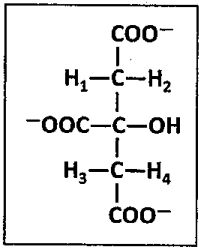 (A) H1 (B) H2 (C) H3 (D) H4 (E) None of them.
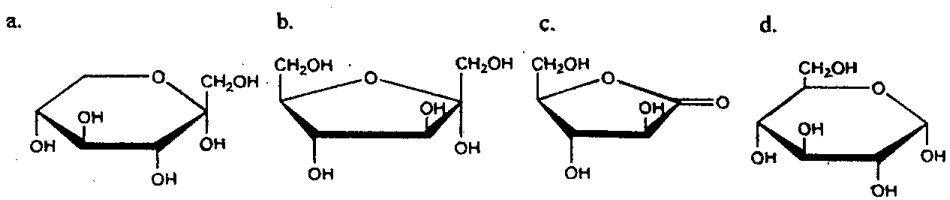 (A)a(B) b (C)c(D)d(E) None of the above.
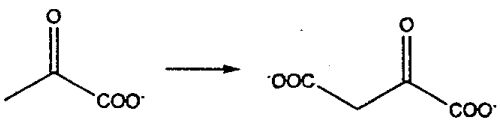 (A) ADP(B) thiamine pyrophosphate (C) biotin (D) lipoic acid (E) coenzyme A