所屬科目:研究所、轉學考(插大)◆物理化學及分析化學
1. How many milliliters of 3.00 M H2SO4 are required to react with 4.35 g of solid containing 23.2 wt% Ba(NO3)2 (FM 261.34 g/mol) if the reaction is → BaSO4(s)?(A) 12.9 (B) 1.29 (C) 4.36 (D) 14.36 (E) 12.1
2. A 0.0450 M solution of weak acid: HA is 0.60% dissociated. Calculate pKa for this acid.(A) 1.65 (B) 3.82 (C) 5.79 (D) 6.21 (E) 6.88
3. Find the pH of 0.050 M HCIO4 plus 0.050 Μ HBr. (μ = 0.050 Μ ⇒ γΗ+ = 0.86; μ = 0.10 M → γΗ+ = 0.83). (A) 0.043 (B) 1.37 (C) 2.37 (D) 0.083 (E) 1.08
4. Calculate the pH of a solution prepared by dissolving 10.0 g of tris(hydroxymethyl)-aminomethane ("tris"; FM: 121.136 g/mol) plus 10.0 g of tris hydrochloride (FM: 157.597 g/mol) in 0.250 L of water.(A) 8.19 (B) 8.25 (C) 9.05 (D) 8.37 (Ε) 7.52
5. Calculate the isoelectric pH of 0.010 M 8-hydroxyquinoline. pKa1: 4.94, pKa2: 9.82(A) 5.36 (B) 6.36 (C) 7.36 (D) 8.36 (E) 9.36
6. Consider the diprotic acid H2A with K₁ = 1.00 × and K2 =1.00 × . Find the pH of HA in0.100 M NaHA. (A) 5.00 (B) 6.00 (C) 7.00 (D) 8.00 (E) 9.00
7. How many milliliters of 0.202 M NaOH should be added to 25.0 mL of 0.023 3 M salicylic acid (2- hydroxybenzoic acid) to adjust the pH to 3.50? [salicylic acid (H2A, pK1 = 2.972, pK2 = 13.7)] (A) 1.023 (B) 2.223 (C) 3.323 (D) 4.023 (E) 5.223
8. A solution containing the complex formed between Bi(III) and thiourea has a molar absorptivity of9.32 × 103 L at 470 nm. What is the absorbance of a 3.79 X M solution of the complex at 470 nm in a 1.00 cm cell? (A) 1.353 (B) 2.021 (C) 0.335 (D) 0.353 (E) 0.153
9. What kind of interferences may cause the complex spectra in atomic mass spectrometry? (A) Isobaric Interferences (B) Polyatomic Ion Interferences (C) Oxide and Hydroxide Species' Interference (D) none of the above (E) all of the above
10. A chromatography column with a length of 10.3 cm and an inner diameter of 4.61 mm is packed with a stationary phase that occupies 61.0% of the volume. If the volume flow rate is 1.13 mL/min, find the linear flow rate in cm/min. (A) 17.4 (B) 12.8 (C) 10.1 (D) 8.32 (E) 4.91
11. If the reaction 2HBr → H2 + Br2 belongs to second-order reaction, which of the following will yield a linear plot? (A). In[HBr] vs time. (B). [HBr] vs time. (C). 1/[HBr] vs time. (D). 1/ln[HBr] vs time. (E). 1/[HBr]² vs time.
12. Which of the following phenomena or effect can be attributed to the quantum nature of light? (A). Blackbody radiation. (B). Photoelectric effect. (C). Laser. (D). Carrots look red. (E). All of these.
13. A particle with mass m is moving freely in one dimension along x with zero potential energy. From the viewpoint of quantum mechanics, which following statement is wrong? (A). The time-independent Schrodinger equation is - = Εψ. (B). ψ(x) = can be the wavefunction for the particle with single linear momentum +kħ. (C). ψ(x) = cos(kx) is one of solutions of its time-independent Schrodinger equation. (D). The total energy of the particle is quantized. (Ε). For (x) = cos(kx), its expectation value of the operator is equal to zero.
14. A particle is confined in a one-dimensional box with a finite length. The potential energies inside and outside the box are equal to zero and infinity, respectively. From the viewpoint of quantum mechanics, which of the following statement is wrong? (A). The degeneracy of each energy level is one. (B). The zero-point energy is equal to zero. (C). The wavefunction with a higher total energy has a larger number of nodes. (D). Outside the box, the value of the wavefunction is equal to zero. (E). The total energy is inversely proportional to the square of the length of the box. (- h2 d22m dx2 +kx²) = Eψ, where x is
15. The Schrodinger equation of a harmonic oscillator is= Εψ,where x is displacement from the equilibrium position, m is mass and k is force constant. Which following statement is wrong? (A). The vibrational frequency is proportional to . (B). The zero-point energy is not equal to zero. (C). The total energy is linearly proportional to vibrational frequency. (D). The expectation value of x, <x>, is equal to zero. (E). The degeneracy of each energy level is two.
16. For the ground state of helium atom, which following statement is wrong? (A). The total angular momentum of two electrons is zero. (B). A helium atom in the ground state is diamagnetic. (C). The term symbol is ¹S0. (D). Two electrons in helium are distinguishable. (E). The shielding effect of two 1s electrons to 2s orbital is smaller than that to 2p orbital.
17. For Born Oppenheimer approximation, which of the following statement is correct? (A). The motion of nuclei and the motion of the electrons are coupled. (B). The motion of electrons is much faster than that of nuclei due to their big differences in mass. (C). In the Hamiltonian operator, the electron-nucleus interactions are removed. (D). The electrons and nuclei are considered to have a similar speed. (E). The energy of electrons depends on positions and velocities of nuclei.
18. For reversible isothermal expansion of an ideal gas (system), which of the following statement is wrong? (A). The heat transfer is zero. (B). The change in the internal energy of the system is zero. (C). The work done by the system is not zero. (D). The entropy change of the system is positive. (E). The enthalpy change of the system is zero.
19. For reversible adiabatic expansion of an ideal gas (system), which of the following statement is wrong? (A). The heat transfer is zero. (B). The change in the internal energy of the system is zero. (C). The work done by the system is not zero. (D). The entropy change of the system is zero. (E). The enthalpy change of the system is not zero.
20. For Gibbs energy, G, which of the following statement is wrong? (A). For a spontaneous process at constant temperature and pressure, the change in G is negative. (B). G is defined by the equation: G = H - TS. (C). Its fundamental thermodynamic relation is: dG = −SdT+PdV. (D). The chemical potential of a pure substance is equal to its molar Gibbs energy. (E). G is a state function.
21. If the reaction CH3NC → CH3CN belongs to second-order reaction, which of the following will yield a linear plot? (A). In[CH3NC] vs time (B). [CH3NC] vs time (C). 1/[ CH3NC] vs time (D). 1/ln[CH3NC] vs time (E). 1/[CH3NC]² vs time
22. For the Arrhenius equation, k = A exp(), which of the following statement is wrong? (A). The effect of catalyst is to increase the magnitude of A. (B). The pre-exponential factor A is associated with the collision frequency of reactants. (C). The activation energy can be positive or negative. (D). The pre-exponential factor A includes the steric factor of reaction. (E). exp(-/RT) represents the fraction of molecules with a kinetic energy larger than Ea.
1. One mole of N2(g) at 298 K expands adiabatically from a volume of 5.0 atm to 1.0 atm in following two conditions: (a) reversibly, and (b) against a constant external pressure of 1.0 atm. The molar heat capacity at constant volume is equal to 5R/2. Determine the values of final temperature of N2(g), for conditions (a) and (b). R = 8.314 J = 0.082 L atm
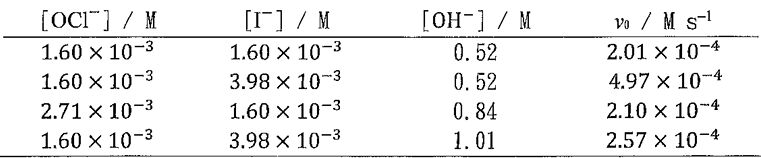
2. Consider the base-catalyzed reaction: . Use the following data of initial rate v0 to determine (a) the rate law and (b) the corresponding rate constant, including the unit, for the reaction.
 阿摩線上測驗
登入
阿摩線上測驗
登入
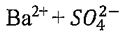 → BaSO4(s)?(A) 12.9 (B) 1.29 (C) 4.36 (D) 14.36 (E) 12.1
 and K2 =1.00 ×
 . Find the pH of HA in0.100 M NaHA. (A) 5.00 (B) 6.00 (C) 7.00 (D) 8.00 (E) 9.00
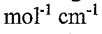 at 470 nm. What is the absorbance of a 3.79 X
 M solution of the complex at 470 nm in a 1.00 cm cell? (A) 1.353 (B) 2.021 (C) 0.335 (D) 0.353 (E) 0.153
 = Εψ. (B). ψ(x) =
 can be the wavefunction for the particle with single linear momentum +kħ. (C). ψ(x) = cos(kx) is one of solutions of its time-independent Schrodinger equation. (D). The total energy of the particle is quantized. (Ε). For (x) = cos(kx), its expectation value of the operator
 is equal to zero.
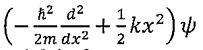 = Εψ,where x is displacement from the equilibrium position, m is mass and k is force constant. Which following statement is wrong? (A). The vibrational frequency is proportional to
 . (B). The zero-point energy is not equal to zero. (C). The total energy is linearly proportional to vibrational frequency. (D). The expectation value of x, <x>, is equal to zero. (E). The degeneracy of each energy level is two.
 ), which of the following statement is wrong? (A). The effect of catalyst is to increase the magnitude of A. (B). The pre-exponential factor A is associated with the collision frequency of reactants. (C). The activation energy
 can be positive or negative. (D). The pre-exponential factor A includes the steric factor of reaction. (E). exp(-
 /RT) represents the fraction of molecules with a kinetic energy larger than Ea.
 = 0.082 L atm

 . Use the following data of initial rate v0 to determine (a) the rate law and (b) the corresponding rate constant, including the unit, for the reaction.