所屬科目:研究所、轉學考(插大)◆物理化學
1. Define the operators, whereare the position and momentum operators. What is the value of the commutator? (hint: = =) (A)0 (B)1 (C) ih (D)h (E) 2h
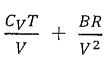
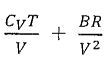
2. What is the , for a non-ideal gas whose state can be expressed as the virial equation: (V=molar volume)? (A) (B)(C)(D)(E)
3. Which valence bond wavefunction for He is not a proper wavefunction because it violates the Pauli exclusion principle? (Please note: the numbers 1 and 2 represent the two electrons of He, N is the normalization constant, 1sA and 1Se represent the atomic orbitals, and a and B are spin wavefunctions.) (A) φ(1,2) = N[1sA(1)1sB;(2)-1SA(2)1sB(1)][a(1)B(2)-a(2)B(1)] (B)φ(1,2)=N[1sA(1)1sB(2)+1sA(2)1sB(1)][a(1)B(2)-a(2)B(1)] (C) φ(1,2)=N[1sA(1)1sB(2)-1sA(2)1SB(1)][(1)β(2)+a(2)β(1)] (D)φ(1,2)=N[1sA(1)1sB(2)-1sA(2)1SB(1)][a(1)a(2)] (E)φ(1,2)=N[1sA(1)1sB(2)-1SA(2)1SB(1)][β(1)β(2)]
4. We can construct three sp2 hybrid orbitals (i.e., φun = 1,2,3) as follows:
φ1=a1(2s)+b1(2pz)
φ2=a2(2s)+b2(2pz)+c2(2px)φ3 =a3(2s)+b3(2pz)+c3(2px)where 2s,2px and 2pz are normalized atomic orbitals and an,bn and cn are constants. Assume these hybrid orbitals are normalized and orthogonal to each other, then which of the following is incorrect. (A)a1 = a2 = a3 = (B)b1= (C)b2 =b3 =- (D)c2=c3 = (E)=1
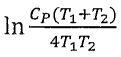
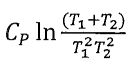
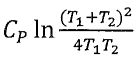
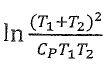
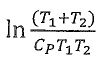
6. Two metal blocks with the same mass at different temperatures (T1 and T2) are contacting each other the reach the same temperature. What is AS assuming no heat loss during heat transfer.(A) (B) (C)(D)(E)
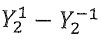
7. The first few spherical harmonics(θ, Φ) responsible for the angular parts of the hydrogen wavefunctions are listed below.Which combination of spherical harmonics (θ,Φ) can give you the py orbital?hint: Euler formula e±inΦ = cos(nΦ) isin(nΦ) (A) (B) (C) (D)(E)
8. An unnormalized wavefunction of the hydrogen atom is given by r2e(3 cos2 θ - 1). What are the three quantum numbers (n, I, m) associated with this orbital? (A) (2,2,0) (B)(2,1,1) (C) (3,2,0) (D) (3,1,1) (E) none of the above.
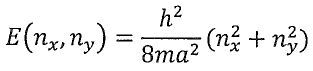
9. The general structure of the porphyrin molecule is shown on the right side. This molecule is planar and so we can approximate the π electrons as being confined in a square with the length a = 10 The porphyrin molecule has "22"π electrons. According to the particle in a two-dimensional (2D) box, the energy states are given bywhere nx and ny are quantum numbers. Assume that each energy levet in the box is capable of holding no more than two electrons. What is the electronic transition responsible for the promotion of an electron from the highest filled energy level to the lowest empty energy level? (A) E(3,3)→E(4,2) (B)E(3,2)→E(4,1) (C) E(2,3) → E(2,4) (D) E(3,3)→E(4,3) (E) E(3,4) → E(4,4)
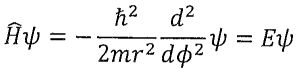
11. Following the questions 09 and 10, alternately, we can approximate the 22πelectrons of the porphyrin molecule on a circular ring with radius of 440 pm (i.e, r = 440 pm), as shown on the right side. For the particle on a ring model, the Schrodinger equation is
What is the predicted lowest transition energy?
(A) 5.2 x 10⁻¹⁴ Hz (B) 6.8 x 10⁻¹⁴ Hz (C) 2.4 X 10⁻¹⁴ Hz (D) 9.0 x 10⁻¹⁵ Hz (E) 1.2 x 10⁻¹⁴ Hz
12. According to the Huckel Molecular Orbital (MO) Theory for s bonding, the sccular determinant for MO energies for cycelopentadiene can be set up as The polynomial f(x) can be factored intof(x)=x5-5x3+5x+2=(x+2)(x2+ ax+6)2What are "a" and "b" values? (A) a =0; b=1 (B)a= 1; b=1 (C) a = -1; b=1 (D)a = 1; b=-1 (E) a = -1; b=-1
13. Following the question 12, what is the total energy value (in terms of a and B) of the ground state for cyclopentadienyI anion which has 6 T electrons? Hint: = 2.24 (A) 6a + 6β (B) 6a + 6.48β (C) 6a + 7.24β (D) 6a + 2.04β (E) 6a + 10.48β
14. Which of the following statement is correct? (A) CO2 is a linear molecule and therefore there is no bending vibration. (B) CO2 has 4 vibrational modes and all of them are IR-active. (C) The frequency of the symmetric stretching vibration mode is lower than that of the antisymmetric stretching mode for CO2. (D) The point group of CO2 is C∞v. (E) CO2is a well-known greenhouse gas, but N2 is not because it has no vibration.
15. CO2 can be hydrogenated into methanol through flowing a gas mixture (molar ratio between H2 and CO2 = 3) into a catalyst bed at 1 bar. It is an exothermic reaction whose equation is shown below. Choose the incorrect statement.CO2(g)+3H2(g)→CH3OH(g)+H2O(g)(A) The yield of methanol cannot reach 100% given any reaction condition. (B) The extent of reaction (ξ) at equilibrium can be increased by pressurizing the reactor. (C) Adding an inert gas into the mixture at fixed pressure will reduce ξ at equilibrium. (D) Decreasing reaction temperature increases ξ at equilibrium. (E) The equilibrium conversion can be calculated by solving Keg =ξ2 (4-2ξ)2/(3-3ξ)3
16. Benzene is mixed with toluene to form an ideal solution. At 100℃, the vapor pressures of pure benzene and toluene are 1.80 bar and 0.74 bar, respectively. Choose the incorrect description. (A) In the boiling point diagram of this mixture, points above the dew point line are in the vapor phase. (B) The bubble point line can be derived from Raoult's law. (C) The enthalpy of mixing is equal to zero. (D) If this mixture boils at 100℃, the mole fraction of benzene in the mixture is higher than that of toluene. (E) The final volume (Vtotal) is equal to Vbenzenc + Vtolvene.
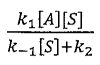
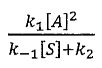
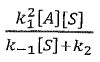
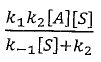
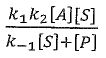
17. Consider a gaseous unimolecular isomerization reaction (which contains two consecutive reactions and the mechanism is shown below), where A and P represent the reactant and product, respectively. S is a non-reactive substrate for activating A. Answer question 17- 20.What is the partial pressure [A*] by applying steady state approximation? (A)(B)(C)(D)(E)
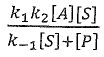
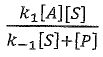
18. What is the formation rate of the product [P]? (A) (B)(C)(D)(E)
21. For an isothermal and irreversible expansion process (V1 to V2) of an ideal gas, which following statement is correct? (A) △S = q/T (B) △S =nRin(V2/V1) (C) w=-nRTIin(V2/V1) (D) △Ssys + △Ssurr >0 (E) q=nRTin(V2/V1)
22. He(g) (n mole) is taken from state 1 (P1, V1) to state 4 (P4, V4) through state 2 (P2, V2) or state 3 (P3, V3). Assuming He(g) obeys ideal gas law, choose the correct statement. (A) w = 0 from state 2 to state 4. V.-30 L (B) q=from state 1 to state 2. (C)△H = n from state 1 to state 3. (D) △H = q from state 3 to state 4. (E) Pathway A (through state 2) and pathway B (through state 3) have the same △H.
23. Given a sequential reaction below, choose the correct statement assuming k1 <k2. (A) At the same conversion, the selectivity of B can be improved by increasing the reaction temperature. (B) The |m| (m = slope) of the curve of the first reaction is smaller than that of the second reaction in the Arrhenius plot. (C) With the same reaction time, adding a catalyst to catalyze the second reaction can improve the yield of C. (D) The apparent activation energy of the whole sequential reaction is closer to the activation energy of the second reaction. (E) The second reaction has a lower activation energy.
24. Considering parallel reactions forming P1 and P2 from A, choose the correct statement given the potential energy diagram on the right side.(A) There is an intermediate from A to P2. (B) P2 is the kinetically controlled product. (C) With a catalyst significantly increasing the rate from B to P2, the selectivity towards P2 can be improved by lowering reaction temperature. (D) There are three transition states in this potential energy diagram. (E) P2 is the thermodynamically controlled product.
 阿摩線上測驗
登入
 , where
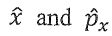 are the position and momentum operators. What is the value of the commutator
 ? (hint:
 =
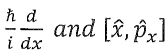 =
 ) (A)0 (B)1 (C) ih (D)h (E) 2h
 , for a non-ideal gas whose state can be expressed as the virial equation:
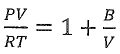 (V=molar volume)? (A)
 (B)
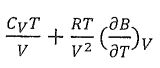 (C)
 (D)
 (E)
 (B)b1=
 (C)b2 =b3 =-
 (D)c2=c3 =
 (E)
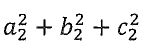 =1
 (B)
 (C)
 (D)
 (E)
 (θ, Φ) responsible for the angular parts of the hydrogen wavefunctions are listed below.
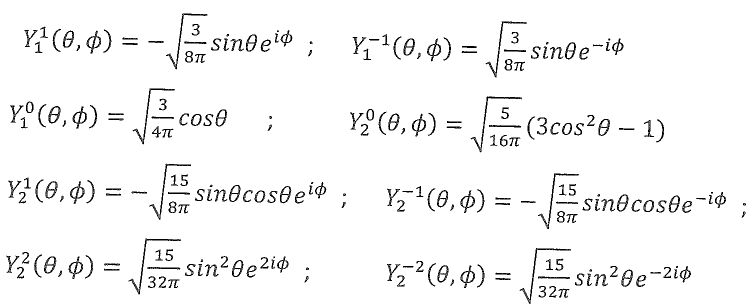 Which combination of spherical harmonics
 (θ,Φ) can give you the py orbital?
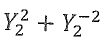 (B)
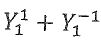 (C)
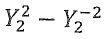 (D)
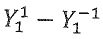 (E)
 (3 cos2 θ - 1). What are the three quantum numbers (n, I, m) associated with this orbital? (A) (2,2,0) (B)(2,1,1) (C) (3,2,0) (D) (3,1,1) (E) none of the above.
 The porphyrin molecule has "22"π electrons. According to the particle in a two-dimensional (2D) box, the energy states are given by
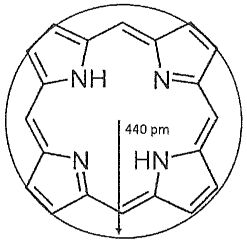 (A) 5.2 x 10⁻¹⁴ Hz (B) 6.8 x 10⁻¹⁴ Hz (C) 2.4 X 10⁻¹⁴ Hz (D) 9.0 x 10⁻¹⁵ Hz (E) 1.2 x 10⁻¹⁴ Hz
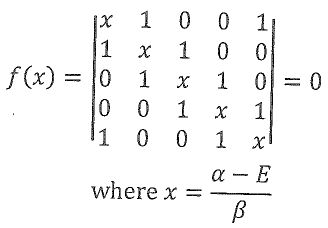
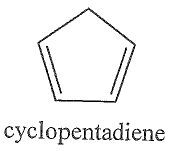
 = 2.24 (A) 6a + 6β (B) 6a + 6.48β (C) 6a + 7.24β (D) 6a + 2.04β (E) 6a + 10.48β
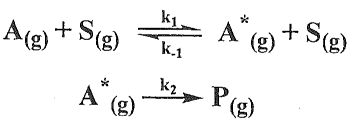
 (B)
 (C)
 (D)
 (E)
 (B)
 (C)
 (D)
 (E)

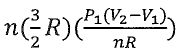 from state 1 to state 2. (C)△H = n
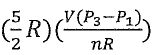 from state 1 to state 3. (D) △H = q from state 3 to state 4. (E) Pathway A (through state 2) and pathway B (through state 3) have the same △H.
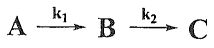 (A) At the same conversion, the selectivity of B can be improved by increasing the reaction temperature. (B) The |m| (m = slope) of the curve of the first reaction is smaller than that of the second reaction in the Arrhenius plot. (C) With the same reaction time, adding a catalyst to catalyze the second reaction can improve the yield of C. (D) The apparent activation energy of the whole sequential reaction is closer to the activation energy of the second reaction. (E) The second reaction has a lower activation energy.
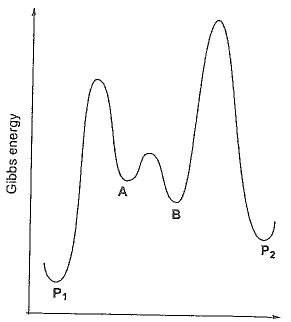 (A) There is an intermediate from A to P2. (B) P2 is the kinetically controlled product. (C) With a catalyst significantly increasing the rate from B to P2, the selectivity towards P2 can be improved by lowering reaction temperature. (D) There are three transition states in this potential energy diagram. (E) P2 is the thermodynamically controlled product.