所屬科目:研究所、轉學考(插大)◆物理化學
1.Given that the ionization energy of hydrogen-atom ground state is 13.6 eV, how much energy in eV is required to remove an electron from the 3d2 orbital in a Be3+ ion? (A) 6.8 eV (B) 18.1 eV (C) 24.2 eV (D) 54.4 eV (E) 61.2 eV
2. Consider a quantum particle of mass m trapped in a 3-dimensional cubic box. The potential energy is zero inside the box and infinity outside the box. The length on each side of the box is a. What is the degeneracy of the energy level of E= ? (h = Planck constant) 8ma² (A) 1 (B) 2 (C) 4 (D) 6 (E) 8
3. In quantum mechanics, the measurements of two physical quantities, a and b, are represented by operators and , respectively. If the two operators commute, which of the following statements is NOT true? (A) It is possible to measure a and b precisely and simultaneously. (B) The two operators possess a common set of eigenfunctions. (C) The two operators possess a common set of eigenvalues. (D), where f is a well-behaved function. (E)
4. Consider a quantum particle confined in a 1-D symmetric finite potential well defined asWhich of the following schematic diagrams of the bound eigenstate energy distribution and probability density functions is most qualitatively correct in all aspects? (A) (B)(C) (D) (E)
5. a A quantum harmonic oscillator (QHO) with a fundamental vibrational frequency v is in superposition state described by a wave function, where Φv(x)'s are normalized eigenfunctions of the QHO (the subscripts "v" denote the vibrational quantum numbers) and c₁ is the expansion coefficient for Φ₁(x). What is the average energy when a very large number of identically prepared QHO's φin (x) state are measured?7, (A) (B) 2hv (C)(D) (E) 4hv
6. The first excited state of helium (He) atom is described by electron configuration 1s¹2s1. Which of the followings is the correct form of spin-orbital functions for He atom first excited-state wave function satisfying the Pauli Principle? (Note: 1S(i) and 2S(1) are the spatial orbitals; α(i) and B(i) are the spin functions; i=1, 2 denotes the electron coordinates; N is the normalization constant) (A) N[IS(1)2S(2) -1S(2)2S(1)][a(1)β(2)] (B) N[IS(1)2S(2)+1S(2)2S(1)][a(1)a(2)] (C) N[1S(1)a(1)][2S(2)β(2)] (D) N[IS(1)2S(2)+1S(2)2S(1)][a(1)β(2) +a(2)β(1([ (E) N[IS(1)2S(2)-1S(2)2S(1)][a(1)β(2)+a(2)β(1)]
7. Consider the variational method for the ground state of a two-electron atom. The simplest trial function is the Hartree product of the form ), where isthe hydrogen-like satomic orbitalwith anefective nuclear changes, ζ , as the variational parameter. The variational integral can be evaluated analytically to give, where Z is the true nuclear charge and Eh=27.2 eV is the Hartree energy.What is the ground state energy of Li+ ion at this level of approximation? (A) -77.5 eV (B) -196.5 eV (C) -54.4 eV (D) -108.8 eV (E) -98.2 eV
8. The hydrogen atomic wave functions can be expressed as , whereAn electron is in the 2p0 orbital of a H atom. What is the most probable radius (the radius where the radial distribution function is at maximum) of finding that electron? (A) 5a0(B) 4a0(C) 3a0(D) 2a0(Ε) a0
9. The complex form of H-atom wave functions for n=3, 1=2, m=±1 states are,where R3d(r) is the radial function and (sinθcosθ)e±iφ are spherical harmonic functions with 1=2 and m=±1. A real form function (3dxz orbital) can be constructed with the linear combination of the two complex wave functions as. Which of the following statements about the 3dxz orbital is NOT correct? (A) 3dxz wave function is an eigenfunction ofH-atom (Hamiltonian operator). (B)3dxz wave function is an eigenfunction of H-atom(operator for square of orbital angular momentum). (C) 3dxz wave function is an eigenfunction of H-atom (operator for angular momentum along the z axis). (D) The magnitude of orbital angular momentum is not zero. (E) the average values of Lz is zero.
10. Allyl radical (CH2-CH-CH2) is a planar molecular radical in which the three a electrons are delocalized. Hückel theory is a simplified molecular orbital (MO) theory describing the MOs of the n-electron system as linear combinations of the 2pz atomic orbitals at each carbon atom involved in the delocalized system. The basic assumptions of Hückel theory are: All overlap integrals are set equal to zero; All resonance integrals between non-neighboring atoms are set equal to zero; All coulomb integrals are set equal to a; All resonance integrals between neighboring atoms are set equal to β. What is the total energy of the three πelectrons predicted by Hückel MO theory? (A)(B) (C)(D) 2a +4β (E) 4α +4β
11. The first excited electron configuration of HF is (1σ)2(2σ)2²(3σ)2(1π)3(4σ*)1. What is (are) molecular term(s) that can arise from this excited configuration? (A) 1Σ and 3Σ (B)1Π and 3Π (C) 3Π and 1Σ (D)3Π (Ε) 3Δ
12. The eigenfunctions of a diatomic rigid rotor are specified by two quantum numbers, I (angular momentum quantum number) and m (magnetic quantum number). Which of the following statements is correct for a diatomic rigid rotor? (A) The rotational energy levels are equally spaced. (B) The lowest rotational energy level has a nonzero energy called zero-point energy. (C) Each rotational energy level has a degeneracy of 2(1+1). (D) If a rigid rotor is measured to be in an eigenstate with / =2 and m = 0, the direction of its angular momentum is accurately determined. (E) Pure rotational transitions usually occur in the microwave region, and the transition lines are equally spaced in frequency.
13. If 2.019 g of ethanol C2H5OH(I) is burned completely in a bomb calorimeter at 298.15 K, the heat produced is 59.68 kJ. △Hf0 for water(1) =-285.8 kJ mol-1 and for CO2(g) =-393.5 kJ mol-1. (A) for ethanol(l) at 298.15 K is 886.7 kJ mol-1 (B) for ethanol(1) at 298.15 K is –886. kJ mol-1 (C) for ethanol(1) at 298.15 K is 210.5 kJ mol-1 (D) for ethanol(1) at 298.15 K is -210.5 kJ mol-1 (E) for ethanol(1) at 298.15 K is –280.4 kJ mol-1
14. The Joule coefficient is defined by. The van der Waals gas of equation is: ; a and b are constants. (A)The joule coefficient for an ideal gas is (B) The joule coefficient for an ideal gas is - (C) The joule coefficient for a van der Waals gas is(D)The joule coefficient for a van der Waals gas is (E) None of above is correct.
15. When the volume of 150.g of CO initially at 273 K and 1.00 bar increases by a factor of two. Take Cp,m to be constant at the value of 29.16 J mol-1K-¹ and assume ideal gas behavior. The temperature of surroundings is 273 K. Which of the following statement is correct if the expansion occurs under that specific condition? (A) In an adiabatic reversible expansion process, △Ssystem > 0. (B) In an adiabatic reversible expansion process,△Stotal = △Ssystem+ △Ssurroundings > 0 (C) In an expansion against Pexternal = 0, △Ssystem <0 (D) In an expansion against Pexternal = 0,△Ssurroundings = 0 (E) In an expansion against Pexternal = 0, △Stotal = 0
16. Consider the second-order reaction aA → products (which has a first half-life of 25 s). If the concentration of A after 17 s is 0.55 M, determine the initial concentration of A. (A) 0.92 M (B) 1.08 M (C) 2.16 M (D) 1.84 M (E) 0.75 M
17. For the reaction: 2N2O5(g) → O2(g) + 4NO2(g) the half-life is a constant 693 s at 45° C and the half-life at 65° C is a constant 70.7 s. Calculate the activation energy for this reaction. (In(10) =2.303) (A) 5.0 x 10² (B) 7.0 × 10² (C) 3.0 × 10² (D) 2.0 × 10² (E) 1.0 × 10² kJ/mol.
18. G denotes Gibbs energy and A denotes Helmholtz energy. Following the Gibbs-Helmholtz equation, at constant pressure we obtain the relation of G/T vs. temperature. Similarly, the A/T vs. temperature for the equation = ? (A) entropy S (B) enthalpy H (C)-H (D) internal energy U (E) -U.
19. The critical pressure, molar volume and temperature denoted as Pc, Tc, and Vmc, respectively can be estimated from the van der Waals constants. Which of the following equations is correct for van der Waals gas? (A) Pc= a/(27b²) (B) Vmc =26 (C) Tc= 6a/(27Rb) (D) zc = PcVc/RTc.= 5/8 (E) None of above is correct.
20. A gaseous system contains CO, CO2, H2, H2O, and C6H6 in chemical equilibrium. The independent equations are: CO2 +H2⇌ H2O + CO and 12CO + 3H2⇌ C6H6 + 6CO2. How many degrees of freedom are there in this system according to phase rule? (A) 2(B) 3 (C) 4 (D) 5 (E) 6
21.At 39.9°C, a solution of ethanol (molar fraction of component 1 in solution x1 = 0.9006, vapor pressure of pure ethanol P₁* = 130.4 torr) and isooctane (P2* = 43.9 torr) forms a vapor phase with y1 = 0.6667 (molar fraction of component 1 in vapor) at a total pressure of 185.9 Torr. Which of the following statement is correct? (A) The activity of component 1 a1 = 0.8501 (B) The activity of component 2 a2 = 1.000 (C) The activity coefficient of component 1 yı= 0.905 (D) The activity coefficient of component 2 Y2 = 14.2 (E) The total pressure of solution is 174.3 Torr if it were ideal solution.
22. Which of the following statement is correct (A) The standard molar entropy of Ne is greater than that of Kr. (B) At room temperature, the rotational partition function of HF is greater than that of CO. (C) Classical statistical mechanics applies accurately to translations of molecules. (D) At 500 K, the vibrational partition function of HF is already close to the classic limit. (E) At 1500 K the vibrational partition function for Cl2 is nearly unity.
23. Molecular oxygen populating the excited singlet state (¹△g) can relax to the ground triplet state (3 Σg) by emitting a 1280 nm (= 7812.5 cm-1) photon. (A) The partition function consist of these electronic states is q = 1 + 3e-β(7812.5), ẞ = 1/RT in (cm¹)-1. (B) Molecular oxygen a homonuclear diatom, shows no infared vibrational spectra. Hence, its vibrational partition function is zero. (C) The translational partition function of molecular oxygen is function of volume. (D) The rotational partition function of molecular oxygen is function of volume. (E) None of above is correct.
24. A reaction is catalyzed by the bromide ion shown below:A proposed mechanism is(1) H++ HNO2 ⇌ H2NO2+ (2) H2NO2++Br-→ ONBr + H2O (3) ONBr + C6H5NH2 → C6H5N2+ + H2O + Br- Symbol kn denotes the rate constant for the step n. (A) Assume that the second step is the rate-limiting. The rate law is k2[H2NO2+][Br_] (B) Assume that the second step is the rate-limiting. The rate law is k2[H+][HNO2][Br-] (C) Assuming quasi-steady-state approximation, the rate law is k2[H2NO2+][Br-]. (D) Assuming quasi-steady-state approximation and excess [Br- ], the rate law is k1[H+][HNO2] (E) Assuming quasi-steady-state approximation and excess [Br-], the rate law is (k1/k-1) k2[H+][HNO2][Br-]
25. In a cubic container with sides 1 cm in length that contains 1 atm of Ar at 298 K. What is the average velocity of Ar approximately? Mass of Ar = 40 (A) 2.0 ×10² (B) 2.0 x10³ (C) 4.0 x10² (D) 4.0 ×10³ (E) 6 x10² m s-¹.
 阿摩線上測驗
登入
 ? (h = Planck constant) 8ma² (A) 1 (B) 2 (C) 4 (D) 6 (E) 8
 and
 , respectively. If the two operators commute, which of the following statements is NOT true? (A) It is possible to measure a and b precisely and simultaneously. (B) The two operators possess a common set of eigenfunctions. (C) The two operators possess a common set of eigenvalues. (D)
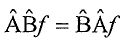 , where f is a well-behaved function. (E)
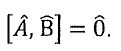

 (B)
 (C)
 (D)
 (E)

 , where Φv(x)'s are normalized eigenfunctions of the QHO (the subscripts "v" denote the vibrational quantum numbers) and c₁ is the expansion coefficient for Φ₁(x). What is the average energy when a very large number of identically prepared QHO's φin (x) state are measured?7, (A)
 (B) 2hv (C)
 (D)
 (E) 4hv
 ), where
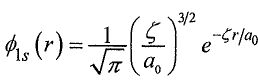 isthe hydrogen-like satomic orbitalwith anefective nuclear changes, ζ , as the variational parameter. The variational integral can be evaluated analytically to give
 , where Z is the true nuclear charge and Eh=27.2 eV is the Hartree energy.What is the ground state energy of Li+ ion at this level of approximation? (A) -77.5 eV (B) -196.5 eV (C) -54.4 eV (D) -108.8 eV (E) -98.2 eV
 , where

 An electron is in the 2p0 orbital of a H atom. What is the most probable radius (the radius where the radial distribution function is at maximum) of finding that electron? (A) 5a0(B) 4a0(C) 3a0(D) 2a0(Ε) a0
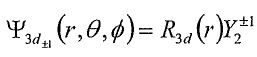 ,where R3d(r) is the radial function and
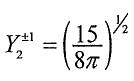 (sinθcosθ)e±iφ are spherical harmonic functions with 1=2 and m=±1. A real form function (3dxz orbital) can be constructed with the linear combination of the two complex wave functions as
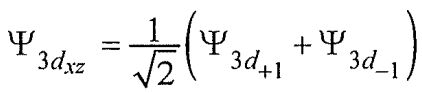 . Which of the following statements about the 3dxz orbital is NOT correct? (A) 3dxz wave function is an eigenfunction ofH-atom
 (Hamiltonian operator). (B)3dxz wave function is an eigenfunction of H-atom
 (operator for square of orbital angular momentum). (C) 3dxz wave function is an eigenfunction of H-atom
 (operator for angular momentum along the z axis). (D) The magnitude of orbital angular momentum is not zero. (E) the average values of Lz is zero.
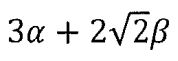 (B)
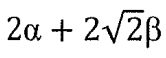 (C)
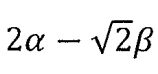 (D) 2a +4β (E) 4α +4β
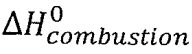 for ethanol(l) at 298.15 K is 886.7 kJ mol-1 (B)
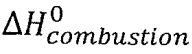 for ethanol(1) at 298.15 K is –886. kJ mol-1 (C)
 for ethanol(1) at 298.15 K is 210.5 kJ mol-1 (D)
 for ethanol(1) at 298.15 K is -210.5 kJ mol-1 (E)
 for ethanol(1) at 298.15 K is –280.4 kJ mol-1
 . The van der Waals gas of equation is:
 ; a and b are constants. (A)The joule coefficient for an ideal gas is
 (B) The joule coefficient for an ideal gas is -
 (C) The joule coefficient for a van der Waals gas is
 (D)The joule coefficient for a van der Waals gas is
 (E) None of above is correct.
 = ? (A) entropy S (B) enthalpy H (C)-H (D) internal energy U (E) -U.
