所屬科目:教甄◆英文科
1. The factory implemented a series of _____ procedures to improve their working efficiency. (A) capricious (B) expeditious (C) laborious (D) intricate
2. The politician’s _____ rhetoric did little to address the real issues but caused more criticism. (A) concise (B) flamboyant (C) insightful (D) substantial
3. The surprising finding of the lab experiment overthrew some of the most _____ assumptions in the field, shocking researchers and professionals. (A) malleable (B) volatile (C) ephemeral (D) entrenched
4. Under the CEO's _____ leadership, characterized by its authoritarian control and strict adherence to company policies, employees found themselves navigating a work environment marked by fear and resentment. (A) autonomous (B) benevolent (C) draconian (D) complacent
5. Art critics lauded the painter's _____ works, praising their profound depth and intricate symbolism, which transcended the boundaries of traditional artistic expression. (A) banal (B) esoteric (C) mundane (D) cynical
6. Throughout the semester, students struggled to comprehend the professor's _____ lectures, which often delved into complex theoretical concepts without providing adequate explanations. (A) disillusioned (B) concrete (C) conspicuous (D) abstruse
7. Fueled by his _____ dedication to training, the athlete spent countless hours honing his skills, determined to achieve success on the world stage. (A) sporadic (B) fervent (C) lackadaisical (D) nonchalant
8. The comedian’s _____ jokes, characterized by their irreverent humor and risqué content, elicited uproarious laughter from the audience throughout the performance. (A) somber (B) ribald (C) austere (D) pensive
9. We are all fed up with grandfather’s ______ before-dinner speech but no one dares to complain. (A) verbose (B) shrewd (C) timid (D) ambivalent
10. Despite her vast vocabulary, the author opted for a ______ writing style, employing clear and concise language that appealed to a broad audience. (A) ostentatious (B) substantial (C) succinct (D) lucid
11. (A) aberration (B) paradigm (C) proliferation (D) enigma
12. (A) phased out (B) hovered over (C) culminated in (D) mulled over
13. (A) obscenity (B) appropriation (C) proximity (D) demeanor
14. (A) prognosis (B) humility (C) ideology (D) pragmatics
15. (A) prioritized (B) fomented (C) assimilated (D) disintegrated
16
17
18
19
20
21
22
23
24
25
26
(AC) From the verdant fields of the American Midwest to the halls of academia, the assimilation of AI-driven solutions is revolutionizing traditional farming practices.
(AD) To date, legislation concerning AI-assisted farming practices has yet to take effect in most developed economies.
(AE) They are considered instrumental in identifying sustainable farming practices resilient to climate change and optimizing resource utilization for improved profitability. (BC) With the average age of farmers hovering around 60, the exigency for innovative solutions to alleviate the burden of manual labor has never been more acute.
(BD) Moreover, the specter of climate change looms large over the agricultural sector, exacerbating uncertainties in growing conditions and threatening crop yields.
27
28
29
30
31. What is the primary purpose of the passage? (A) To advocate for a new field of study focused on deep time. (B) To explain the challenges and benefits of studying deep time. (C) To describe the methods geologists use to study Earth's history. (D) To highlight the awe-inspiring nature of geological formations.
32. According to the passage, what is a challenge to the human mind? (A) The complexity of rock formations. (B) The vastness of geological timescales. (C) The methods of scientific inference. (D) The cryptic nature of fossils.
33. According to the passage, which of the following is NOT what geologists rely on to study deep time? (A) Direct observation of past events. (B) Analysis of rock formations. (C) Interpretation of fossils. (D) Sophisticated scientific modeling.
34. Why does the author compare geologists to archaeologists? (A) Both focus on the study of ancient human civilizations. (B) Both utilize fragmentary evidence to reconstruct the past. (C) Both conduct research primarily in controlled lab settings. (D) Both primarily rely on written records for their work.
35. According to the passage, what might be the benefits of understanding deep time? (A) To develop new technologies for extracting resources from Earth. (B) To make informed decisions about environmental sustainability. (C) To predict the exact timing of future geological events. (D) To feel a greater sense of personal control over the planet.
VI. Curriculum Design
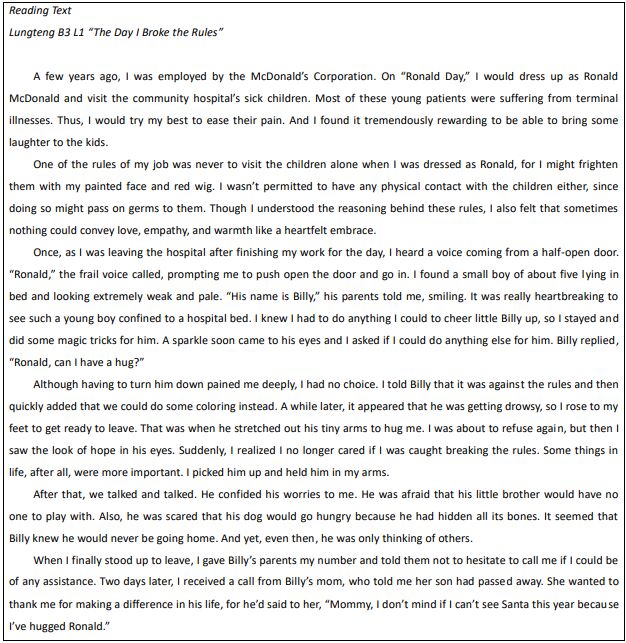
Go over the reading text: “The Day I Broke the Rules.” Identify ONE core concept (e.g., writing skills, genre, and text structure) to teach in FOUR periods. Design a FOUR-period course in which you guide TNGS 11th graders to understand the core concept through the reading text.
VII. Essay Questions
The senior high school English curriculum often emphasizes critical thinking and analysis. How would you design a lesson plan that encourages students to develop such skills? Use one specific lesson in the current textbooks to further explain your ideas.
VIII. Examination Questions Design
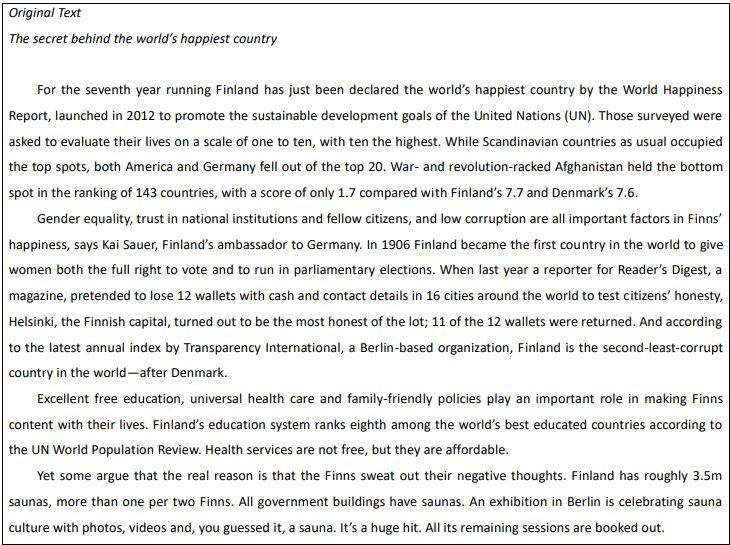
Summarize the following article in 200 to 250 words . Based on your rewritten passage, design FIVE cloze test questions and FOUR reading comprehension questions with 混合題 being the last question for TNGS 11th graders. The cloze test questions should each have four options and the correct answers should be included.
 阿摩線上測驗
登入