所屬科目:研究所、轉學考(插大)◆有機化學及無機化學
1. Which of the following is an inorganic compound? (A) H2O2 (B) MeOH (C) CH4 (D) HCOOH (E) Me2O
2. Which of the following is a coinage metal? (A) Cu (B) Ni (C) Co (D) Fe (E) none of the above
3. The E/RH value for an electron at n = 2 in a Li2+ cation is x, where E = energy, RH = Rydberg constant = 13.61 eV, n = principal quantum number. The nearest whole number of x is (A) 1 (B) 2 (C) 3 (D) 4 (E) none of the above
4. The electron spin multiplicity of a ground-state carbon atom is (A) 0 (B) 1 (C) 2 (D) 3 (E) none of the above
5. Of the following compounds, which has the largest bond angle? (A) CO2 (B) H2O (C) NH3 (D) CH4 (E) BF3
6. The point group of ClF3 is (A) C2v (B) C3v (C) D3h (D) Td (E) none of the above
7. In the hydride bridged dinuclear chromium complex,, the number of IR active Cr-H stretching bands is (A) 0 (B) 1 (C) 2 (D) 3 (E) none of the above
8. The bond order of He2+ is (A) 0 (B) 1 (C) 2 (D) 3 (E) none of the above
9. The electron spin multiplicity of a linear CH2 is (A) 0 (B) 1 (C) 2 (D) 3 (E) none of the above
10. In molecular orbital theory, how many group orbitals does BH3 have? (A) 1 (B) 2 (C) 3 (D) 4 (E) 5
11. In cationic BH2+, which of the following orbitals at boron participates in HOMO? (A) 1s (B) 2s (C) 2px (D) 2py (E) 2pz
12. The number of unpaired electrons in ground state [Fe(OH2)6]3+ is (A) 1 (B) 2 (C) 3 (D) 4 (E) 5
13. The spin-only magnetic moment of [Co(OH2)6]2+ is x Bohr magneton. The nearest whole number of x is (A) 1 (B) 2 (C) 3 (D) 4 (E) 5
14. The dz2 orbital in Ni(CO)4 is (A) σ bonding (B) π bonding (C) non-bonding (D) π anti-bonding (E) σ anti-bonding
15. The number of microstates in the ground state MnO42- is (A) 1 (B) 2 (C) 3 (D) 4 (E) none of the above
16. The number of d-d transition bands in the UV-vis spectrum of [V(OH2)6]4+ is (A) 0 (B) 1 (C) 2 (D) 3 (E) none of the above
17. The point group of [Cu(H2O)6]2+ is (A) C2v (B) C4h (C) D4d (D) Oh (E) none of the above
18. Which of the following shows Jahn-Teller effect? (A) [Fe(η5-C5H5)2]+ (B) Fe(η5-C5H5)2 (C) Co(η5-C5H5)2 (D) Ni(η5-C5H5)2 (E) none of the above
19. In the tungsten complex W(CCMe3)(CHCMe3)(CH2CMe3)(dmpe) where dmpe =Me2PCH2CH2PMe2, the CHCMe3 ligand is (A) a pure σ donor (B) a pure π acceptor (C) a σ donor and a π donor (D) a σ donor and a π acceptor (E) none of the above
20. With covalent bond classification (CBC) method, the equivalent neutral class formula of [Fe(η5-C5H5)2]+ is [MLlXx], where l = (A) 1 (B) 2 (C) 3 (D) 4 (E) none of the above
21. How many CO stretching bands does fac-Mo(CO)3(PMe3)3 have? (A) 1 (B) 2 (C) 3 (D) 4 (E) none of the above
22. The metal-metal bond order of Zn2(η5-C5Me5)2 is (A) 0 (B) 1 (C) 2 (D) 3 (E) none of the above
23. Which of the following statements is CORRECT?(A) (i) and (iv) are identical (B) (i) and (ii) are enantiomers (C) (i) and (iii) are enantiomers (D) (ii) and (iv) are diastereomers
24. Which of the following projections of (2R,3S)-3-bromo-2-iodopentane is INCORRECT?(A) Structure A (B) Structure B (C) Structure C (D) Structure D
25. Which of the following has an INCORRECT IUPAC name? (A) (B) (C) (D)
26. Which of the following is an ANTIAROMATIC compound? (A) (B)(C) (D)
27. Which of the following elimination reactions provides an INCORRECT product? (A)(B) (C) (D)
28. Identify the missing intermediates for the following reaction sequence. (A) (B)(C) (D)
29. Hydrocortisone, a naturally occurring hormone produced in the adrenal glands, is often used to treat inflammation, severe allergies, and numerous other conditions. Which of the following statements is CORRECT? (A) The two 2° (methyl) groups are in the axial position. (B) The two 1° (methyl) groups are in the equatorial position. (C) The hydroxy with oxygen-18 is at the axial position. (D) The hydroxy with oxygen-18 is at the equatorial position.
30. Which of the following structures represent meso compounds? (A) I only (B) I and IV (C) I and II (D) II and III
31. Rank the following Newman projections of 2,3-dimethylpentane from LOWEST energy to HIGHEST energy. (A) IV < II < III < I (B) I < III < II < IV (C) IV < III < II < I (D) I < II < III < IV
32. Which synthetic route is best for obtaining the desired product, 3-nitrobenzoic acid? (A) (B) (C)(D)
33. Give the primary product of the following reaction.(A)(B)(C)(D)
34. Compound A on ozonolysis yields acetophenone and propanal. What is the structure of compound A?(A) 2-phenyl-2-pentene (B) 1-phenyl-1-hexene (C) 1-phenyl-2-pentene (D) 2-phenyl-2-hexene
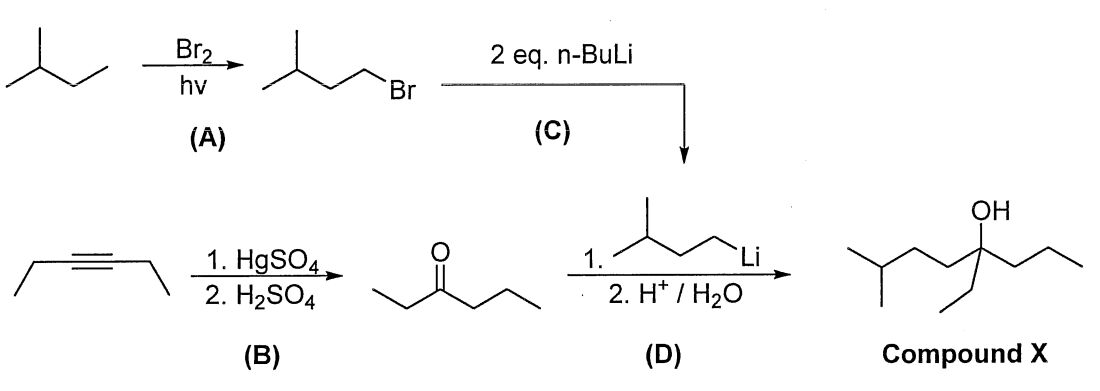
35. Below is a proposed synthesis of compound X. Which step would not work?
36. What are the correct reagents to obtain the respective alcohols from methylenecyclopentane?(A)(B) (C) (D)
37. The 1H NMR spectrum of a C6H8 hydrocarbon displays a single sharp signal. The 13C NMR spectrum has two resonance signals. Which of the following compounds would fit this evidence?(A) Dewar benzene (bicyclo[2.2.0]hexa-2,5-diene) (B) Benzvalene (C) Cyclohexadiene (D) Cyclohexane
38. Which of the following best depicts the initial nucleophilic addition step in the acid-catalyzed hydrolysis of the acetonitrile shown below? (A)(B) (C) (D)
39. What is the major product of an E2 reaction of the compound shown below?(A) (B)(C)(D)
40. What is the correct IUPAC systematic name for the compound below? (A) (2R,3S,E)-3-ethyl-6-methylhept-4-en-2-ol (B) (2S,3R,E)-3-ethyl-6-methylhept-4-en-2-ol (C) (2S,3R,E)-3-ethyl-2-hydroxy-6-methylhept-4-en (D) (2R,3S,E)-3-ethyl-2-hydroxy-6-methylhept-4-en
41. What is the correct IUPAC systematic name for the compound below?(A) (1R,3S)-3-hydroxycyclohexane-1-carboxamide (B) (1R,3R)-3-hydroxycyclohexane-1-carboxamide (C) (1S,3S)-3-hydroxycyclohexane-1-carboxamide (D) (1S,3R)-3-hydroxycyclohexane-1-carboxamide
(a)
(b)
2. Give the final product for the reaction sequence shown below. (2.5%)
 阿摩線上測驗
登入
阿摩線上測驗
登入
 , the number of IR active Cr-H stretching bands is (A) 0 (B) 1 (C) 2 (D) 3 (E) none of the above
 (A) (i) and (iv) are identical (B) (i) and (ii) are enantiomers (C) (i) and (iii) are enantiomers (D) (ii) and (iv) are diastereomers
 (A) Structure A (B) Structure B (C) Structure C (D) Structure D
 (B)
 (C)
 (D)

 (B)
 (C)
 (D)

 (B)
 (C)
 (D)

 (A)
 (B)
 (C)
 (D)

 (A) The two 2° (methyl) groups are in the axial position. (B) The two 1° (methyl) groups are in the equatorial position. (C) The hydroxy with oxygen-18 is at the axial position. (D) The hydroxy with oxygen-18 is at the equatorial position.
 (A) I only (B) I and IV (C) I and II (D) II and III
 (A) IV < II < III < I (B) I < III < II < IV (C) IV < III < II < I (D) I < II < III < IV
 (B)
 (C)
 (D)

 (A)(B)(C)(D)
 (A) 2-phenyl-2-pentene (B) 1-phenyl-1-hexene (C) 1-phenyl-2-pentene (D) 2-phenyl-2-hexene
 (A)
 (B)
 (C)
 (D)

 (A) Dewar benzene (bicyclo[2.2.0]hexa-2,5-diene) (B) Benzvalene (C) Cyclohexadiene (D) Cyclohexane
 (A)
 (B)
 (C)
 (D)

 (A)
 (B)
 (C)
 (D)

 (A) (2R,3S,E)-3-ethyl-6-methylhept-4-en-2-ol (B) (2S,3R,E)-3-ethyl-6-methylhept-4-en-2-ol (C) (2S,3R,E)-3-ethyl-2-hydroxy-6-methylhept-4-en (D) (2R,3S,E)-3-ethyl-2-hydroxy-6-methylhept-4-en
 (A) (1R,3S)-3-hydroxycyclohexane-1-carboxamide (B) (1R,3R)-3-hydroxycyclohexane-1-carboxamide (C) (1S,3S)-3-hydroxycyclohexane-1-carboxamide (D) (1S,3R)-3-hydroxycyclohexane-1-carboxamide


