所屬科目:研究所、轉學考(插大)◆普通化學
1. A hypothetical element consists of two isotopes of masses 79.95 amu and 81.95 amu with abundances of 31.3% and 68.7%, respectively. What is the average atomic mass of this element? (A) 80.95 amu (B) 79.95 amu (C) 80.6 amu (D) 81.3 amu (E) 81.95 amu
2. Naturally occurring copper exists in two isotopic forms: 63Cu and 65Cu. The atomic mass of copper is 63.55 amu. What is the approximate natural abundance of 63Cu? (A) 63% (B) 90% (C) 70% (D) 50% (E) 30%
3. Consider two organic molecules, ethanol and benzene. One dissolves in water and the other does not. Why? (A) They have different molar masses. (B) One is ionic, the other is not. (C) One is an electrolyte, the other is not. (D) Ethanol contains a polar O–H bond, and benzene does not. (E) Two of these are correct.
4. Which of the following is a strong acid? (A) HF (B) KOH (C) HClO4 (D) HClO (E) HBrO
5. Pressure is (A) defined as the mass that an object exerts when at rest (B) measured in Newtons (C) defined as the number of moles of substance divided by the mass of the substance (D) defined as the force per unit area (E) measured in grams
6. Four identical 1.0 L flasks contain the gases He, Cl2, CH4, and NH3, each at 0°C and 1 atm pressure. Which gas has the highest density? (A) He (B) Cl2 (C) CH4 (D) NH3 (E) all gases the same
7. What is the kinetic energy of a 2.57 kg object moving at 92.5 km/hr? (A) 8.48 × 10² kJ (B) 1.10 × 10⁴ kJ (C) 8.48 × 10⁻⁴ kJ (D) 1.70 × 10³ kJ (E) 3.30 × 101 kJ
8. What is the specific heat capacity of a metal if it requires 169.6 J to change the temperature of 15.0 g of the metal from 25.0 °C to 32.0 °C? (A) 0.619 J/g°C (B) 11.3 J/g°C (C) 24.2 J/g°C (D) 1.62 J/g°C (E) 275 J/g°C
9. Which of the following frequencies corresponds to light with the longest wavelength? (A) 3.00 × 10¹³ s–1 (B) 4.12 × 10⁵ s–1 (C) 8.50 × 10²⁰ s–1 (D) 9.12 × 10¹² s–1 (E) 3.20 × 10⁹ s–1
10. Yellow light can have a wavelength of 599 nm. The energy of a photon of this light is (hint: h = 6.626×10⁻³⁴ Js) (A) 1.19 × 10⁻³¹ J (B) 5.99 × 10⁻⁷ J (C) 3.32 × 10⁻¹⁹ J (D) 5.01 × 10¹⁴ J (E) 3.02 × 10¹⁸ J
11. Which of the following molecules exhibits the greatest bond energy? (A) F2 (B) Cl2 (C) Br2 (D) I2 (E) all the same
12. Which of the following molecules has a dipole moment? (A) CH4 (B) CCl4 (C) CO2 (D) SO2 (E) none of these
13.Which molecule contains a carbon atom with trigonal planar geometry? (A) CH3CHO (B) CO2 (C) CH3Cl (D) C2H6 (E) none of these
14. In the molecule C2H4 the valence orbitals of the carbon atoms are assumed to be (A) not hybridized (B) sp hybridized (C) sp2 hybridized (D) sp3 hybridized (E) dsp hybridized
15. Which of the following substances contains two pi bonds? (A) C2H4 (B) C3H8 (C) C2H2 (D) C2H6 (E) CH4
16. For which of the following diatomic molecules would the bond order become greater if an electron is removed (i.e., if the molecule is converted to the positive ion in its ground state)? (A) B2 (B) C2 (C) P2 (D) F2 (E) Na2
17. Which of the following would you expect to have the highest boiling point? (A) F2 (B) Cl2 (C) Br2 (D) I2 (E) All of the above have the same boiling point.
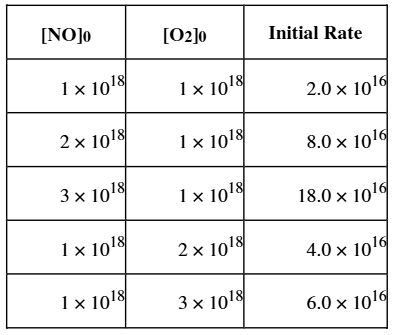
18. The following data were obtained for the reaction of NO with O2. Concentrations are in molecules/cm3 and rates are in molecules/cm3⋅s. What is the rate law?
(A) Rate = k[NO][O2](B)Rate = k[NO][O2]2 (C) Rate = k[NO]2[O2] (D) Rate = k[NO]2 (E) Rate = k[NO]2 [O2]2
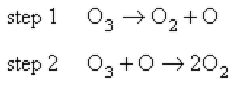
19. The decomposition of ozone may occur through the two-step mechanism shown:
The oxygen atom is considered to be a(n) (A) reactant (B) product (C) catalyst (D) reaction intermediate (E) activated complex
20. The equation 2Al(s) + 3Br2(l) → 2AlBr3(s) is a(n) ______________ reaction. (A) oxidation-reduction (B) combustion (C) precipitation (D) acid-base (E) none of these
21. Consider the following numbered processes:
1. A → 2B ΔH1
2. B → C + D ΔH2
3. E → 2D ΔH3
ΔH for the process A → 2C + E is
(A) ΔH1 + ΔH2 + ΔH3 (B) ΔH1 + ΔH2 (C) ΔH1 + ΔH2 – ΔH3 (D) ΔH1 + 2ΔH2 – ΔH3 (E) ΔH1 + 2ΔH2 + ΔH3
22. In the reaction between Mg and S, the Mg atoms (A) share electrons with S. (B) become part of polyatomic ions. (C) become anions (-). (D) become cations (+). (E) none of these
23. The _____ is defined as the change in energy that takes place when separated gaseous ions are packed together to form an ionic solid. (A) atomic binding energy (B) bond energy (C) ionization energy (D) lattice energy (E) dissociation energy
24. All of the following reactions are described as decomposition reactions except (A) PCl5(g) → PCl3(g) + Cl2(g). (B) 2H2O(g) → 2H2(g) + O2(g). (C) CH4(g) + Cl2(g) → CH3Cl(g) + HCl(g). (D) CaCO3(s) → CaO(s) + CO2(g). (E) 2HgO(s)→2Hg(l)+O2(g)
25. Equilibrium is reached in chemical reactions when: (A) All chemical reactions stop. (B) The concentrations of reactants and products become equal. (C) The rates of the forward and reverse reactions become equal. (D) The temperature shows a sharp rise. (E) The forward reaction stops.
 阿摩線上測驗
登入
 (A) Rate = k[NO][O2](B)Rate = k[NO][O2]2 (C) Rate = k[NO]2[O2] (D) Rate = k[NO]2 (E) Rate = k[NO]2 [O2]2