所屬科目:學士後西醫-物理
1. The lifesaving jolt of a defibrillator requires a large amount of energy delivered in a few milliseconds. Where does that energy come from? (A) an inductor (B) a transformer (C) a rectifier (D) a resistor (E) a capacitor.
2. Many physical units, particularly in the SI units and scientific measurements, are named after influential scientists to honor their contributions to physics and metrology. What is the unit of magnetic flux? (A) farad (B) tesla (C) henry (D) weber (E) gauss.
3. Two objects, A and B, have a mass ratio of mA : mB = 2 : 1. If both objects have the same kinetic energy, what is the ratio of the magnitudes of their momenta, pA : pB?(A) 1 : 1(B) :1(C) 2 : 1(D) 4 : 1
4. The laws of Coulomb and Biot-Savart describe how fields arise from point-like sources, that is, charge elements d? and current elements I, respectively. In fact, the laws of and Biot-Savart are related in the same way as Gauss’s and Coulomb’s laws. What should be ? (A) Faraday (B) Ampere (C) Newton (D) Lenz (E) Maxwell.
5. A wooden block with a density of 0.6 g/cm³ floats on water (density of water = 1.0 g/cm³). What percentage of the block's total volume is submerged?(A) 40%(B) 50%(C) 60%(D) 100%
6. When the temperature of a superconductor is lower than its critical point, the superconductor becomes perfectly (A) ferromagnetic (B) paramagnetic (C) diamagnetic (D) ferrimagnetic (E) none of the above.
7. Which of the following physical principles is applied in the design of a hydraulic jack? (A) Archimedes' principle (B) Bernoulli's principle (C) Pascal's principle (D) Stokes' law
8. Which of following images is impossible to be generated by a concave mirror? (A) a real, inverted, reduced image (B) a real, inverted, enlarged image (C) a virtual, upright, enlarged image (D) a virtual, upright, reduced image (E) none of the above.
9. According to the First Law of Thermodynamics, if a closed system absorbs heat Q from its surroundings and does work W on its surroundings, what is the change in the internal energy of the system, ΔU? (Sign convention: heat absorbed is positive, work done by the system is positive) (A) ΔU = Q + W (B) ΔU = Q - W (C) ΔU = W - Q (D) ΔU = -Q - W
10. Two satellites, A and B, orbit the Earth in uniform circular motion. If the orbital radius of satellite A is 4 times that of satellite B, what is the ratio of the orbital period of satellite A to that of satellite B (TA/TB)? TA and TB are their orbital period, respectively. (A) 2 (B) 4 (C) 8 (D) 16
11. Which of following scientists produced coherent light in his 1801 experiment that demonstrated the wave nature of light? (A) Christiaan Huygens (B) Thomas Young (C) Albert Michelson (D) James Clerk Maxwell (E) Clinton Davisson
12. The speed of light propagating in vacuum is equal to (A) (B) (C) (D) (E) ∈0μ0. Note that∈0 is the electric constant and μ0 is the magnetic constant.
13. A metal’s conductivity depends on temperature T. In classical physics, thermal speed describing the characteristic speed of the random motion of particles is proportional to . On the other hand, experiments show that resistivity is nearly proportional to (A) (B) 1/ (C) T (D) 1/T (E) T2 .
14. The nucleus of oxygen-17 has spin . How many possible orientations are there for its spin angular momentum vector? (A) 5 (B) 6 (C) 10 (D) 11 (E) 16
15. A 2 kg object is launched from the ground with an initial speed of 30 m/s at an angle of 30° above the horizontal. Neglecting air resistance, what is its kinetic energy when it reaches its maximum height? (A) 0 J (B) 225 J (C) 450 J (D) 675 J
16. A charged raindrop carrying 10 μC experiences an electric force of 0.3 N in the +x-direction. What is the electric field at its location? (A) 3 kN/C (B) 10 kN/C (C) 30 kN/C (D) 100 kN/C (E) None of the above.
17. A uniform rope of length L and mass M lies on a frictionless horizontal table. If a horizontal force F is applied to pull one end of the rope, what is the magnitude of the tension in the rope at a distance of L/3 from the pulled end? (A) F (B) 2F/3 (C) F/3 (D) F/2
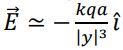
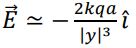
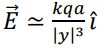
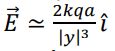
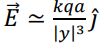
18. A polar molecule may be modeled approximately as a positive charge ? at x = a and a negative charge −q at x = −a. If we calculate the electric field on the y-axis, what is an approximate expression valid at large distance ( |y| ≫ a )? Note that k is the Coulomb constant, and and are the unit vectors. (A)(B) (C) (D) (E)
19. In the figure, ?1, ?2, and ?3 are charges on a two-dimensional plane. We take . If the force on q1 points in the −x-direction, what is the magnitude of ?3? (A) Q (B) (C) (D) (E)
20. A force F = (3x² + 2x) N (where x is in meters) acts on an object along the x-axis. As the object moves from x = 0 to x = 2 m, how much work is done by this force on the object? (A) 10 J (B) 12 J (C) 14 J (D) 16 J
21. A U-shaped tube contains mercury (density 13.6 g/cm3 ). If a 13.6 cm column of water is poured into the left arm, what is the difference in height between the mercury levels in the two arms? (Assume the system reaches equilibrium) (A) The mercury level in the left arm is 12.6 cm higher. (B) The mercury level in the right arm is 1 cm higher. (C) The mercury level in the left arm is 1 cm higher. (D) The mercury levels in both arms are at the same height.
22. The potential difference across a cell membrane is 64 mV. On the outside are 4.0 × 10⁶ singly ionized potassium atoms. Assuming an equal negative charge on the inside, what is the membrane’s capacitance? Note that one elementary charge is about 1.6 × 10⁻¹⁹ C. (A) 1 nF (B) 10 nF (C)100 nF (D) 1 pF (E) 10 pF.
23. Blood flows through a blood vessel. If the radius of the vessel is reduced to half of its original size due to atherosclerosis, and assuming the pressure difference remains constant and the flow is laminar, according to Poiseuille's Law, the blood flow rate will become how many times the original rate? (A) 1/2 (B) 1/4 (C) 1/8 (D) 1/16
24. The figure shows a cube of side ? in a uniform electric field. What’s the flux through the cube face C with the cube rotated 45°?(A)(B)(C)(D) (E)
25. Ion channels are narrow pores that allow ions to pass through cell membranes. A particular channel has a circular across section 0.15 nm in radius; it opens for 1 ms and passes 1.0 × 10⁴ singly ionized potassium ions. What is the current density in the channel? Note that one elementary charge is about 1.6 × 10⁻¹⁹ C. (A) 5.0 × 10⁶ A/m2 (B) 2.5 × 10⁷ A/m2 (C) 5.0 × 10⁷ A/m2 (D) 7.5 × 10⁷ A/m2 (E) 1.0 × 10⁸ A/m2
26. Because the magnetic force depends on velocity but the electric force doesn’t, it’s possible to use perpendicular electric and magnetic fields to select charged particles with a particular velocity. A such velocity selector uses a 20-mT magnetic field perpendicular to a 2-kN/C electric field. At what speed will charged particles pass through the selector undeflected? (A) 20 km/s (B) 40 km/s (C) 80 km/s (D) 100 km/s (E) 200 km/s
27. The design of an airplane wing causes the speed of the airflow above the wing to be greater than that below it. If both the upper and lower surface areas of the wing are A, the air density is ρ, the flow speed above is v₁, and the flow speed below is v₂ (v₁ > v₂), what is the approximate magnitude of the lift force experienced by the wing? (A) (1/2)ρA(v₁ - v₂)² (B) (1/2)ρA(v₁² - v₂²) (C) ρA(v₁ - v₂) (D) ρA(v₁² - v₂²)
28. An air bubble rises from the bottom of a lake to the surface. Assuming the lake water temperature is uniform and treating the air inside the bubble as an ideal gas, the volume of the bubble at the surface becomes 3 times its volume at the bottom. Given that atmospheric pressure is equivalent to the pressure of a 10-meter column of water, what is the approximate depth of the lake in meters? (A) 10 m (B) 20 m (C) 30 m (D) 40 m
29. Coronal streamers in the Sun’s atmosphere contain magnetic fields in the opposite directions. The figure shows a model calculation of the magnetic field in a single streamer. The long dimension of the rectangular loop in the figure is400 Mm, and the magnetic field strength near the loop has a constant magnitude of 2 mT. What is the total current encircled by the rectangle? Note that the magnetic constant ?0 is 1.26 × 10⁻⁶ N/A2 .(A) 0 A (B) 103 A (C) 106 A (D) 109 A (E) 1012 A
30. In the emission spectrum of mercury, there is a spectral line at 404.66 nm produced by mercury atoms undergoing electronic transitions from n=7 to n=6, where n is the principal quantum number. Since the upper level is threefold degenerate, in an external magnetic field the symmetry is broken and the degeneracy disappears, and thus the spectral line splits into three, as shown in the figure. This spectroscopic phenomenon is ascribed to (A) Meissner effect (B) Stark effect (C) Raman effect (D) Hall effect (E) Zeeman effect. 。
31. With sufficient energy, it’s possible to eject an electron from an inner atomic orbital. A higher-energy electron will then drop into the unoccupied state, emitting a photon with energy equal to the difference between the two levels. For inner-shell electrons, photon energies are in the keV range, putting them in the X-ray region of the spectrum. These characteristic X-rays are labeled with the letter indicating the shell to which the electron drops, followed by a Greek letter indicating the higher level from which it drops; thus ?? designates a transition from the L shell to the K shell. Molybdenum’s X-ray spectrum has its ?? peak at17.4 keV. Note that Plank’s constant is 6.626 × 10⁻³⁴ m2 ∙ kg/s, speed of light is 3 × 10⁸ m/s, and one electron charge is 1.6 × 10⁻¹⁹ C. The corresponding X-ray wavelength is closest to (A) 10 pm (B) 30 pm (C) 70 pm (D) 150 pm (E) 200 pm.
32. A long ladder leans against a smooth vertical wall, with its base resting on a rough horizontal floor. Let the length of the ladder be L, its weight be W, and the angle it makes with the floor be θ (less than 90°). If the ladder is on the verge of sliding, what is the coefficient of static friction between the floor and the base of the ladder? (A) (1/2) tan θ (B) (1/2) cot θ (C) 2 tan θ (D) 2 cot θ
33. The circuit in the figure extends forever to the right, and all the resistors have the same value ?. What is the equivalent resistance measured across the two terminals at left? Note that ≈ 1.414, ≈ 1.732, ≈ 2.236, and≈ 2.646. (A) 1.57 ? (B) 1.62 ? (C) 1.67 ? (D) 1.72 ? (E) 1.77 ?
34. What is the function of the circuit in the figure if we focus on the voltage change across the resistor? Assume the RC time constant is large enough in the case. (A) As a step-up transformer (B) As a step-down transformer (C) As a DC power supply (D) As an AC power supply (E) As a photodiode
35. Phasor diagrams summarize phase and amplitude relations among passive components in AC circuits. A phasor is an arrow whose length represents the amplitude of an AC voltage or current, rotating counterclockwise with the angular frequency ω of the AC quantity. The phasor’s component on either axis represents the sinusoidally varying AC quantity. The figure shows the phasor diagram for an RLC circuit. Note that VRp is the peak value of the voltage across the resistor, VCp is the peak value of the voltage across the capacitor, and VLp is the peak value of the voltage across the inductor. About this RLC circuit, which of the following statement is correct? (A) The driving frequency is above resonance. (B) The driving frequency is about resonance. (C) The driving frequency is below resonance. (D) The driving frequency varies. (E) The driving frequency is dominantly determined by V?p.
36. A solid spher of radius ? carries a uniform volume charge density ?. A hole of radius R/2 occupies a region from the center to the edge of the sphere, as shown in the figure. Whate is the electric field everywhere in the hole? Note that ∈0is the electric constant.(A) ρR/2∈0 (B) ρR/3∈0 (C) ρR/4∈0 (D) ρR/5∈0 (E)ρR/6∈0
37. A container filled with water rests on a horizontal floor. If the container moves to the right with a constant acceleration a, the water surface will tilt. Given the acceleration due to gravity is g, which of the following equations is satisfied by the angle θ between the water surface and the horizontal? (A) sin θ = a/g (B) cos θ = a/g (C) tan θ = a/g (D) tan θ = g/a
38. An object of density ρ and volume V is suspended from a spring scale and completely submerged in a liquid of density ρL (ρ > ρL). If the container is placed in an elevator accelerating vertically upward with an acceleration a, what is the reading on the spring scale? (A) V(ρ - ρL)(g + a) (B) V(ρ - ρL)g + Vρa (C) V(ρ + ρL)(g + a) (D) V(ρ - ρL)(g - a)
39. On a thermodynamic P-V (pressure-volume) diagram, comparing the slope of the curve for an adiabatic process to that of an isothermal process (assuming the gas expands), which of the following is correct? (A) The adiabatic curve is steeper (has a greater absolute slope). (B) The isothermal curve is steeper (has a greater absolute slope). (C) The slopes are the same. (D) It depends on the type of gas.
40. An ideal gas undergoes a Carnot cycle. If the volume of the gas doubles during the isothermal expansion, how does the magnitude of the work done on the gas during the isothermal compression compare to the magnitude of the work done by the gas during the isothermal expansion? (A) The work of compression is greater. (B) The work of expansion is greater. (C) Both are equal. (D) It depends on the temperature ratio of the high- and low-temperature reservoirs.
41. One mole of a monatomic ideal gas is mixed with one mole of a diatomic ideal gas. Assuming no chemical reaction occurs and they reach thermal equilibrium, what is the molar specific heat at constant volume of this gas mixture? (assume R is the ideal gas constant) (A) 1.5 R (B) 2.0 R (C) 2.5 R (D) 3.5 R
42. The current density in a particle beam with circular cross section of radius a points along the beam axis with a magnitude that decreases linearly from J0 at the center (r = 0) to half that value at the edge (r = a). What is the total current in the beam? (A) (B) (C) (D)(E)
43. A disk of radius a carries uniform surface charge density σand rotates with angular speed ω about the disk axis. What is the magnetic field at the disk center? (μ0 is the magnetic constant.) (A) μ0σωa (B)μ0πσa2 (C) μ0πσa2(D) μ0σωa2(E) μ0σωa
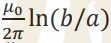
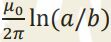
44. A long, straight coaxial cable consists of two thin, tubular conductors, the inner of radius a and the outer radius b. Current I flows out along one conductor and back along the other. What is the self-inductance per unit length of the cable? (μ0 is the magnetic constant.) (A) (B) (C) (D) (E)
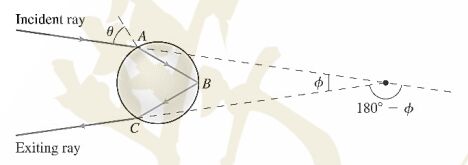
45. The figure shows light passing through a spherical raindrop, undergoing two refractions and total internal reflection. What is the correct relation among angleΦ in the figure, the incident angleθ, and the refractive index of the raindrop n? (A)Φ = 4 sin−1 (sin 2θ /n) − θ (B) Φ= 2 sin−1 (sin 2θ /n) − 2θ (C) Φ = 4 sin−1 (sin θ /n) −θ(D) Φ = 4 sin−1 (sinθ /n) − 2θ(E) Φ= 2 sin−1 (sin θ /n) − 2θ
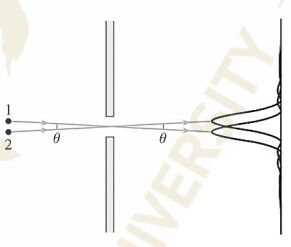
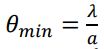
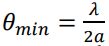
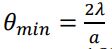
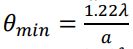
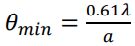
46. Diffraction imposes a fundamental limit on the ability of optical systems to distinguish closely spaced objects. In general, two peaks are barely distinguishable if the central maximum of one coincides with the first minimum of the other. The two sources become just barely resolved when the Rayleigh criterion is met. Accordingly, what is the Rayleigh criterion for single-slit diffraction? Assume a is the slit width andθmin is the minimum angle separation in the figure. (A) (B) (C) (D)(E)
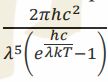
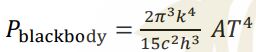
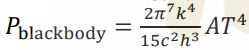
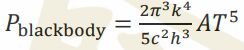
47. In 1900, the German physicist Max Planck formulated an equation that fit the observed radiance curves forblackbody radiation at all wavelengths: R(λ, T) =, where ℎ is Planck’s constant, c is the speed of light, λ is wavelength, k is Boltzmann’s constant, and T is the absolute temperature. If we integrate the equation over all wavelengths to calculate the total power radiated per unit area, the Stefan-Boltzmann law for blackbody radiation can be derived. Assume A is the area of the radiating surface. Note that, where Γ(n) is the gamma function and ζ(n) is the Riemann zeta function.For references,. What is the Stefan-Boltzmann law for blackbody radiation?(A) (B)(C) (D) (E)
48. A bullet of mass m is fired horizontally with a speed v into a stationary wooden block of mass M and becomes embedded in it. If the block is suspended by a string of length L (forming a simple pendulum system), what fraction of the initial kinetic energy is lost as mechanical energy during the moment of impact? (A) m / (m + M) (B) M / (m + M) (C) m / M (D) (M - m) / (M + m)
49. Consider a soap bubble and a liquid drop of the same radius. If both have the same surface tension γ, radius R, and external pressure P0, what is the relationship between the internal pressure of the soap bubble (Pbubble) and the internal pressure of the liquid drop (Pdrop)? (A) Pbubble > Pdrop (B) Pbubble < Pdrop (C) Pbubble = Pdrop (D) Cannot be compared
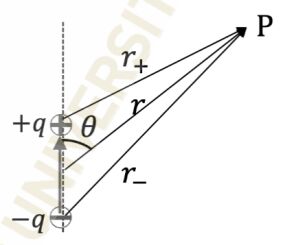
50. An electric diple consists of point charges ±q a distance 2a apart. The potential at an arbitrary point P can be expressed as V(P) = = , where k is the Coulomb constant, r+ is the distance to the point charge +, r− is the distance to the point charge −q. If r is the distance to the dipole center, for r ≫ a, the quantities r+, r−, and r are nearly the same as r2 ≈ r+r−. The difference between the distances from the two charges to P, that is, r− − r+, is approximately equal to 2a cos θ, where θ is the angle as shown in the figure. Eventually, the dipole potential for r ≫ a becomes V(r, θ) = . What is the electric field at an arbitrary position P for r ≫ a? Note that and are unit vectors. (A) (B)(C) (D)(E)
 阿摩線上測驗
登入
 :1(C) 2 : 1(D) 4 : 1
 , respectively. In fact, the laws of
 and Biot-Savart are related in the same way as Gauss’s and Coulomb’s laws. What should be
 ? (A) Faraday (B) Ampere (C) Newton (D) Lenz (E) Maxwell.
 (B)
 (C)
 (D)
 (E) ∈0μ0.
 . On the other hand, experiments show that resistivity is nearly proportional to (A)
 (B) 1/
 (C) T (D) 1/T (E) T2 .
 . How many possible orientations are there for its spin angular momentum vector? (A) 5 (B) 6 (C) 10 (D) 11 (E) 16
 and
 are the unit vectors. (A)
 (B)
 (C)
 (D)
 (E)
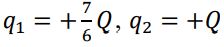 . If the force on q1 points in the −x-direction, what is the magnitude of ?3?
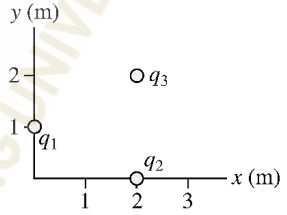 (A) Q (B)
 (C)
 (D)
 (E)

 . What’s the flux through the cube face C with the cube rotated 45°?
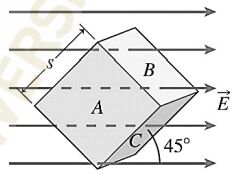 (A)
 (B)
 (C)
 (D)
 (E)

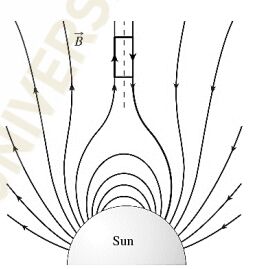 (A) 0 A (B) 103 A (C) 106 A (D) 109 A (E) 1012 A
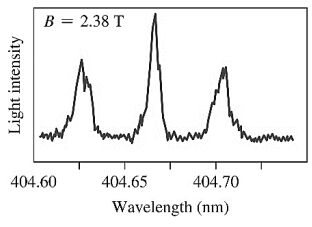 (A) Meissner effect (B) Stark effect (C) Raman effect (D) Hall effect (E) Zeeman effect. 。
 ≈ 1.414,
 ≈ 1.732,
 ≈ 2.236, and
 ≈ 2.646.
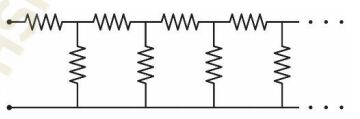 (A) 1.57 ? (B) 1.62 ? (C) 1.67 ? (D) 1.72 ? (E) 1.77 ?
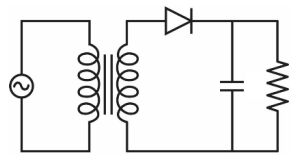 (A) As a step-up transformer (B) As a step-down transformer (C) As a DC power supply (D) As an AC power supply (E) As a photodiode
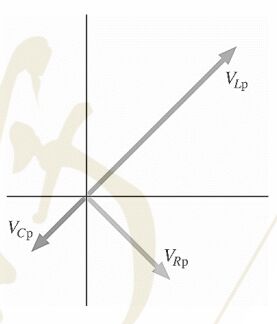 (A) The driving frequency is above resonance. (B) The driving frequency is about resonance. (C) The driving frequency is below resonance. (D) The driving frequency varies. (E) The driving frequency is dominantly determined by V?p.
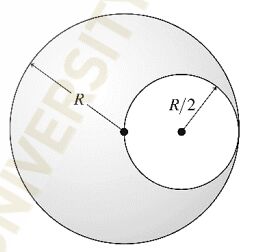 (A) ρR/2∈0 (B) ρR/3∈0 (C) ρR/4∈0 (D) ρR/5∈0 (E)ρR/6∈0
 (B)
 (C)
 (D)
 (E)

 μ0πσa2(D)
 μ0σωa2(E)
 μ0σωa
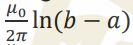 (B)
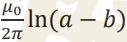 (C)
 (D)
 (E)

 (A)Φ = 4 sin−1 (sin 2θ /n) − θ (B) Φ= 2 sin−1 (sin 2θ /n) − 2θ (C) Φ = 4 sin−1 (sin θ /n) −θ(D) Φ = 4 sin−1 (sinθ /n) − 2θ(E) Φ= 2 sin−1 (sin θ /n) − 2θ
 (A)
 (B)
 (C)
 (D)
 (E)
 , where Γ(n) is the gamma function and ζ(n) is the Riemann zeta function.
 . What is the Stefan-Boltzmann law for blackbody radiation?


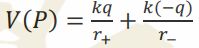 =
 , where k is the Coulomb constant, r+ is the distance to the point charge +, r− is the distance to the point charge −q. If r is the distance to the dipole center, for r ≫ a, the quantities r+, r−, and r are nearly the same as r2 ≈ r+r−. The difference between the distances from the two charges to P, that is, r− − r+, is approximately equal to 2a cos θ, where θ is the angle as shown in the figure. Eventually, the dipole potential for r ≫ a becomes V(r, θ) =
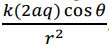 . What is the electric field
 at an arbitrary position P for r ≫ a? Note that
 and
 are unit vectors.
 (A)
 (B)
 (C)
 (D)
 (E)
