所屬科目:研究所、轉學考(插大)◆經濟學原理
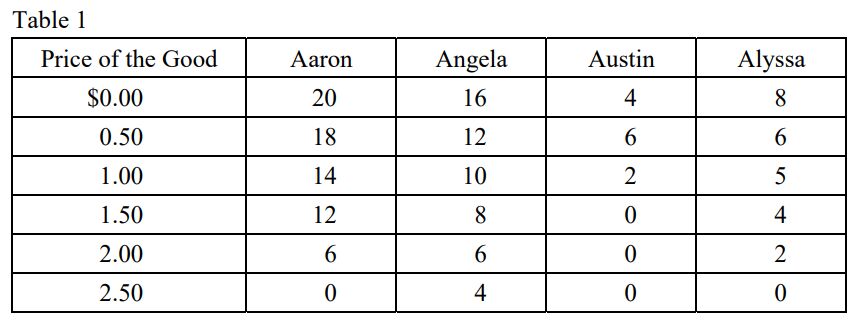
1. The table 1 shows individual demand schedules for a market. Refer to Table 1. When the price of the good is $1.00, the quantity demanded in this market would be (A) 42 units. (B) 31 units. (C) 24 units. (D) 14 units.
2. Refer to Table 1. If the price increases from $1.00 to $1.50, (A) the market demand decreases by 20 units. (B) individual demand curves, when drawn, will shift to the left. (C) the quantity demanded in the market decreases by 2 units. (D) the quantity demanded in the market decreases by 7 units.
3. Refer to Table1. Whose demand does not conform to the law of demand? (A) Aaron’s (B) Angela’s (C) Austin’s (D) Alyssa’s
4. Refer to Table 1. For whom is the good a normal good? (A) for Aaron (B) for Austin (C) for all of the four demanders (D) This cannot be determined from the table.
5. Which of the following events would cause a movement upward and to the right along the supply curve for tomatoes? (A) The number of sellers of tomatoes increases. (B) There is an advance in technology that reduces the cost of producing tomatoes. (C) The price of fertilizer decreases, and fertilizer is an input in the production of tomatoes. (D) The price of tomatoes rises.
6. There are very few, if any, good substitutes for motor oil. Therefore, (A) the demand for motor oil would tend to be inelastic. (B) the demand for motor oil would tend to be elastic. (C) the demand for motor oil would tend to respond strongly to changes in prices of other goods. (D) the supply of motor oil would tend to respond strongly to changes in people’s tastes for large cars relative to their tastes for small cars.
7. Suppose the price of Twinkies decreases from $1.45 to $1.25 and, as a result, the quantity of Twinkies demanded increases from 2,000 to 2,200. Using the midpoint method, the price elasticity of demand for Twinkies in the given price range is (A) 2.00. (B) 1.55. (C) 1.00. (D) 0.64.
8. For a particular good, a 3 percent increase in price causes a 10 percent decrease in quantity demanded. Which of the following statements is most likely applicable to this good? (A) The relevant time horizon is short. (B) The good is a necessity. (C) The market for the good is broadly defined. (D) There are many close substitutes for this good.
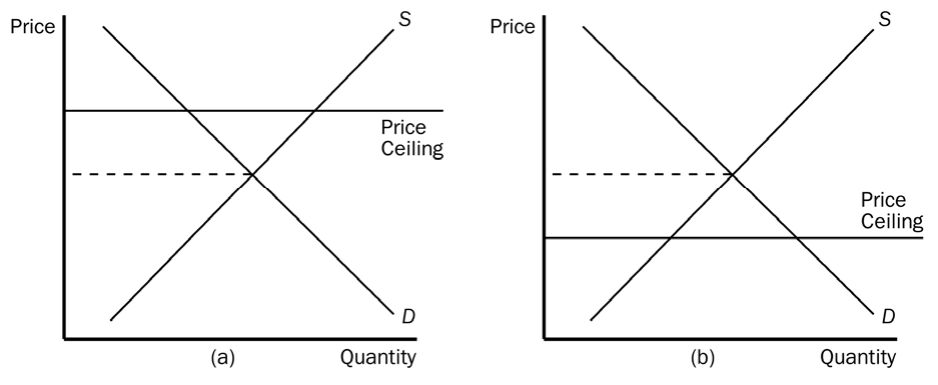
9. Refer to Figure 1. A binding price ceiling is shown in (A) panel (a) but not panel (b). (B) panel (b) but not panel (a). (C) both panel (a) and panel (b). (D) neither panel (a) nor panel (b).
10. Refer to Figure 1. In which panel(s) of the figure would there be a shortage of the good at the ceiling price? (A) panel (a) but not panel (b). (B) panel (b) but not panel (a). (C) panel (a) and panel (b). (D) neither panel (a) nor panel (b).
11. Refer to Figure 1. The situation in panel a. may be described as one in which (A) the price ceiling is not binding. (B) the price “ceiling” really functions as a price floor. (C) a surplus of the good will be observed. (D) All of the above are correct.
12. When a buyer’s willingness to pay for a good is equal to the price of the good, (A) the buyer’s consumer surplus for that good is maximized. (B) the buyer will buy as much of the good as the buyer’s budget allows. (C) the price of the good exceeds the value that the buyer places on the good. (D) the buyer is indifferent between buying the good and not buying it.
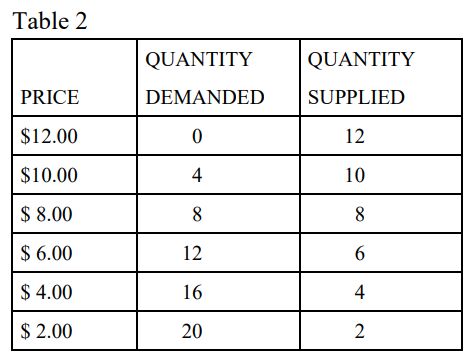
13. Market Supply and Demand for Pepperoni Pizza Refer to Table 2. The equilibrium or market-clearing price is (A) $10.00. (B) $8.00. (C) $6.00. (D) $4.00.
14. Refer to Table 2. At a price of $4.00, total surplus is (A) more than it would be at the equilibrium price. (B) less than it would be at the equilibrium price. (C) the same as it would be at the equilibrium price. (D) There is insufficient information to make this determination.
15. Refer to Table 2. As the table suggests, the demand curve is a straight line and so is the supply curve. Taking this into account, when there is equilibrium, total surplus is (A) $44. (B) $48. (C) $54. (D) $68.
16. Refer to Table 2. As the table suggests, the demand curve is a straight line and so is the supply curve. Take this into account and suppose the price is $8, with only 4 pizzas being bought and sold. Total surplus amounts to (A) $20. (B) $30. (C) $36. (D) $40.
17. A tax on a good (A) raises the price that buyers effectively pay and raises the price that sellers effectively receive. (B) raises the price that buyers effectively pay and lowers the price that sellers effectively receive. (C) lowers the price that buyers effectively pay and raises the price that sellers effectively receive. (D) lowers the price that buyers effectively pay and lowers the price that sellers effectively receive.
18. A tax of $10 per unit is imposed on a certain good. The supply curve and the demand curve are straight lines. The tax reduces the equilibrium quantity in the market by 200 units. The deadweight loss from the tax is (A) $2,000. (B) $,1000. (C) $500. (D) $250.
19. The impact of one person's actions on the well-being of a bystander is called (A) an economic dilemma. (B) deadweight loss. (C) a multi-party problem. (D) an externality.
20. When a market is characterized by an externality, the government (A) can correct the market failure only in the case of positive externalities. (B) can correct the market failure only in the case of negative externalities. (C) can correct the market failure in the case of both positive and negative externalities by inducing market participants to internalize the externality. (D) cannot correct for externalities due to the existence of patents.
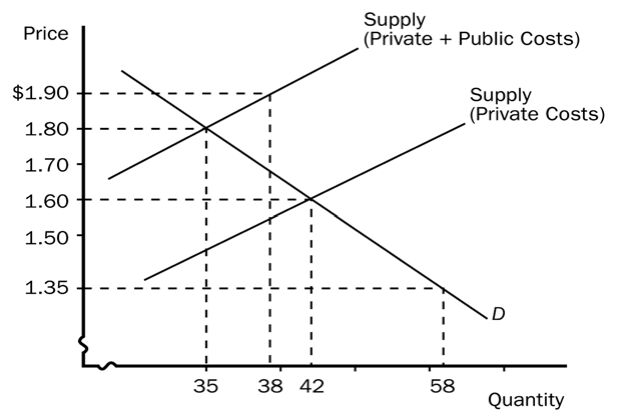
21. Figure 2 Refer to Figure 2. This graph represents the tobacco industry. The industry creates (A) positive externalities. (B) negative externalities. (C) no externalities. (D) no equilibrium in the market.
22. Refer to Figure 2. This graph represents the tobacco industry. Without any government intervention, the equilibrium price and quantity are (A) $1.90 and 38 units, respectively. (B) $1.80 and 35 units, respectively. (C) $1.60 and 42 units, respectively. (D) $1.35 and 58 units, respectively.
23. Refer to Figure 2. This graph represents the tobacco industry. The socially optimal price and quantity are (A) $1.90 and 38 units, respectively. (B) $1.80 and 35 units, respectively. (C) $1.60 and 42 units, respectively. (D) $1.35 and 58 units, respectively.
24. Refer to Figure 2. This graph represents the tobacco industry. If the government uses a pollution tax, how much of a tax must be imposed on each unit of production? (A) $1.90. (B) $1.80. (C) $1.60. (D) $0.30.
25. Refer to Figure 2. This graph represents the tobacco industry. If the government uses a pollution tax, how much tax revenue will the government receive? (A) $7.00. (B) $10.50. (C) $63.00. (D) $67.20.
26. Macroeconomics is (A) the study of the stock market returns. (B) the study of how households make decisions. (C) the study of how firms make decisions. (D) the study of economy-wide phenomena.
27. Gross Domestic Product is defined as (A) the market value of all intermediate goods and services produced by a country's citizens in a given period of time. (B) the market value of all final goods and services produced by a country's citizens in a given period of time. (C) the market value of all intermediate goods and services produced within a country in a given period of time. (D) the market value of all final goods and services produced within a country in a given period of time.
28. Goods and services produced and sold illegally (A) are included in GNP. (B) are excluded from GDP. (C) are included in GDP as inventory investment. (D) are included in GDP as consumption.
29. A circular-flow diagram is a model that (A) illustrates cost-benefit analysis. (B) explains how banks circulate money in the economy. (C) illustrates the analysis of demand and supply. (D) explains how the economy is organized.
30. Which of the following represents a transfer payment? (A) the government sends your grandfather his social security check. (B) you transfer $10,000 from your bank account to a mutual fund. (C) the bank transfers $100 quarterly interest to your savings account. (D) a payment that is automatically transferred from your bank account to pay your bill.
31. Michelle decides to hire Angel to do her housework, instead of doing it herself, as she is accustomed to do. As a result of this transaction, (A) GDP will increase. (B) GDP will decrease. (C) GDP will be unaffected because the same service would be performed in either case. (D) GDP will be unaffected because housework is not included in GDP.
32. Which of the following would NOT be considered a factor of production? (A) capital (B) money (C) land (D) Labor
33. Given the following information, calculate the rate of increase in the price level from 2009 to 2010. (A) -9% (B) -10% (C) 12% (D) 10%
34. Who would be included in the labor force? (A) Mike, an unpaid homemaker. (B) Sam, a college student who is not working or looking for a job. (C) John, who does not have a job, but is looking for work. (D) None of the above are included in the labor force.
35. Which of the following is included in M2 but not in M1? (A) currency (B) demand deposits (C) savings deposits (D) travelers’ checks
36. Fiat money (A) has intrinsic value equal to its value in exchange. (B) has no intrinsic value. (C) may be used as a medium of exchange, but is not legal tender. (D) is worthless.
37. If you deposit $1,000 into a demand deposit at a bank, this action by itself (A) increases the M1 money supply immediately. (B) increases the M2 money supply immediately. (C) does not change the money supply. (D) decreases the money supply.
38. When the Fed conducts open market sales, (A) it buys Treasury securities, which increases the money supply. (B) it buys Treasury securities, which decreases the money supply. (C) it sells Treasury securities, which increases the money supply. (D) it sells Treasury securities, which decreases the money supply.
39. If the reserve ratio is 20 percent, $1,000 of excess reserves can create (A) $100 of new money. (B) $1,000 of new money. (C) $5,000 of new money. (D) $10,000 of new money.
40. If the public decides to hold fewer currency and more deposits in banks, (A) the money supply eventually decreases. (B) the money supply eventually increases. (C) the money supply does not change. (D) the money supply decreases but bank reserves increase.
41. The supply curve of money is vertical because the quantity of money supplied increases (A) only if the value of money increases. (B) only if the demand for money increases. (C) only if people desire to hold more money. (D) only if the central bank increases the money supply.
42. When the money market is drawn with the value of money on the vertical axis, an increase in the money supply shifts the money supply curve to the (A) left, lowering the price level. (B) right, raising the price level. (C) left, raising the price level. (D) right, lowering the price level.
43. The price level is a (A) stable variable. (B) actual variable. (C) real variable. (D) nominal variable.
44. Net capital outflow measures an imbalance between a country's (A) sale of domestic assets abroad and domestic purchase of foreign assets. (B) directly investment abroad and indirectly investment abroad. (C) income and expenditure. (D) investment and saving.
45. The value of net exports equals the value of (A) national saving – domestic investment. (B) public saving. (C) national saving. (D) private saving .
46. The classical dichotomy refers to the separation of (A) variables that move with the business cycle and variables that do not. (B) variables that move with the changes in government expenditures and variables that do not. (C) endogenous and exogenous variables. (D) real and nominal variables.
47. According to the theory of liquidity preference, which variable adjusts to balance the supply and demand for money? (A) output (B) interest rate (C) liquidity (D) price level
48. Which of the following shifts aggregate demand to the right? (A) an increase in the price level (B) a decrease in the price level (C) a decrease in government spending (D) an increase in the money supply
49. If the MPC (Marginal Propensity to Consume) = 0.65, then the government purchases multiplier is about (A) 0.35. (B) 1.54. (C) 2.86. (D) 6.5.
50. In the long run, which of the following would shift the long-run Phillips curve to the right? (A) an increase in the minimum wage (B) an increase in the money supply (C) an increase in inflation rate (D) tax cuts
 阿摩線上測驗
登入
 Refer to Table 1. When the price of the good is $1.00, the quantity demanded in this market would be (A) 42 units. (B) 31 units. (C) 24 units. (D) 14 units.
 Refer to Figure 1. A binding price ceiling is shown in (A) panel (a) but not panel (b). (B) panel (b) but not panel (a). (C) both panel (a) and panel (b). (D) neither panel (a) nor panel (b).
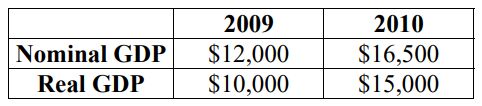 (A) -9% (B) -10% (C) 12% (D) 10%