所屬科目:研究所、轉學考(插大)◆生物化學
1. Aspirin produces most of its analgesic effects by (A) binding to the plasma membrane of nerve cells (B) inhibiting the synthesis of vitamin A (C) inhibiting the synthesis of phospholipids (D) inhibiting the synthesis of prostaglandins
2. Which amino acids contain sulfur? (A) cysteine and lysine (B) cysteine and methionine (C) arginine and methionine (D) cysteine and isoleucine
3. In affinity chromatography, a protein (A) which binds to the ligand will remain on the column. (B) which binds to the ligand will elute from the column. (C) which is hydrophobic will remain on the column. (D) which is hydrophilic will remain on the column.
4. In addition to all the other problems, why can a person get fat from overdrinking alcohol? (A) Alcohol inhibits carnitine palmitoyltransferase I (B) Ethanol is converted to acetate and then to acetyl-CoA which makes lipids (C) Ethanol converts carbohydrates into lipids (D) none of these
5. The citric acid cycle is amphibolic, meaning (A) it plays a role in both anabolism and catabolism. (B) it is essentially irreversible. (C) it can operate both in the presence and absence of oxygen. (D) it can oxidize carbons and nitrogens equally well.
6. In the malate-aspartate shuttle, electrons from NADH are transferred to _____,forming malate.
(A) oxaloacetate (B) aspartate (C) glutamate (D) none of the above , forming malate.
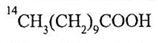
7. The following fatty acid, in which the indicated carbon is labeled with , is fed to an animal:
After allowing 30 minutes for fatty acid ẞ oxidation, the label would most likely be recovered in: (A) acetyl-CoA (B) beta-hydroxybutyryl-CoA (C) both acetyl-CoA and propionyl-CoA (D) propionyl-CoA
8. The conversion of 1 mol of pyruvate to 3 mol of CO2 via pyruvate dehydrogenase and the citric acid cycle also yields _____mol of NADH,_____mol of FADH;, and _ mol of ATP (or GTP).
(A) 2; 2; 2 (B) 3; 1; 1 (C) 3; 2; 0 (D) 4; 1; 1 mol of FADH2, and mol of ATP (or GTP).
9. In the phosphoglyceratemutase reaction, the side chain of which amino acid in the enzyme is transiently phosphorylated as part of the reaction? (A) serine (B) threonine (C) tyrosine (D) histidine
10. Fructose can enter glycolysis at two distinct points, depending on the tissue. How is fructose metabolized in adipose tissue? (A) Fructose is cleaved to two molecules of GAP. (B) Fructose is converted to fructose-1-phosphate. (C) Fructose is converted to fructose-6-phosphate. (D) Fructose is converted to glucose, which enters the pathway
11. In human, during starvation, which organ uses keton body as fuel? (A) Liver (B) Adipose tissues (C) Brain (D) Kidney
12. What cofactor is needed in formation of malonyl-CoA by acetyl-CoA carboxylase? (A) Pantothenic acid (B) Biotin (C) Vitamin B12 (D) ATP
13. Which of the followings statement is not correct? (A) low doses of Aspirin reduce heart attack (B) The inhibition of Aspirin on COX enzyme is irreversible (C) Some COX-2 specific drugs were removed from the market, since they reduced prostacyclin production leading to heart attack. (D) Aspirin can help Asthma (氣喘) patients
14. The starting materials necessary to synthesize sphinogosine are (A) palmitoyl CoA and serine (B) acetyl CoA and glycine (C) palmitoyl CoA and aspartate (D) acetyl CoA and glutamine
15. Acetyl CoA is transported from the mitochondria to the cytosol for lipid synthesis by forming? (A) Malate (B) Pyruvate (C) Oxaloacetate (D) Citrate
16. Sodium dodecyl sulfate (SDS) is a commonly used detergent for protein extraction in proteomic researches. After trypsin digestion, which of the following materials/conditions may effectively remove SDS from the peptide mixture and make the sample more compatible with mass spectrometric analysis? (A) reverse phase resins, pH 3.0 (B) anion exchange resins, pH 8.0 (C) cation exchange resins, pH 3.0 (D) anion exchange resins, pH 3.0
17. Amino acids are precursors of many nitrogen-containing biomolecules. Which molecule does not use arginine as a precursor for synthesis? (A) nitric oxide (B) y -aminobutyrate (C) spermine (D) creatine
18. Which of the following molecules is involved in turning on genes encoding proteins for ẞ-oxidation and for energy dissipation through uncoupling of mitochondria? (A) PPARa (peroxisome proliferator-activated receptor alpha) (B) PPARY (C) PPARS (D) none of the above
19. The plasma concentration of which molecule is least affected after starvation for several days? (A) glucose (B) fatty acid (C) acetoacetate (D) cortisol
20. An integral (intrinsic) membrane protein can be extracted with: (A) a buffer of alkaline or acid pH. (B) a solution of high ionic strength. (C) a chelating agent that removes divalent cations. (D) a solution containing detergent.
21. Movement of water across membranes is facilitated by proteins called: (A) aquaporins. (B) selectins. (C) hydropermeases. (D) transportins.
22. Which technique separates proteins on the basis of density? (A) Gel filtration (B) SDS PAGE (C) Ammonium sulfate precipitation (D) Equilibrium centrifugation
23. The compound beta-mercaptoethanol is the most commonly used reducing agent in SDS-PAGE buffers. What is its function in PAGE? (A) organic solvent helps denature the proteins (B) breaking of disulfide bonds to help protein unfold (C) breaks amide bonds to generate peptide "fingerprint" (D) cleaves modifying groups on proteins; e.g., phosphate, myristate, acetate
24. Which of the following molecule is able to translate proteins? (A) DNA polymerase I (B) Proteinase K (C) RNA polymerase II (D) Ribosome
25. What is the correct order of the following elements in a gene-start codon, stop codon, polyadenylation signal, and promoter? (A) Promoter-start codon-stop codon-polyadenylation signal (B) Promoter-polyadenylation signal-start codon-stop codon (C) Start codon-stop codon-promoter-polyadenylation signal (D) Start codon-promoter-stop codon-polyadenlyation signal
26. Which of the following statements is not true ? (A) Histones help compact chromosomes (B) Histones help regulate gene expression in prokaryotes (C) Histones have N-terminal tails that can be covalently modified (D) Histones exist as octamers
27. Which of the following techniques cannot be used to test the loss-of-function phenotype of a gene? (A) Reporter construct (B) RNAi (C) Knock-out animal (D) Radiation induced chromosomal deletion
28. Which substrate acts as a coenzyme for the transamination reaction in generation of glutamate? (A) NADPH (B) Tetrahydrofolate (C) Vitamin K (D) S-adenosylmethionine
29. Which of the following protects the ends of linear eukaryotic chromosomes? (A) Telomeres (B) Centromeres (C) Telomerase (D) Centrosomes
30. What type of gel would you recommend for analyzing a sample of glycosylated proteins having a wide range of sizes? (A) gradient gel (B) low density gel (C) high density gel (D) agarose gel
31. Which the following strategy can be used for identifying the binding site of transcription factor within promoter region? (A) DNA microarray (B) Southern blotting (C) DNA fingerprinting (D) Dot blotting
32. Which statement for the purine biosynthesis is incorrect ? (A) This reaction is regulated by feedback inhibition. (B) The IMP is a precursor of AMP and GMP synthesis. (C) This reaction requires ATP, not GTP. (D) The de novo synthesis of ring in the base is bonded to the ribose phosphate.
33. What is the precursor of these two sexual hormones, estrogen and androgen? (A) Polypeptide (B) Amino acid (C) Steroid (D) Glucose
34. Which statement is correct about the fluid mosaic of biological membrane? (A) All membrane proteins are bound to the interior of the membrane. (B) Carbohydrates are covalently bound to the outside of the membrane. (C) Both lipids and proteins undergo transverse (flip-flop) diffusion from the inside to the outside of the membrane. (D) The term mosaic refers to the rearrangement of the lipids only.
35. Which of the following is not involved in the processes of protein folding? (A) hydrophobic interaction (B) peptide bond hydrolysis (C) disulfide bridge formation (D) heat shock proteins
36. In general, protein can not be denatured by: (A) urea (B) 50 mMTris buffer, pH 7.5 (C) heating to 90°C. (D) pH 2.5.
37. One enzyme, M protein, exhibits maximum activity at pH = 6.9. M protein shows a fairly sharp decrease in its activity when the pH goes much lower than 6.4. One likely interpretation of this pH activity is that: (A) the enzyme is a calcium-binding protein (B) the enzyme is found in saliva. (C) a Asp residue on the enzyme is involved in the reaction. (D) a His residue on the enzyme is involved in the reaction.
38. Protein kinase A is: (A) can be activated by ligand-binding G-protein coupled receptor (GPCR) (B) inhibited by binding of ATP. (C) allosterically activated by cyclic AMP. (D) suppressed by cyclic CMP.
39. The biological function of adhesion receptor is major in: (A) regulate cell apoptosis (B) regulate protein transcription (C) regulate the steroid hormone activation (D) regulate cellular mobility
40. The three-dimensional structure of protein can be determined by: (A) confocal microscopy (B) x-ray diffraction (C) circular dichroism spectrum (D) mass spectrometry
41. Proteasome and lysosome are cellular machineries to remove unwanted or damaged proteins. Which of the following is correct? (A) Both are double-membrane structures. (B) Acidic environment is essential for functions of both proteasome and lysosome. (C) Both are involved in protein trafficking such as endocytosis. (D) Both can be found in cytoplasm.
42. After the CO2 fixation step in photosynthesis the production of sugars takes place (A) as a reversal of glycolysis. (B) as a reversal of the citric acid cycle. (C) in the same manner as gluconeogenesis. (D) as a reversal of the pentose phosphate pathway.
二、問答題1. Explain with words, diagrams, or structures why lactate accumulates in the blood during bursts of very vigorous exercise (such as a 100-meter dash).
2. Briefly describe the relationship of the pyruvate dehydrogenase complex reaction to glycolysis and the citric acid cycle.
三、翻譯題The template strand of the DNA is copied during transcription, and its sequence is the complement of the RNA transcript. The coding strand of the DNA has the same sequence as the RNA transcript (except for T in the DNA and U in the RNA). Hence, for example, the start codon for transcription is 5'-ATG in the coding strand of the DNA and 5'-AUG in the mRNA. By convention, gene, promoter, and regulatory sequences in DNA are written as they appear in the coding strand.
 阿摩線上測驗
登入
 , is fed to an animal: