所屬科目:研究所、轉學考(插大)◆普通化學
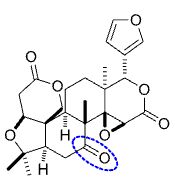
1. Limonin is a limonoid, found at higher concentrations in seeds of citrus fruits and other plants, such as those of the Dictamnus genus. Identify the functional group circled. (A) Alcohol (B) Aldehyde (C) Ester (D) Ether (E) Ketone
2. A scientist obtains the number 0.03500860 on a calculator. If this number actually has four (4) significant figures, how should it be written? (A) 0.3586 (B) 0.3501 (C) 0.0350 (D) 0.03501 (E) 0.03500
3. A sample of chemical Y is found to contain 5.0 grams of oxygen, 10.0 grams of carbon, and 15.0 grams of nitrogen. The law of definite proportion would predict that a 60 gram sample of chemical Y should contain how many grams of nitrogen? (A) 30 grams (B) 20 grams (C) 15 grams (D) 10 grams (E) 5 grams
4. The numbers of protons, neutrons, and electrons in \( _{20}^{40}\text{Ca}^{2+} \) are: (A) 22 protons, 20 neutrons, and 20 electrons. (B) 20 protons, 22 neutrons, and 18 electrons. (C) 20 protons, 20 neutrons, and 18 electrons. (D) 22 protons, 18 neutrons, and 18 electrons. (E) 20 protons, 20 neutrons, and 22 electrons.
5. Naturally occurring copper exists in two isotopic forms: \( ^{63}\text{Cu} \) and \( ^{65}\text{Cu} \). The atomic mass of copper is 63.55 amu. What is the approximate natural abundance of \( ^{63}\text{Cu} \)?(A) 80% (B) 72.5% (C) 60% (D) 50% (E) 27.5%
6. Consider two organic molecules, methanol and benzene. One dissolves in water and the other does not. Why? (A) They have different molar masses. (B) One is ionic, the other is not. (C) One is an electrolyte, the other is not. (D) Methanol contains a polar O–H bond, and benzene does not. (E) Two of these are correct.
7. Which of the following statements are true concerning ionic bonding? (A) MgCl2 forms because Mg2+ is always a more stable species than the calcium atom alone. (B) Ionic bonding occurs between a metal, which has a high affinity for electrons, and a nonmetal, which loses electrons relatively easy. (C) Compounds with ionic bonds tend to have low melting points. (D) The electronegativity difference between the bonding atoms of ionic compounds is small since the electrons are not shared but rather held together by electrostatic forces. (E) All of the above statements are false.
8. On a cold winter day, a steel metal fence post feels colder than a wooden fence post of identical size because: (A) Steel has the ability to resist a temperature change better than wood. (B) The specific heat capacity of steel is higher than the specific heat capacity of wood. (C) The specific heat capacity of steel is lower than the specific heat capacity of wood. (D) The mass of steel is less than wood so it loses heat faster. (E) Two of the above statements are true.
9. Which one of the following types of radiation has the shortest wavelength, the greatest energy, and the highest frequency? (A) Visible red light. (B) Visible blue light. (C) Infrared radiation. (D) Ultraviolet radiation. (E) None, because short wavelength is associated with low energy and low frequency, not high energy and high frequency.
10. Which of the following is an incorrect designation for an atomic orbital? (A) 1s (B) 3d (C) 4f (D) 2p (E) 1p
11. Which of the following best describes an orbital? (A) The space in an atom where an electron is most likely to be found. (B) Space where electrons are unlikely to be found in an atom. (C) Space which may contain electrons, protons, and/or neutrons. (D) Small, walled spheres that contain electrons. (E) A single space within an atom that contains all electrons of that atom.
12. Which statement about hydrogen bonding is true? (A) Hydrogen bonding is the intermolecular attractive forces between two hydrogen atoms in solution. (B) The hydrogen bonding capabilities of water molecules cause butane to be more soluble in water than methanol. (C) Hydrogen bonding of solvent molecules with a solute will not affect the solubility of the solute. (D) Hydrogen bonding arises from the dipole moment created by the unequal sharing of electrons within certain covalent bonds within a molecule. (E) Hydrogen bonding interactions between molecules are stronger than the covalent bonds within the molecule.
13. All of the following are weak acids except (A) HCNO (B) HCN (C) HNO2 (D) HF (E) HClO4
14. Which of the following aqueous solutions contains the greatest number of ions? (A) 400.0 mL of 0.10 \( M \) NaCl (B) 200.0 mL of 0.10 \( M \) KBr (C) 200.0 mL of 0.10 \( M \) FeCl3 (D) 300.0 mL of 0.10 \( M \) CaCl2 (E) 700.0 mL of 0.10 \( M \) KCl
15. As indicated by Lewis structures, which of the following would probably not exist as a stable molecule? (A) C2H4 (B) C3H4 (C) CH3O (D) CH2O (E) CH3OH
16. What hybridization is predicted for the nitrogen atom in the NO3- ion? (A) \( sp \) (B) \( sp^2 \) (C) \( sp^3 \) (D) \( dsp \) (E) \( dsp^3 \)
17. Which of the following molecules contains the shortest C—C bond? (A) C2H2 (B) C2H4 (C) C2H6 (D) C2Cl4(E) C2Cl6
18. Which of the following is the correct order of boiling points for KNO3, CH3OH, C2H6 and Ne? (A) C2H6 < Ne < CH3OH < KNO3 (B) Ne < C2H6 < KNO3 < CH3OH (C) KNO3 < CH3OH < C2H6 < Ne (D) Ne < CH3OH < C2H6 < KNO3 (E) Ne < C2H6 < CH3OH < KNO3
19. Which is a possible product of the chlorination of butane in the presence of light? (A) C4H3Cl (B) C4H9Cl (C) C4H2Cl2 (D) C4H4Cl2 (E) C4H5Cl
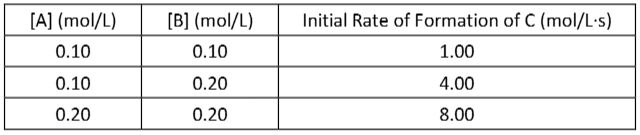
20. For a reaction in which A and B react to form C, the following initial rate data were obtained. What is the rate law? (A) \( R = k[A]^3 \) (B) \( R = k[A][B] \) (C) \( R = k[A]^2[B] \) (D) \( R = k[A][B]^2 \) (E) \( R = k[A]^2[B]^2 \)
21. Order the following in increasing rate of effusion: F2, Cl2, NO, NO2, and CH4. (A) Cl2 < NO2 < F2 < NO < CH4 (B) Cl2 < F2 < NO2 < CH4 < NO (C) CH4 < NO < F2 < NO2 < Cl2 (D) CH4 < NO2 < NO < F2 < Cl2 (E) F2 < NO < Cl2 < NO2 < CH4
22. The rate expression for a particular reaction is rate = k[A][B]3. If the initial concentration of B is increased from 0.1 M to 0.2 M, the initial rate will increase by which of the following factors? (A) 2 (B) 4 (C) 8 (D) 16 (E) 32
23. Order the four metric prefixes from smallest to largest. (A) nano- < milli- < centi- < kilo- (B) milli- < nano- < centi- < kilo- (C) kilo- < centi- < nano- < milli- (D) kilo- < centi- < milli- < nano- (E) centi- < nano- < kilo- < milli-
24. Apply the law of mass action to determine the equilibrium expression for \( 2\text{NO}_2\text{Cl}(aq) \rightleftharpoons 2\text{NO}_2(aq) + \text{Cl}_2(aq) \). (A) \( K = 2[\text{NO}_2][\text{Cl}_2]/2[\text{NO}_2\text{Cl}] \) (B) \( K = 2[\text{NO}_2\text{Cl}]/2[\text{NO}_2][\text{Cl}_2] \) (C) \( K = [\text{NO}_2\text{Cl}]^2/[\text{NO}_2]^2[\text{Cl}_2] \) (D) \( K = [\text{NO}_2]^2[\text{Cl}_2]/[\text{NO}_2\text{Cl}]^2 \) (E) \( K = [\text{NO}_2\text{Cl}]^2[\text{NO}_2]^2[\text{Cl}_2] \)
25. How would you expect the melting point of CCl4 to compare to that of KBr? (A) It should be similar since they are both ionic solids. (B) It should be lower because KBr forms an extended ionic crystal lattice, whereas CCl4 is a covalently-bonded small molecule. (C) It should be higher because the bonds are stronger due to the higher charge on C (+4). (D) It should be higher because CCl4 is larger than KBr. (E) It is not possible to say anything about their melting points without more information.
 阿摩線上測驗
登入
 (A) Alcohol (B) Aldehyde (C) Ester (D) Ether (E) Ketone
 (A)