所屬科目:研究所、轉學考(插大)◆分子生物學
1. An open reading frame (ORF) that is not likely to encode a functional polypeptide usually has the following feature not found in other ORF. (A) It has many termination codons. (B) It has many coding triplets before a termination codon. (C) It has an initiation codon. (D) It encodes functional polypeptides in the other two reading frames of the same sequence. (E) It is never transcribed.
2. A class of mutations that results in multiple contiguous amino acid changes in a protein is probably caused by the following type of mutation. (A) frameshift. (B) transversion. (C) transition. (D) RNAi. (E) base analogue.
3. The condensed state of nucleic acids in cells results from its binding to what type of proteins? (A) amphipathic (B) acidic (C) basic (D) hydrophilic
4. Regions flanking centromeres in chromosomes are rich in: (A) unique sequence DNA and euchromatin (B) unique sequence DNA and heterochromatin (C) satellite DNA and euchromatin (D) satellite DNA and heterochromatin
5. Which of the following is a false statement about telomerase? (A) dCTP and dATP are not substrates of telomerase. (B) The RNA component of telomerase serves as the template for telomere synthesis. (C) Telomerase uses the 5'-end of the telomere to prime telomere synthesis (D) The protein component of telomerase is a reverse transcriptase.
6. The transient covalent modification of the N-terminal tails of the core histone proteins: (A) facilitates the process of transcription and DNA replication (B) disrupts nucleosome/DNA interaction by the introduction of a net positive charge on the nucleosomes. (C) is specific for the R groups of valine, isoleucine and alanine. (D) exclusively involve the histone tails of H2A and H2B. (E) answers A and B are correct
7. Which of the following features are common to essentially all (prokaryotic, eukaryotic, viral) replication origins? (A) Origin sequences have inverted repeats that form stable secondary structures for assembly of the replication apparatus. (B) Origins are unique DNA segments that often contain multiple short repeated sequences involved in binding to replication proteins. (C) DNA polymerase is able to recognize promoter-like sequences at the replication origins. (D) The origin-flanking sequences are G-C rich to stabilize the DNA-protein initiation complex.
8. At normal growth temperature (37°C), how long does it take for complete replication of the (E) coli chromosome? (A) 20 minutes (B) 40 minutes (C) 60 minutes (D) 90 minutes
9. Transfer of the F factor from one bacterial cell to another occurs as: (A) Single-stranded DNA generated by rolling circle replication in the donor cell. (B) Single-stranded DNA generated by unidirectional replication in the donor cell. (C) Double-stranded DNA generated by rolling circle replication in the donor cell. (D) Double-stranded DNA generated by unidirectional replication in the donor cell.
10. In September 2016, a baby was born with the DNA of two women (the mother and a donor) and a man (the father). The baby was conceived through the technique of so called "three-parent in vitro fertilization". Which of the following statement is correct: (A) The three parents provided DNA from nucleus, peroxisome and mitochondrion, respectively. (B) The nucleus was removed from the egg cell of a donor and the de-nucleated egg cell was then injected with the nuclear DNA from the mother's egg cell. (C) The technique was used because the mother has a genetic disease due to a mutation in the nuclear DNA. (D) The sperm provided the mitochondrial DNA.
11. What two proteins are required for unwinding duplex DNA and stabilizing the resulting single strands? (A) DNA primase and helicase (B) DNA primase and replicase (C) Replicase and single-stranded DNA binding protein (D) Helicase and single-stranded DNA binding protein
12. The (E) coli chromosome replicates bidirectionally, this means there: (A) are two replication origins on the bacterial chromosome. (B) are two daughter duplexes formed after replication of the DNA. (C) are two replication forks established that move in opposite directions. (D) is replication of both a leading strand and a lagging strand.
13. An (E) coli mutation that greatly reduces the 3'-5' exonuclease activity of DNA polymerase I would result in: (A) cell death (B) very little or no effect on cell viability (C) a significantly decreased mutation rate (D) a significantly increased mutation rate
14. What type of DNA structure is needed for initiation of homologous DNA recombination? (A) broken, blunt-ended DNA (B) a free 5' single-stranded region (C) a free 3' single-stranded region (D) any of the above
15. The photoreactivation repair system in (E) coli acts specifically on: (A) pyrimidine dimers (B) double-strand breaks (C) abasic sites (D) mispaired DNA sites.
16. Homologous recombination between two identical direct repeat elements present in a genome results in: (A) a duplication of the DNA between the repeats (B) an inversion of the DNA between the elements (C) deletion and circularization of the DNA between the repeats (D) none of the above
17. Genetic recombination during meiosis is initiated by a (A) pair of single-stranded nicks at identical sites, one within each parental duplex. (B) single-stranded nick in only one of the two parental duplexes. (C) pair of single-stranded nicks at different sites, one within each parental duplex. (D) double-stranded break in only one of the two parental duplexes.
18. Considering the polymerase chain reaction, what kind of bonds holds the primer to the template DNA? (A) covalent (B) ionic (C) Van der Waals (D) hydrogen (E) hydrophobic
19. The "2016 Nobel Prize in Physiology or Medicine" was awarded to Dr. Yoshinori Ohsumi "for his discoveries of mechanisms for autophagy". Which of the following statement about autophagy is incorrect? (A) A mitochondrion was observed being engulfed by a cup-shaped double-membrane. This mitochondrion might be going through the process of autophagy. (B) In autophagy, the engulfed organelles will be sent to the 26S proteosome for degradation. (C) Autophagy mediates the digestion and recycling of non-essential parts of the cell during starvation. (D) Autophagy is capable of clearing invading microorganisms and toxic protein aggregates.
20. CRISPR/Cas9 is the most talked about technique in the past few years for targeted genome editing. Which of the following statement about CRISPR/Cas9 is incorrect? (A) Cas9 is an endonuclease that cut double-stranded RNA. (B) An RNA molecule guides Cas9 to the target. (C) The system has been shown to work in many organisms including fish, yeast and plants. (D) The system was originally discovered as part of adaptive immunity in bacteria.
21. Which of the following statements about RNA polymerase is NOT correct? (A) DNA moves through a channel in RNA polymerase and makes a sharp turn at the active site (B) Sigma factor is required for both the initiation and elongation steps of RNA synthesis (C) Sigma factor changes the DNA-binding properties of RNA polymerase so that its affinity for general DNA is reduced and its affinity for promoter is increased (D) Core RNA polymerase of bacteria can synthesize RNA from a DNA template but cannot initiate transcription at the correct site
22. All of the following elements can function as prokaryotic promoter except (A) A TATA box centered at~-10 (B) A purine at the start point (C) CpG islands (D) A hexamer with a sequence close to TTGACA centered at ~-35
23. Which of the following statements about Eukaryotic RNA polymerases and promoters is NOT correct? (A) mRNA is synthesized by RNA polymerase II in the nucleoplasm (B) rRNA is synthesized by RNA polymerase I in the nucleolus (C) Promoter is always located in the upstream of the transcription start point (D) Chromatin must be opened before RNA polymerase can bind the promoter
24. Which of the following is not used in the electrophoretic mobility shift assay (EMSA)? (A) A radiolabeled DNA fragment (B) A polyacrylamide gel (C) A DNA binding protein (D) DNase I
25. Which of the following is not a structural motif found in a DNA-binding domain? (A) Random-coil acidic domain (B) Zinc-finger (C) Helix-loop-helix (D) Homeodomain
26. Splice sites in pre-mRNA are marked by two universally conserved sequences contained (A) In the middle of the intron. (B) At the ends of the exons. (C) At the ends of the introns. (D) None of the above
27. Which of the following RNA functions in the removal of introns from pre-RNAs. (A) snRNA (small nuclear RNA) (B) snoRNA (small nucleolar RNA) (C) siRNA (small interfering RNA) (D) miRNA (micro RNA)
28. Indicate the order in which the following steps occur in the production of a mature mRNA. (A) Initiation of transcription, splicing, addition of 5' cap, addition of polyA. tail, transport to cytoplasm (B) Initiation of transcription, addition of 5' cap, splicing, transport to cytoplasm, addition of polyA. tail, (C) Initiation of transcription, addition of polyA. tail, addition of 5′ cap, splicing, transport to cytoplasm (D) Initiation of transcription, addition of 5' cap, addition of polyA. tail, splicing, transport to cytoplasm
29. Comparing mRNA molecules from human and Escherichia coli cells, which of the following is typically NOT true? (A) A human mRNA has a special 5' cap, while a bacterial mRNA does not. (B) A human mRNA has a poly-A tail, while a bacterial mRNA does not. (C) A human mRNA undergoes alternative splicing, while a bacterial mRNA does not. (D) A human mRNA contains noncoding sequences, while a bacterial mRNA does not. (E) A typical human mRNA encodes one protein, while many bacterial mRNAs encode several different proteins.
30. In the following schematic graph of a hypothetical set of RNA-seq data, the number of reads is plotted for a region of chromosome containing two genes, from samples obtained from two different tissues. Which gene (X or Y) do you think is more likely a "housekeeping" gene? Which region (1 or 2) within gene Y most likely corresponds to an exon? (A) Gene X; region 1 (B) Gene X; region 2 (C) Both genes; region 1 (D) Gene Y; region 1 (E) Gene Y; region 2
31. Which of the following statements about splicing is correct? (A) All of the splicing require enzymatic activity provided by proteins (B) Splicing can occur during or after transcription (C) Splicing reactions occur only in cis between splice sites on the same molecular of RNA (D) Production of rRNA requires cutting and rejoining in separate reactions
32. Which of the following is not a feature of ribosomes? (A) Cytoplasmic and organellar ribosomes of eukaryotes are identical. (B) All ribosomes have one large subunit and one small subunit. (C) All ribosomes are composed of RNA and protein. (D) Ribosomes interact with both mRNA and tRNA.
33. The function of bacterial EF-Ts is to (A) Convert EF-Tu GDP to an active form. (B) Convert GTP to GDP. (C) Allow binding of aminoacyl-tRNAs to the A site of the ribosome. (D) Move the peptidyl-tRNA from the A site to the P site. (E) Deacylate tRNAs.
34. The antibiotic puromycin inhibits protein synthesis by (A) Preventing formation of the peptide bond due to its similarity to peptidyl transferase. (B) Blocking the translocation of the ribosome. (C) Inhibiting the binding of EF-Tu to aminoacyl-tRNAS. (D) Temporarily binding to the A site and taking the polypeptide from the ribosome. (E) Preventing the association of the large and small ribosomal subunits.
35. Different aminoacyl-tRNA synthetases (A) may bind the same amino acid. (B) may bind the same tRNA. (C) do not appear to recognize the same features of tRNAs. (D) will always recognize both the acceptor stem and anticodon sequences of tRNAs. (E) will always recognize the complete tRNA anticodon sequence.
36. Which of the following statements about genetic code is NOT correct (A) Slippery sequences allow more than polypeptide to be coded by a single gene. (B) A nonsense suppressor mutation in a tRNA gene allows a ribosome to read through a mutant stop codon in the middle of a coding sequence. (C) Having several codons that differ in the third nucleotide position minimizes the functional effects of mutations. (D) Due to wobble pairing, a single tRNA can recognize several codons. (E) None of the above.
37. The covalent modifications of DNA that are responsible for establishing and/or maintaining epigenetic inheritance patterns include all of the following except: (A) The association with members of the Pc-G family of proteins. (B) The methylation of histone H3. (C) The acetylation of histones H3 and H4. (D) The methylation of cytosine. (E) All of the above modifications establish or maintain epigenetic inheritance patterns.
38. To prevent spurious transcription from a gene, acetylation of histones which is carried out by histone acetyl transferases ahead of a moving RNA polymerase II-is quickly reversed by histone deacetylases and histone methyl transferases in the wake of the polymerase, leaving a trail of specific methylated histones. Which of the following curves do you think better represents the distribution of this specific histone methylation mark with respect to a gene? (A) A (B) B (C) C (D) D
39. Which of the following classes of noncoding RNAs is NOT directly involved in RNA interference? (A) miRNA (B) snoRNA (C) piRNA (D) siRNA
40. What is the function of RNA-dependent RNA polymerases in RNAi? (A) They prevent the spread of the RNAi pathway by replicating the target RNAs. (B) They help amplify the RNAi response by replicating the target RNAS. (C) They produce additional copies of the siRNAs to ensure that the RNAi response is sustained and spread. (D) They are viral proteins that prevent the spread of RNAi by preferentially replicating siRNA sponges.
 阿摩線上測驗
登入
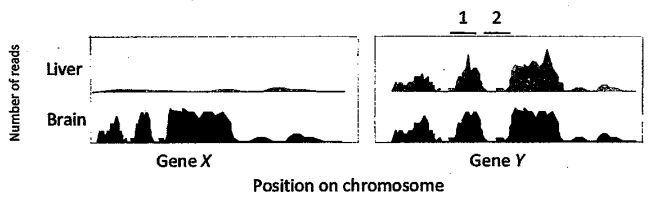 (A) Gene X; region 1 (B) Gene X; region 2 (C) Both genes; region 1 (D) Gene Y; region 1 (E) Gene Y; region 2


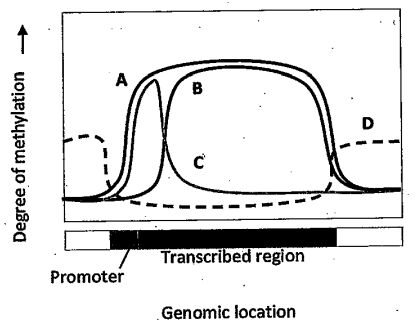 (A) A (B) B (C) C (D) D