所屬科目:研究所、轉學考(插大)◆普通化學
1. What will happen if a small amount of hydrochloric acid is added to a 0.1 M solution of HF?(A) The percent ionization of HF will decrease.(B) The percent ionization of HF will increase.(C) The percent ionization of HF will remain unchanged.(D) Ka for HF will increase.(E) Ka for HF will decrease.
2. What is the correct IUPAC name of 2-methyl-4-t-butylpentane?(A) 2-t-butyl-4-methylpentane(B) 2,2,3,5-tetramethylhexane(C) 2,4,5,5-tetramethylhexane(D) 1-sec-butyl-1,2,2-trimethylpentane(E) 2-t-butyl-3-isopropylpropane
3. What is the cell reaction for the voltaic cell Cr(s) | Cr3+(aq) || Cl–(aq) | Cl2(g) | Pt?(A) Cr(s) + 2Cl–(aq) ↔ Cl2(g) + Cr3+(aq) (B) 2Cr3+(aq) + 6Cl–(aq) ↔ 2Cr(s) + 3Cl2(g)(C) Cr(s) + 3Cl2(g) ↔ Cr3+(s) + 2Cl–(aq) (D) 2Cr3+(aq) + 3Cl2(g) ↔ 2Cr(s) + 6Cl–(aq)(E) 2Cr(s) + 3Cl2(g) ↔ 2Cr3+(aq) + 6Cl–(aq)
4. What are the oxidation numbers of each central metal atom in K3[Fe(CN)6], [Cr(NH3)4Br2]Br,[Ni(H2O)6]Cl2, and Na2[TaF7]?(A) 3, 3, 2, 5 (B) 3, 3, 2, 7 (C) 3, 3, 3, 5 (D) –3, 1, 2, 5 (E) –3, 3, 2, 5
5. Why is nitrogen not able to form molecules with five covalent bonds?(A) Because nitrogen only form a trigonal bipyramidal shape when it bonds with other elements.(B) Because nitrogen has a high ionization energy that having five covalent bonds is not possible.(C) Because of nitrogen's small size and lack of available d orbitals for electrons.(D) Because nitrogen only exists as N2 gas at room temperature.(E) At least two of the above are correct.
6. The number of a certain radioactive nuclide present in a sample decays from 160 to 20 in 4hours. What is the half-life of this radioactive species?(A) 20 minutes (B) 40 minutes (C) 48 minutes (D) 60 minutes (E) 80 minutes
7. The following question refers to the following system: 3Ag(s) + NO3–(aq) + 4H+(aq) → 3Ag+(aq)+ NO(g) + 2H2O(l).Anode reaction: Ag → Ag+(aq) + e– –0.7990 VCathode reaction: NO3–(aq) + 4H+(aq) + 3e– → NO(g) + 2H2O(l) 0.9644 VDetermine the standard cell potential.(A) 0.1654 V(B) 2.0942 V(C) 3.5268 V(D) 0.5878 V(E) –1.7634 V
8. Metal X is a better reducing agent than metal Y. This must mean that:(A) X+ is a better oxidizing agent than Y+.(B) X+ is a better reducing agent than Y+.(C) Y+ is a better reducing agent than X+.(D) Y+ is a better oxidizing agent than X+.(E) Y is a better oxidizing agent than X.
9. The galvanic cell described by Zn(s) | Zn2+(aq) | Cu2+(aq) | Cu( ) has a standard cell potential of1.101 volts. Given that Zn(s) → Zn2+(aq) + 2e– has an oxidation potential of 0.764 volts,determine the reduction potential for Cu2+(A) 0.674 V (B) 1.865 V (C) –1.865 V (D) –0.337 V (E) 0.337 V
10. The molar solubility of PbI2 is 1.52 × 10⁻³ M. Calculate the value of Ksp for PbI2.(A) 1.52 × 10⁻⁵ (B) 4.62 × 10⁻⁶ (C) 5.32 × 10⁻⁷ (D) 1.40 × 10⁻⁸ (E) 3.51 × 10⁻⁹
11. Determine Go for the following reaction: CH4(g) + 2O2(g) ↔ CO2(g) + 2H2O(l). Substance [Gfo(kJ/mol)]: CH4(g) [–50.69], O2(g) [0], CO2(g) [–394.4], and H2O(l) [–237.4].(A) –581.1 kJ(B) –682.5 kJ(C) –818.5 kJ(D) –919.9 kJ(E) 131.1 kJ
12. If you know Kb for NH3, you can calculate the equilibrium constant, Ka, for the followingreaction: NH4+ ↔ NH3 + H+ by the equation:(A) Ka = Kw × Kb(B) Ka = Kw / Kb(C) Ka = 1 / Kb(D) Ka = Kb / Kw(E) Ka = Kw + Kb
13. If the equilibrium constant for A + B ↔ C is 0.208, then the equilibrium constant for 2C ↔ 2A+ 2B is(A) 0.584 (B) 4.81 (C) 0.416 (D) 23.1 (E) 0.208
14. The following questions refer to the equilibrium shown here: 4NH3(g) + 5O2(g) ↔ 4NO(g) +6H2O(g). What would happen to the system if oxygen were added?(A) More ammonia would be produced.(B) More oxygen would be produced.(C) The equilibrium would shift to the right.(D) The equilibrium would shift to the left.(E) Nothing would happen.
15. For a reaction in which A and B react to form C, the following initial rate data were obtained.What is the rate law?(A) Rate = k[A][B](B) Rate = k[A]2[B](C) Rate = k[A][B]2(D) Rate = k[A]2[B]2(E) Rate = k[A]3
16. The solubility of an unknown salt, MY3, at 25℃ is 3.1×10⁻⁵ M. What is the Ksp for MY3 at 25℃? (A) 2.5 × 10⁻¹⁷ (B) 2.5 × 10⁻¹⁵ (C) 3.8 × 10⁻¹³ (D) 1.2 × 10⁻¹³ (E) 1.2 × 10⁻¹¹
17. Given the following acids and Ka values: HClO4 Ka= 1 × 10⁷, HOAc Ka= 1.76 × 10⁻⁵, HCN Ka= 4.93× 10⁻¹⁰, and HF Ka= 3.53 × 10⁻⁴. What is the order of increasing base strength?(A) CN–, F–, OAc–, ClO4–(B) CN–, OAc–, F–, ClO4–(C) CN–, ClO4–, F–, OAc–(D) ClO4–, OAc–, CN–, F–(E) ClO4–, F–, OAc–, CN–
18. Rank the following compounds according to increasing solubility in water.I: CH3–CH2–CH2–CH3, II: CH3–CH2–O–CH2–CH3, III: CH3–CH2–OH, and IV: CH3–OH(A) I < III < IV < II(B) I < II < IV < III(C) I < IV < II < III(D) I < II < III < IV(E) I < IV < III < II
19. The two salts AgX and AgY exhibit very similar solubilities in water. It is known that the salt AgXis much more soluble in acid than is AgY. What can be said about the relative strengths of theacids HX and HY?(A) Both acids are strong.(B) The acids are weak acids and have equal values for Ka.(C) HX is stronger than HY.(D) HY is stronger than HX.(E) Nothing.
20. The hybridization of the carbon atom in the cation CH3+ is:(A) s (B) sp (C) sp2 (D) sp3 (E) dsp
21. Which of the following is the correct order of boiling points for KNO3, CH3OH, C2H6, Ne?(A) Ne < CH3OH < C2H6 < KNO3(B) Ne < C2H6 < KNO3 < CH3OH(C) KNO3 < CH3OH < C2H6 < Ne(D) Ne < C2H6 < CH3OH < KNO3 (E) C2H6 < Ne < CH3OH < KNO3
22. Methyl orange is an indicator with a Ka of 1 × 10⁻⁴. Its acid form, HIn, is red, while its base form,In–, is yellow. At pH 6.0, the indicator will be(A) red(B) orange(C) yellow(D) green(E) blue
23. Which of the following statements is true concerning the electrochemical cell depicted below?Ca | Ca2+(aq) || K+(aq) | K Ca2+(aq) + 2e- ↔ Ca(s) • \( \epsilon^{\circ} = -2.87 \text{ V} \) K+(aq) + e- ↔ K(s) • \( \epsilon^{\circ} = -2.93 \text{ V} \)(A) The cell reaction is spontaneous with a standard cell potential of –0.06 V.(B) The cell reaction is nonspontaneous with a standard cell potential of 0.06 V.(C) The cell reaction is nonspontaneous with a standard cell potential of –5.80 V.(D) The cell reaction is spontaneous with a standard cell potential of 5.80 V.(E) The cell is at equilibrium.
24. Which of the following molecules has no dipole moment?(A) D2O (B) CH3OH (C) NH3 (D) H2O (E) CO2
25. Penicillin antibiotics, derived from Penicillium fungi, are still widely used today, though manytypes of bacteria have developed resistance following extensive use. Which are the functionalgroups (amide and lactam) in penicillin G?(A) I and II(B) II and III(C) II and IV(D) III and IV(E) IV and V
 阿摩線上測驗
登入
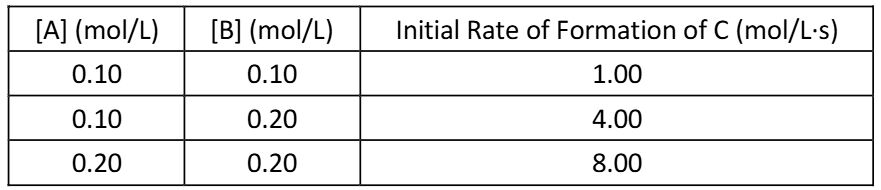 (A) Rate = k[A][B](B) Rate = k[A]2[B](C) Rate = k[A][B]2(D) Rate = k[A]2[B]2(E) Rate = k[A]3
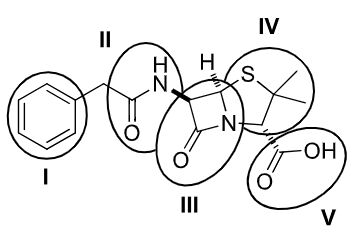 (A) I and II(B) II and III(C) II and IV(D) III and IV(E) IV and V