所屬科目:研究所、轉學考(插大)◆數理統計學
(a) (8%) Find the maximum likelihood estimator \( T_{n}(X) \) of \( \theta \), where \( X = (X_{1}, X_{2}, \dots, X_{n})' \).
(b) (8%) Find the maximum likelihood estimator of the median.
(c) (8%) Find the Rao-Cramer lower bound for the variance of \( T_{n}(X) \).
(d) (8%) Based on \( T_{n}(X) \), find the unique minimum variance unbiased estimator of \( \theta \).
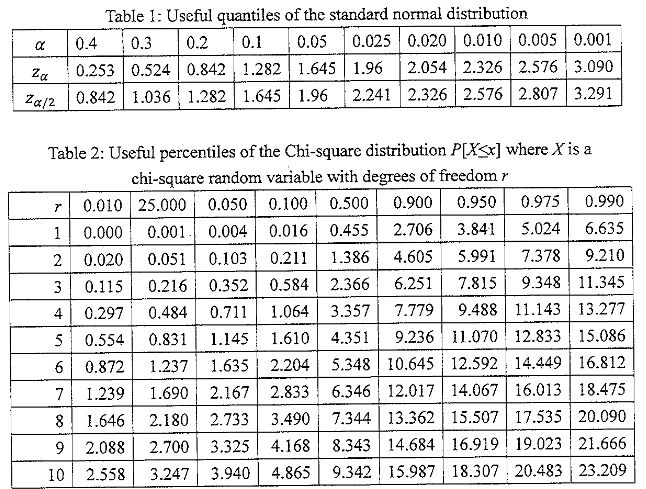
(e) (8%) Consider \( H_0: \theta = 2 \) versus \( H_a: \theta > 2 \). Suppose a random sample of size 50 is collected as follows:0.68 0.21 0.53 0.06 0.47 0.58 0.56 0.29 0.81 0.42 0.85 0.09 0.97 0.57 0.17 0.64 0.49 0.41 0.59 0.47 0.18 0.17 0.31 0.41 0.58 0.66 0.74 0.49 0.71 0.50 0.45 0.23 0.68 0.60 0.06 0.91 0.63 0.57 0.49 0.34 0.59 0.46 0.29 0.34 0.15 0.78 0.37 0.44 0.85 0.38
We find $50 - \sum_{i=1}^{50} x_i = 25.77$ and $\sum_{i=1}^{50} \log(1 - x_i) = -17.43$. Construct a Wald-type test to these hypotheses. Use this test to make inference about this sample given the significance level 0.05.
2. (10%) Let $X_1, X_2, \cdots, X_n$ be a random sample from the distribution with a probability density function $f(x; \theta) = \theta_1 e^{-\theta_1(x - \theta_2)}, x > 0; \theta_1 > 0; \theta_1 \in R.$
(a) \( (5\%) \) Suppose that \( \tilde{X}_k = \sum_{i=1}^{n} X_{ki} \). Find the mean and variance of \( \tilde{X}_k \).
(b) (5%) The correlation of \( \tilde{X}_1 \) and \( \tilde{X}_4 \) is negative. Give a reason to explain this.
(c) \( (10\%) \) Find \( \operatorname{Cov}(\tilde{X}_1, \tilde{X}_4) \).
(d) \( (10\%) \) Let \( Z_{1} = \tilde{X}_{1} + \tilde{X}_{2}, Z_{2} = \tilde{X}_{3} \) and \( Z_{3} = \tilde{X}_{4} \). Find the joint distribution of \( (Z_{1}, Z_{2}, Z_{3}) \).
(a) \( (10\%) \) Find the joint distribution of \( (U,V) \), where \( U = X / Y \) and \( V = |Y| \).
(b) \( (2\%) \) Find the sample space of \( (U,V) \).
(c) \( (8\%) \) Compute the distribution of \( U \)
 阿摩線上測驗
登入