所屬科目:學士後西醫物理及化學
1. Two balls, projected at different times so they don't collide, have trajectories A and B, as shown below. Which statement is correct?(A) VOB must be greater than voA. (B) Ball A is in the air for a longer time than ball B. (C) Ball B is in the air for a longer time than ball A. (D) Ball B has a greater acceleration than ball A. (E) Ball A has a greater acceleration than ball B.
5.A bar magnet is dropped from above and falls through the loop of wire shown below. The north pole of the bar magnet points downward towards the page as it falls. Which statement is correct? (A) The current in the loop always flows in a counterclockwise direction. (B) The current in the loop always flows in a clockwise direction. (C) The current in the loop flows first in a clockwise, then in a counterclockwise direction. (D) No current flows in the loop because both ends of the magnet move through the loop. (E) The current in the loop flows first in a counterclockwise, then in a clockwise direction.
6.A 3.0-kg mass is projected down a rough, circular track (radius = 2.0 m) as shown. The speed of the mass at point A is 4.0 m/s, and at point B, it is 7.0 m/s. What is the change in mechanical energy
done on the system between A and B by the force of friction?
(A) -24 J
(B) -9.3 J
(C) -8.1 J
(D) -7.2 J(E) -6.6 J
7.A straight wire is bent into the shape shown. Determine the net magnetic force on the wire when the current I travels in the direction shown in the magnetic field B: (A) 2IBL in the +z direction (B) 2IBL in the -z direction (C) 4IBL in the +y direction (D)4IBL in the -y direction (E) zero
8.Three particles travel through a region of space where the magnetic field is out of the page, as shown in the figure. The electric charge of each of the three particles is, respectively, (A) 1 is positive, 2 is neutral, and 3 is negative (B) 1 is positive, 2 is negative, and 3 is neutral (C) 1 is neutral, 2 is negative, and 3 is positive (D) 1 is neutral, 2 is positive, and 3 is negative (E) 1 is negative, 2 is neutral, and 3 is positive
9.The figure shows the displacement y of a wave at a given position as a function of time and the displacement of the same wave at a given time as a function of position. Determine the frequency of the wave. (A) 4.0 Hz (B) 3.0 Hz (C) 0.50 Hz (D) 0.33 Hz (E) 0.25 Hz
10. An ice cube at 0℃ is placed in a very large bathtub filled with water at 30℃ and allowed to melt, causing no appreciable change in the temperature of the bath water. Which one of the following statements is true? (A) The entropy gained by the ice cube is equal to the entropy lost by the water. (B) The entropy lost by the ice cube is equal to the entropy gained by the water. (C) The net entropy change of the system (ice plus water) is zero because no heat was added to the system. (D) The entropy of the system (ice plus water) increases because the process is irreversible. (E) The entropy of the water does not change because its temperature did not change.
14. A solid sphere, spherical shell, solid cylinder and a cylindrical shell all have the same mass m and radius R. If they are all released from rest at the same elevation and roll without slipping, which reaches the bottom of an inclined plane first? () (A) Solid sphere (B) Spherical shell (C) Solid cylinder (D) Hoop (E) All take the same time
15. Assume that the two liquids in the U-shaped tube as shown are water and oil. Compute the density of the oil if the water stands 19 cm above the interface and the oil stands 24 cm above the interface.(A) 455 kg/m3 (B) 532kg/m3 (C) 664kg/m3 (D) 792 kg/m3 (E) 825kg/m3
22. The molecules below are: (A) constitutional isomers(B) enantiomers (C) diastereomers (D) identical (E) none of above
25. Rank the following compounds from the most soluble to the least soluble in water.(A)1>2>3>4(B)2>4>1>3(C)2>1>4>3(D)3>4>1>2(E)4>2>1>3
31. Two bodies, A and B, collide as shown in Figures I and II below. Which statement is true?(A) They exert equal and opposite forces on each other in both I and II. (B) They exert equal and opposite forces on each other in II but not in I. (C) They exert equal and opposite forces on each other in I but not in II. (D) The forces are equal and opposite to each other in I, but only the components of the forces parallel to the velocities are equal in II. (E) The forces are equal and opposite in I, but only the components of the forces perpendicular to the velocities are equal in II.
32.Two identical balls strike normal to a wall with the same velocity respectively. Ball A bounces backwards at the same speed. Ball B stops. Which statement correctly describes the change in momentum of the two balls? (A) |△pB|>|△pAl (B) |△pB=|△pA|(C) |△pBI <I△pAl (D) △pB=△pA (E) △pB>△pA
33. The circuit right contains three 100-W light bulbs. The emf ε = 220 V. Which light bulb(s) is(are) the brightest? (A) A (B) B (C) C (D) Band C (E) All three are equally bright
36. A block of material of mass m and specific heat c falls from height h and reaches speed v just before striking the ground. Its temperature is measured immediately after it strikes the ground. If we ignore any change in temperature owing to interaction with the air, the change in temperature of the block of material is(A)
(B)
(C)
(D) All of the answers above are correct
(E) Only ( A ) and ( B ) above are correct
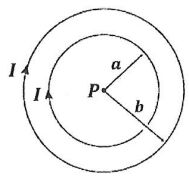
38. What is the magnitude of the magnetic field at point P if a = R and b = 2R? (A) (B)(C)(D)(E)
39. The wave function φ(x) of a particle confined to 0≤x≤L is given by φ(x) = Ax. φ(x) = O for x < 0 and x> L. When the wave function is normalized, the probability density at coordinate x has the value (A)(B)(C)(D) (E)
40. Two conducting spheres, of radii R1 = 0.2 m and R2 = 0.1 m, carry charges q1 = 6 x10⁻⁸ C, q2 = -2 x10⁻⁸ C and are placed at a distance>> R1, R2 from cach other. They are then connected by a conducting wire. What are their final charges (q1', q2')? (A) 1.85✖10-8 C, 2.15 ✖10-8C (B) 2.67✖10-8 C, 1.33✖10-8C (C) 2.33 ✖10-8 C, 1.67 ✖10-8C (D) 2.15✖10-8 C, 1.85✖10-8C (E) 1.33 ✖10-8 C, 2.67 ✖10-8C
42. Two batteries of different emfs and different internal resistances are connected. The voltage across AB in volt is (A) 1(B) 2 (C) (D) (E) 5
44. The magnetic field of a plane-polarized electromagnetic wave moving in the z-direction is given by in St units. What is the speed of the EM wave? (A) 3 x 10⁸m/s (B) 100m/s (C) 106m/s (D) 2 x 10⁷m/s (E) 2x10⁸m/s
47. Two blocks are accelerated across a horizontal frictionless surface as shown below. Frictional forces keep the two blocks from sliding relative to each other, and the two move with the same acceleration. If F = 1.2 N and M = 1.0 kg, what is the horizontal component (frictional force) of the force of the small block on the large block? (A) 0.48 N to the right (B) 0.72 N to the right (C) 0.72 N to the left (D) 0.48 N to the left (E) 0.65 N to the left
48. Two particles (m1 = 0.20 kg, m2 = 0.30 kg) are positioned at the ends of a 2.0-m long rod of ncgligible mass. What is the moment of inertia of this rigid body about an axis perpendicular to the rod and through the center of mass? (A) 0.48kg ●m2 (B) 0.50 kg●m2(C) 1.2kg●m2 (D) 0.8kg●m2(E) 0.7kg●m2
49. Two blocks, m1= 1.0 kg and m2 = 2.0 kg, are connected by a light string as shown right. If the radius of the pulley is 1.0 m and its moment of inertia is 5.0 kg ㆍ m2, the acceleration of the system is (A) g/6 (B) 3g/8 (C) g/8 (D) g/2 (E) 8g/5
51. The diagram shows three isotherms for an ideal gas, with T3-T2 the same as T2-T1. It also shows five thermodynamic processes carried out on the gas. Rank the processes in order of the change in the internal energy of the gas, least to greatest.(A) I, II, III, IV, V (B) V; I; then III, and IV tied; then II (C) I; then I, Ill and IV tied; then V (D) II; I; then III, IV, and V tied (E) V; then I, IIl and IV tied; then II
52. A 2.0 kg block on a frictionless table is connected to two ideal massless springs with spring constants k1 and k2 whose opposite ends are fixed to walls, as shown in the figure. What is angular frequency of the oscillation if k1 = 7.5 N/m and k2 = 5.0 N/m? (A) 0.40 rad/s (B) 0.56 rad/s (C) 1.2 rad/s (D) 2.5 rad/s (E) 3.5 rad/s
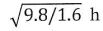
53. Suppose you have a pendulum clock which keeps correct time on Earth (acceleration due to gravity 9.8 m/s2). Without changing the clock, you take it to the Moon (acceleration due to gravity = 1.6 m/s2). For every hour interval (on Earth) the Moon clock will record: (A)(B) (1.6/9.8) h (C) 1h (D) (9.8/1.6) h (E)
55. A wheel of radius 0.5 m rolls without sliding on a horizontal surface as shown. Starting from rest, the wheel moves with constant angular acceleration 6 rad/s2. The distance in traveled by the center of the wheel from t = 0 to t = 4 s is: (A) 0m (B) 12m (C) 24m (D) 48 m (E) None of these
57. Electrons are in a two-dimensional square potential energy well with sides of length L. The potential energy is infinite at the sides and zero inside. The single-particle energies are given bywhere nx and ny are integers. At most the number of electrons that can have energy 5(h2/8mL2) is: (A) 1 (B) 2 (C) 3 (D) 4 (E) Any number
58. The figure shows a velocity selector that can be used to measure the speed of a charged particle. A beam of particles is directed along the axis of the instrument. A parallel plate capacitor sets up an electric feld E, which is oriented perpendicular to a uniform magnetic field B. If the plates are separated by 2.0 mm and the value of the magnetic field is 0.90 I, what voltage between the plates will allow particles of speed 5.0x10⁵ m/s to pass straight through without deflection? (A) 900V (B) 1900 V(C) 3800 V(D) 190 V (E) 94 V Capaeitor xxxxx plates
60 One mole of an ideal gas has a temperature of 25 ℃. If the volume is held constant and the pressure is doubled, the final temperature (in ℃) will be (A) 174 (B) 596 (C) 50 (D) 323 (E) 25
61. Which of the following complexes only has σ-bonds between the organic ligand and the central metal? (A) Cp2Fe (Cp = Cyclopentadienyl)(B) (η6-C6H6)2Cr(C) W(CH3)6(D) K[PtC3(C2H4)](E) None of above
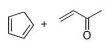
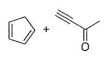
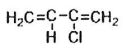
64. Which diene and dienophile would you choose to synthesize the following compounds? (A) (B) (C)(D)(E)
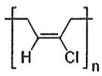
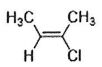
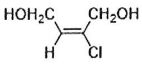
67. Which of the following monomers or pairs of monomers is used to make the addition polymer neoprene shown on the right? (A)(B)(C) (D)(E)
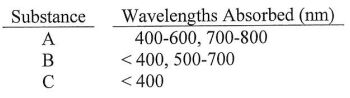
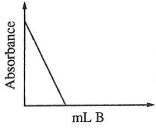
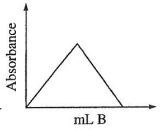
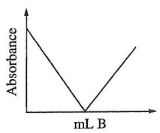
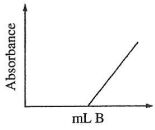
68. For the titration reaction A+B→C, where A=analyte, B-titrant, and C-product, the end point is to be detected spectrophotometrically at 550 nm, based on the absorbance information shown on the right. The shape of the titration curve at 550 nm would most closely resemble which of the following?(A)(B)(C)(D)(E)
70. Analysis of a bottle of 100 mg vitamin C tablets yields an average vitamin C content of 99.8 mg, with a standard deviation of ±0.3 mg. Assuming Gaussian statistics, which of the following is true? (A) None of the tablets contains less than 99.5 mg of vitamin C. (B) 68% of the tablets contain between 99.5 and 100.1 mg of vitamin C. (C) 97% of the tablets contain between 99.5 and 100. 1 mg of vitamin C. (D) All of the tablets contain less than 100 mg of vitamin C. (E) The average value is incorrect.
76. The boiling points of halogens (see table right) increases from F2to I2. This is the result of an increase in which quantity from F2to I2?(A) Ionic bonding (B) Covalent bond strength (C) Electron affinity (D) Van der Waals forces (E) Nuclear quadrupole moment
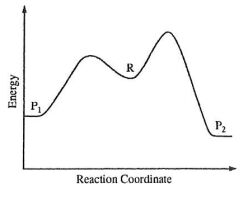
77. A reactant, R, can produce either of two products, P1 or P2, with competing pathways, as illustrated in the reaction profile shown right. If the reaction is carried out at low temperature, which of the following best indicates the preferred product and the type of control? (A) Preferred product P1, kinetic control (B) Preferred product P1, thermodynamic control (C) Preferred product P2, kinetic control (D) Preferred product P2, thermodynamic control (E) Preferred product R, thermodynamic control
78. The reaction energy diagram for the electrophilic bromination of benzene with Br2 and FeBr3 is shown right. Which position on the energy diagram corresponds to Structure 1? (A) I (B) II (C) Ⅲ (D) IV (E) V
81. At some temperatures, the relative reactivities of 3°, 2°, and 1° alkane hydrogens in free radical chlorination are in the ratio of 5:3:1. Thus, monochlorination of isopentane should produce these percentages of 2-chloro-2-methylbutane (a), combined 1-chloro-2-methybutane and 1-chloro-3- methylbutane (b), and 2-chloro-3-methylbutane (c): (A) 8% a, 75% b,17%c (B) 25% a, 45% b, 30% (C) 29% a, 44% b,18%c (D) 30% a, 35% b, 35% c (E) 36% a, 43% b, 21%c
 阿摩線上測驗
登入
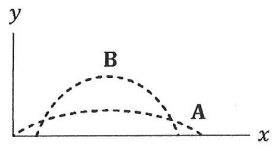 (A) VOB must be greater than voA. (B) Ball A is in the air for a longer time than ball B. (C) Ball B is in the air for a longer time than ball A. (D) Ball B has a greater acceleration than ball A. (E) Ball A has a greater acceleration than ball B.
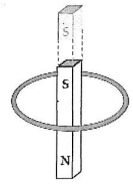 (A) The current in the loop always flows in a counterclockwise direction. (B) The current in the loop always flows in a clockwise direction. (C) The current in the loop flows first in a clockwise, then in a counterclockwise direction. (D) No current flows in the loop because both ends of the magnet move through the loop. (E) The current in the loop flows first in a counterclockwise, then in a clockwise direction.
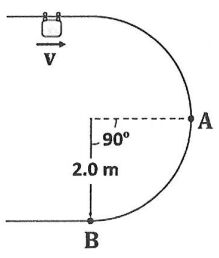 (A) -24 J
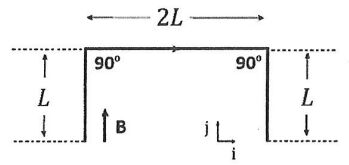 (A) 2IBL in the +z direction (B) 2IBL in the -z direction (C) 4IBL in the +y direction (D)4IBL in the -y direction (E) zero
 (A) 1 is positive, 2 is neutral, and 3 is negative (B) 1 is positive, 2 is negative, and 3 is neutral (C) 1 is neutral, 2 is negative, and 3 is positive (D) 1 is neutral, 2 is positive, and 3 is negative (E) 1 is negative, 2 is neutral, and 3 is positive
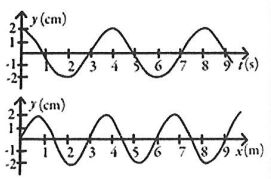 (A) 4.0 Hz (B) 3.0 Hz (C) 0.50 Hz (D) 0.33 Hz (E) 0.25 Hz

 ) (A) Solid sphere (B) Spherical shell (C) Solid cylinder (D) Hoop (E) All take the same time
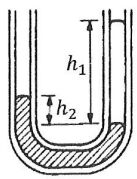 (A) 455 kg/m3 (B) 532kg/m3 (C) 664kg/m3 (D) 792 kg/m3 (E) 825kg/m3
 (A)+1135J(B)-1135J(C)+355kJ(D)+35kJ(E)-35kJ
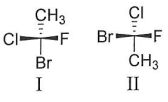 (A) constitutional isomers(B) enantiomers (C) diastereomers (D) identical (E) none of above
 (A)1>2>3>4(B)2>4>1>3(C)2>1>4>3(D)3>4>1>2(E)4>2>1>3
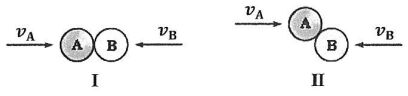 (A) They exert equal and opposite forces on each other in both I and II. (B) They exert equal and opposite forces on each other in II but not in I. (C) They exert equal and opposite forces on each other in I but not in II. (D) The forces are equal and opposite to each other in I, but only the components of the forces parallel to the velocities are equal in II. (E) The forces are equal and opposite in I, but only the components of the forces perpendicular to the velocities are equal in II.
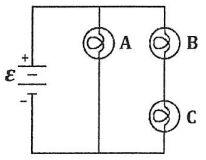 (A) A (B) B (C) C (D) Band C (E) All three are equally bright


 (A)
 (B)
 (C)
 (D)
 (E)

 (B)
 (C)
 (D)
 (E)

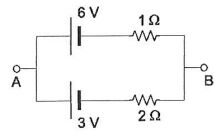 (A) 1(B) 2 (C) (D) (E) 5
 in St units. What is the speed of the EM wave? (A) 3 x 10⁸m/s (B) 100m/s (C) 106m/s (D) 2 x 10⁷m/s (E) 2x10⁸m/s
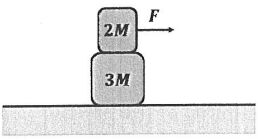 (A) 0.48 N to the right (B) 0.72 N to the right (C) 0.72 N to the left (D) 0.48 N to the left (E) 0.65 N to the left
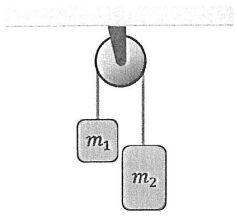 (A) g/6 (B) 3g/8 (C) g/8 (D) g/2 (E) 8g/5
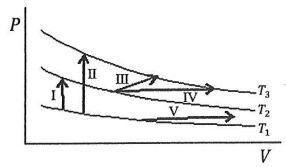 (A) I, II, III, IV, V (B) V; I; then III, and IV tied; then II (C) I; then I, Ill and IV tied; then V (D) II; I; then III, IV, and V tied (E) V; then I, IIl and IV tied; then II
 (A) 0.40 rad/s (B) 0.56 rad/s (C) 1.2 rad/s (D) 2.5 rad/s (E) 3.5 rad/s
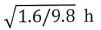 (B) (1.6/9.8) h (C) 1h (D) (9.8/1.6) h (E)
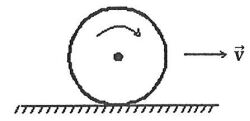 (A) 0m (B) 12m (C) 24m (D) 48 m (E) None of these
 where nx and ny are integers. At most the number of electrons that can have energy 5(h2/8mL2) is: (A) 1 (B) 2 (C) 3 (D) 4 (E) Any number
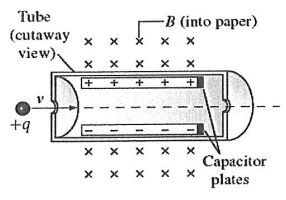 (A) 900V (B) 1900 V(C) 3800 V(D) 190 V (E) 94 V Capaeitor xxxxx plates
 (A)
 (B)
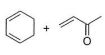 (C)
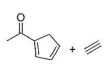 (D)
 (E)
 (A)
 (B)
 (C)
 (D)
 (E)

 (A)
 (B)
 (C)
 (D)
 (E)
 (A) Ionic bonding (B) Covalent bond strength (C) Electron affinity (D) Van der Waals forces (E) Nuclear quadrupole moment
 (A) Preferred product P1, kinetic control (B) Preferred product P1, thermodynamic control (C) Preferred product P2, kinetic control (D) Preferred product P2, thermodynamic control (E) Preferred product R, thermodynamic control
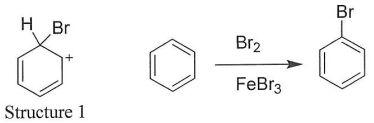
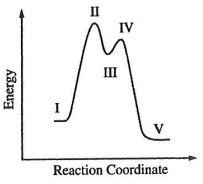 (A) I (B) II (C) Ⅲ (D) IV (E) V