所屬科目:研究所、轉學考(插大)◆有機化學
1. Which of these dienes is the most reactive in the Diels-Alder reaction? (A) 1,3-Butadiene (B) 1,4-Pentadiene (C) 2,3-Dimethyl-1,3-butadiene (D) 1,2-Butadiene (E) 1,4-Cyclohexadiene
2. Which of the following is not true concerning the strength of a nucleophile? (A) Nucleophilicity may not parallel basicity. (B) Negatively charged nucleophiles are always more reactive than their conjugate acids. (C) The greater the strength of a nucleophile, the faster an Sₙ2 reaction will occur. (D) Strong bases are always good nucleophiles (E) None of these answer choices are correct.
3. Why is sodium methoxide not used in the Claisen condensation of ethyl acetate? (A) The methoxide is a weaker base than the ethoxide which is used. (B) sodium methoxide is more difficult to prepare than sodium ethoxide. (C) The methoxide would abstract a proton from the ethyl group of the ester. (D) Use of sodium methoxide would result in transesterification. (E) sodium methoxide can be used as well as sodium ethoxide.
4. Which of these is not a reversible process? (A) Base-promoted ester hydrolysis (B) Acid-catalyzed ester hydrolysis (C) Aldol addition (D) Claisen condensation (E) Acetal formation
5. A compound has the molecular formula, C₆H₁₂O₂. Its IR spectrum shows a strong absorption band near 1740 cm⁻¹; its ¹H NMR spectrum consists of two singlets, at δ 1.2 and 3.6 ppm. The most likely structure for this compound is: (A) Isopropyl propionate (B) Propyl propionate (C) Ethyl isobutyrate (D) tert-Butyl acetate (E) Methyl pivalate
6. Which of the following terms correctly describes these compounds listed below?
(A) conformational isomers (B) not isomers (C) stereoisomers (D) constitutional isomers (E) enantiomers
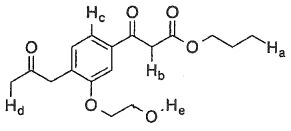
7. Which of the following predictions of δ value and splitting pattern of the labeled protons in ¹H NMR (CDCl₃) is true?
(A) Hₐ (2.5 ppm, triplet) (B) Hb (3.1 ppm, triplet of triplet) (C) Hc (3.1 ppm, triplet of triplet) (D) Hd (2.2 ppm, triplet of doublet) (E) He (2.0 ppm, singlet)
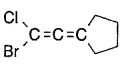
8. List of the following compounds in order of increasing reactivity in a Sₙ1 reaction. (i) MeI (ii) nBuBr (iii) tBuI (iv) iBuBr (v) iBuI (A) i < ii < v < iv < iii (B) i < ii < iv < v < iii (C) iii < v < iv < ii < i (D) iii < iv < v < ii < i (E) iii < i < iv < ii < v
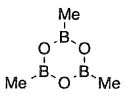
9. Which of the following compound is aromatic? (A) (B) (C) (D) (E)
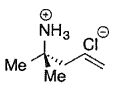
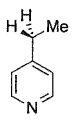
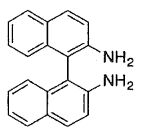
10. Which of the following amine can be resolved into enantiomers? (A)(B) (C) (D) (E)
11. At some temperatures, the relative reactivities of 3°, 2° and 1° alkane hydrogens in free radical chlorination are in the ratio of 5:3:1. What would be the expected percentages of monochlorination of isopentane produced? (i) 2-chloro-2-methylbutane, (ii) combined 1-chloro-2-methylbutane and 1-chloro-3-methylbutane, and (iii) 2-chloro-3-methylbutane. (A) 10% (i), 75% (ii), 15% (iii) (B) 25% (i), 45% (ii), 30% (iii) (C) 29% (i), 44% (ii), 18% (iii) (D) 30% (i), 35% (ii), 35% (iii) (E) 36% (i), 43% (ii), 21% (iii)
12. Rank the pKa values in the increasing order for the indicated protons.
(A) Hb < Hd < He < Hc < Hₐ (B) Hₐ < Hc < Hd < Hb < He (C) He < Hc < Hd < Hb < Hₐ (D) He < Hb < Hd < Hc < Hₐ (E) Hb < He < Hd < Hc < Hₐ
13. Chih-Ming is an undergraduate student working in the organic chemistry laboratory. He found two compounds with chemical structure labelled on the round flasks from his senior's shelf in the fridge. Those compounds (I and II) are:
(A) constitutional isomers. (B) enantiomers. (C) identical. (D) diastereomers. (E) not isomeric.
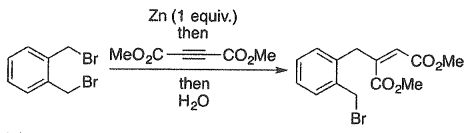
14. Which of the final product is correct for the reactions listed below? (A) (B) (C) (D) (E)
15. Which annulene would you not expect to be aromatic? (A) [6]Annulene (B) [14]Annulene (C) [16]Annulene (D) [18]Annulene (E) [22]Annulene
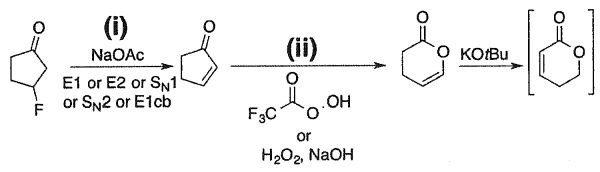
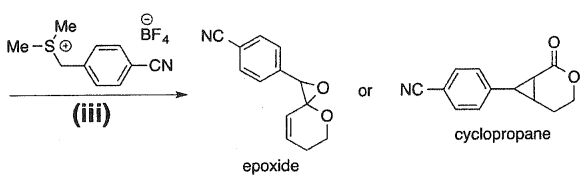
16. Which the following combination best answer the following questions (step-i to step-iii)?
(i) what type of reaction is step-(i)?
(ii) which is the correct condition for step-(ii)?
(iii) which is the correct final product for step-(iii)?
(A) (Sₙ2) (CF₃C(O)OOH) (cyclopropane)
(B) (E1) (H₂O₂, NaOH) (cyclopropane)
(C) (E1cb) (CF₃C(O)OOH) (cyclopropane)
(D) (E1cb) (CF₃C(O)OOH) (epoxide) (E) (E2) (H₂O₂, NaOH) (epoxide)
17. Remdesivir, one of the most popular molecules in the past three years, was approved or authorized for emergency use to treat COVID-19 in numerous countries. How many stereogenic centers are there in Remdesivir?
(A) 4 (B) 5 (C) 6 (D) 7 (E) 8
18. (continued) Consider the ¹H-NMR spectrum of very pure Remdesivir. Presuming that J ab is sufficiently different from J bc and that the instrument has sufficient resolving power. Assuming the maximum multiplicity of signals and non-superposition of peaks, what is the expected signal splitting pattern for each signal, in the order (Hₐ, Hb, Hc). Note: s: singlet, d: doublet, t: triplet, dd: doublet of doublet, dt: doublet of triplet (A) d, dd, dt (B) s, dd, dt (C) d, dd, d (D) d, t, d (E) s, t, dt
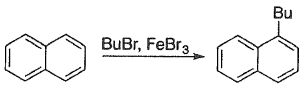
19. In the following reactions, which is the correct major product? (A) (B) (C) (D) (E)
20. Starting with benzene, the best method for preparing para-nitrobenzoic acid is: (A) HNO₃/H₂SO₄; then CH₃Cl/AlCl₃; then separation of isomers; then KMnO₄/⁻OH/heat, followed by H₃O⁺. (B) CH₃Cl/AlCl₃; then HNO₃/H₂SO₄; then separation of isomers; then KMnO₄/⁻OH/heat, followed by H₃O⁺. (C) CH₃Cl/AlCl₃; then KMnO₄/⁻OH/heat, followed by H₃O⁺; then HNO₃/H₂SO₄. (D) HNO₃/H₂SO₄; then KMnO₄/⁻OH/heat, followed by H₃O⁺; then CH₃Cl/AlCl₃. (E) HNO₃/H₂SO₄; then CO₂, followed by H₃O⁺.
21. Rank the aromaticities of the following compounds from most stable to least stable. (i) thiophene (ii) benzene (iii) pyrrole (iv) furan (A) ii > i > iii > iv (B) ii > iv > iii > i (C) ii > iv > i > iii (D) ii > iii > iv > i (E) iv > ii > i > iii
22. Which of the following is true about the Witting reaction? (A) The formation of carbon-carbon double bond from carbonyl compounds (aldehydes and ketones) and triphenylphosphite is known as the Witting reaction. (B) The Horner-Wadsworth-Emmons reaction is a variation of the Witting reaction. The major is usually the (Z)-alkene isomer. (C) The Horner-Wadsworth-Emmons reaction involves use of a phosphonate ester instead of a triphenylphosphonium salt. (D) A cis oxaphosphetane intermediate is formed to produce a ( E )-alkene in the Wittig reaction. (E) All of these choices.
23. List of the following acid derivatives from most reactive carbonyl to least reactive carbonyl toward Grignard reagent. (i) acid chloride (ii) carboxylic acid (iii) acid anhydride (iv) amide (v) ester. (A) ii > v > iv > iii > i (B) i > iii > v > ii > iv (C) i > iii > v > iv > ii (D) iii > i > v > iv > ii (E) iii > i > v > ii > iv
24. Malonic ester (diethyl malonate) is treated successively with sodium ethoxide (1 eq.), ethyl bromide, potassium tert-butoxide, isobutyl chloride, hot aqueous NaOH, HCl, and heat. What is the final product? (A) 4-Ethyl-2-methylpentanoic acid (B) 6-Methylheptanoic acid (C) 2-Ethyl-3-methylpentanoic acid (D) 2-Ethyl-4-methylpentanoic acid (E) Ethylisobutylmalonic acid
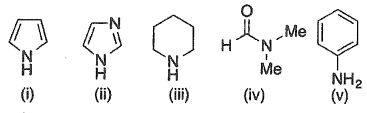
25. Arrange the compounds below in an order of increasing basicity.
(A) ii < iii < i < v < iv (B) i < v < ii < iii < iv (C) i < iv < v < iii < ii (D) i < iv < v < ii < iii (E) iv < i < v < ii < iii
26. When an equimolar mixture of ammonia and butyl bromide reacts, which of these products will form? (A) Butylamine (B) Dibutylamine (C) Tributylamine (D) Tetrabutylammonium bromide (E) All of these choices.
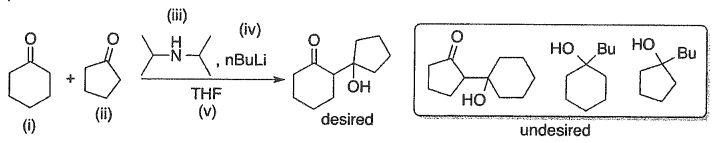
27. What would be the correct order of adding reagents (i)~(v), for the formation of the desired product?
(A) v → iii → iv → i → ii (B) v → iv → i → iii → ii (C) v → i → iii → iv → ii (D) v → i → ii → iii → iv (E) i → iii → iv → v → ii
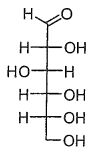
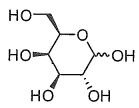
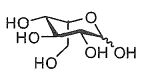
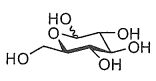
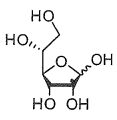
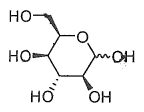
28. Which of the following carbohydrate structure is the cyclized form of the hexose in Fischer projection?
(A)(B) (C) (D) (E)
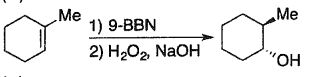
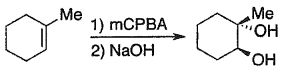
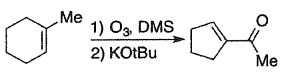
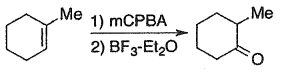
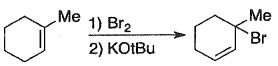
29. Which of the major product in the following transformations is incorrect? (A)(B) (C)(D) (E)
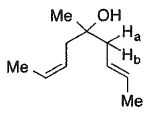
30. What best describes the relationship between Hₐ and Hb?
(A) Anomeric protons (B) Enantiotopic protons (C) Diastereotopic protons (D) Endotopic protons (E) Chemical equivalent
1. The chemical structure of (S)-N-methylbicyclo[2.2.1]heptan-2-amine is A:
2. Two organic chemists, B. Tollens and von Marle, found that the reaction of acetophenone with a formaldehyde solution and ammonium chloride led to the formation of compound B. Please draw the chemical structure of compound B.
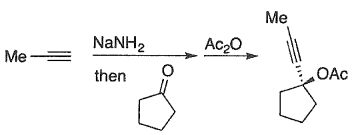
(A) 3-methylbutanoic acid + 1) SOCl₂; 2) NaN₃; heat; propylamine → C
(B)
(C)
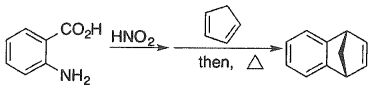
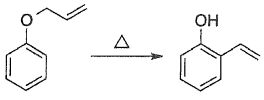
4. Provide a detail mechanism for the following reaction.
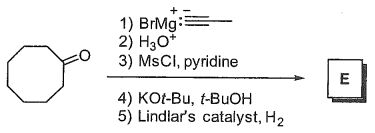
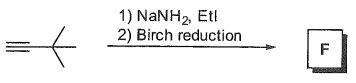
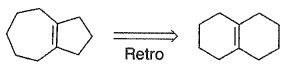
5. Design a route to synthesize the corresponding product.
(A) How many 1° (CH₃), 2° (CH₂), 3° (CH), 4°
(B) Determine the structure of the unknown.
(C) are there for the unknown respectively?
 阿摩線上測驗
登入
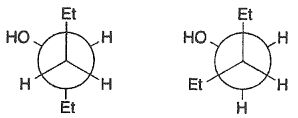 (A) conformational isomers (B) not isomers (C) stereoisomers (D) constitutional isomers (E) enantiomers
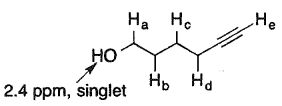 (A) Hₐ (2.5 ppm, triplet) (B) Hb (3.1 ppm, triplet of triplet) (C) Hc (3.1 ppm, triplet of triplet) (D) Hd (2.2 ppm, triplet of doublet) (E) He (2.0 ppm, singlet)
 (B)
 (C)
 (D)
 (E)

 (B)
 (C)
 (D)
 (E)
 (A) Hb < Hd < He < Hc < Hₐ (B) Hₐ < Hc < Hd < Hb < He (C) He < Hc < Hd < Hb < Hₐ (D) He < Hb < Hd < Hc < Hₐ (E) Hb < He < Hd < Hc < Hₐ
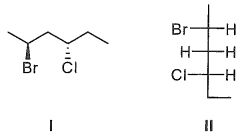 (A) constitutional isomers. (B) enantiomers. (C) identical. (D) diastereomers. (E) not isomeric.
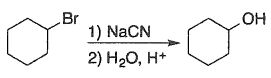 (B)
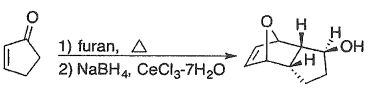 (C)
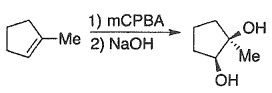 (D)
 (E)
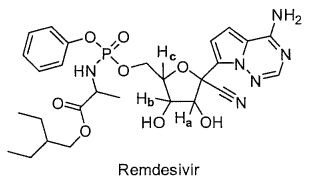 (A) 4 (B) 5 (C) 6 (D) 7 (E) 8
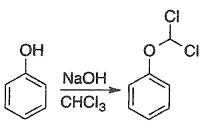 (B)
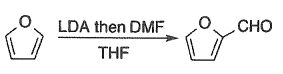 (C)
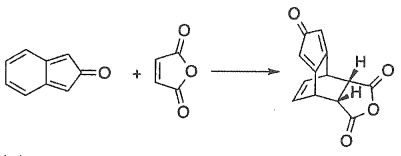 (D)
 (E)
 (A) ii < iii < i < v < iv (B) i < v < ii < iii < iv (C) i < iv < v < iii < ii (D) i < iv < v < ii < iii (E) iv < i < v < ii < iii
 (A) v → iii → iv → i → ii (B) v → iv → i → iii → ii (C) v → i → iii → iv → ii (D) v → i → ii → iii → iv (E) i → iii → iv → v → ii
 (A)
 (B)
 (C)
 (D)
 (E)
 (B)
 (C)
 (D)
 (E)
 (A) Anomeric protons (B) Enantiotopic protons (C) Diastereotopic protons (D) Endotopic protons (E) Chemical equivalent