所屬科目:研究所、轉學考(插大)◆生物化學
1. When mitochondria are actively carrying out aerobic respiration(A)the pH of the matrix is greater than the pH of the intermembrane space.(B)the pH of the matrix is less than the pH of the intermembrane space.(C)the pH ofthe matrix is about the same as the pH of the intermembrane space.(D)the pH of the matrix versus the intermembrane space has nothing to do with whether not aerobic respiration is occurring.
2. The fate of pyruvate produced during glycolysis depends primarily on the availability of(A)NAD+ to keep the pathway going.(B)molecular oxygen.(C)ADP for conversion to ATP.(D)coenzyme A for further metabolism of pyruvate.(E)phosphoric acid for the synthesis of ATP.
3. In humans, pyruvate can be converted to(A)acetyl-CoA only.(B)lactate only.(C)ethanol only.(D)acetyl-CoA and lactate.
4. The phosphorylation of glucose to glucose 6-phosphate(A)is so strongly exergonic that it does not require a catalyst.(B)is an exergonic reaction not coupled to any other reaction.(C)is an endergonic reaction that takes place because it is coupled to the exergonic hydrolysis of ATP.(D)is an exergonic reaction that is coupled to the endergonic hydrolysis of ATP.
5. Which of the following is not a component of the pyruvate dehydrogenase complex?(A)pyruvate dehydrogenase(B)dihydrolipoyl transacetylase(C)dihydrolipoył dehydrogenase(D)pyruvate dehydrogenase kinase(E) aconitase
6. The key element at the center of chlorophyll is(A)chlorine.(B)copper.(C)iron.(D)magnesium.(E) manganese.
7. The terminal electron acceptor during the light phase of photosynthesis in green plants is(A)Hydrogen (H2→ H2О).(B)NAD+(→ NADH).(C)NADP+ (→ NADPH).(D)Oxygen (O2→ H2O).(E) Sulfur (→ H2S).
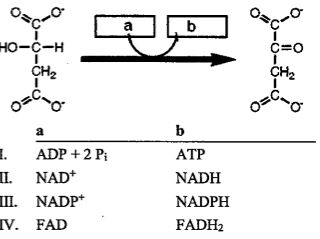
8. Which group of small molecules best fit the boxes associated with the reaction shown?(A)I(B)II(C)III(D)IV
9. Which of the following statements is true of the glycolytic pathway?(A)Each reaction in the glycolytic pathway is catalyzed by a single enzyme, acetyl CoA dehydrogenase.(B)In each reaction in the pathway, one molecule of ATP is hydrolyzed for each molecule of glucose that is metabolized.(C)In each reaction in the glycolytic pathway, two NADP molecules are released that make coupled exergonic reactionspossible.(D)Each reaction has a net gain of three ATP molecules for each glucose molecule processed in glycolysis.
10. Which of the reactions of the citric acid cycle requires FAD as a coenzyme?(A)the conversion of isocitrate to a-ketoglutarate(B)the conversion of citrate to isocitrate(C)the conversion of succinate to fumarate(D)the conversion of malate to oxaloacetate(E) none of these
11. What is the relationship between glycolysis and cancer?(A)cancer cells lack a glycolytic pathway(B)cancer cells use a modified version of glycolysis(C)cancer cells exhibit a much higher level of anaerobic glycolysis than normal cells(D)none of these
12. In the reoxidation of QH2 by purified ubiquinone-cytochrome c reductase (Complex III) from heart muscle, the overallstoichiometry of the reaction requires 2 mol of cytochrome e per mole of QH2 because:(A)cytochrome c is a one-electron acceptor, whereas QH₂ is a two-electron donor.(B)cytochrome c is a two-electron acceptor, whereas QH₂ is a one-electron donor.(C)cytochrome c is water soluble and operates between the inner and outer mitochondrial membranes(D)heart muscle has a high rate of oxidative metabolism, and therefore requires twice as much cytochrome c as QH, forelectron transfer to proceed normally.(E)two molecules of cytochrome c must first combine physically before they are catalytically active.
13. During strenuous exercise, the NADH formed in the glyceraldehyde 3-phosphate dehydrogenase reaction in skeletal muscle must be reoxidized to NAD+ if glycolysis is to continue. The most important reaction involved in the reoxidation of NADH is:(A)dihydroxyacetone phosphate → glycerol 3-phosphate.(B)glucose 6-phosphate fructose 6-phosphate.(C)isocitrate → a-ketoglutarate.(D)oxaloacetate malate.(E) pyruvate lactate.
14. The essential enzyme for the C4 pathway is(A)ribulose bisphosphate carboxylase:oxygenase(B)phosphoenolpyruvate carboxylase(C)ferredoxin-thioredoxin reductase(D)glyoxylate oxygenase(E) none of these
15. How do uncoupling agents affect the electron transport chain and oxidative phosphorylation?(A)They block the flow of electrons, so protons aren't pumped, and ATP synthesis ceases.(B)They remove electrons from the chain, so less protons are pumped, and ATP synthesis decreases.(C)They block the flow of protons through the ATP synthase, so ATP synthesis ceases. Electron flow and proton pumping arealso halted as a result.(D)They provide an alternative path for protons to re-enter the mitochondrial matrix, so ATP synthesis decreases. Electron flowand proton pumping are not affected.
16. Which of the following statements about sterols is true?(A)Cholesterol is the principal sterol in fungi.(B)Sterols are found in the membranes of all living cells.(C) Sterols are soluble in water, but less so in organic solvents such as chloroform.(D)All sterols share a fused-ring structure with four rings.(E) The principal sterol of animal cells is ergosterol.
17. An example of a glycerophospholipid that is involved in cell signaling is:(A) arachidonic acid. (B) ceramide. (C) testosterone. (D) phosphatidylinositol. (E) vitamin A (retinol).
18.The inner membrane of mitochondria is about 75% lipid and 25% protein by weight. How many molecules of membrane lipid are there for each molecule of protein? (Assume that the average protein is Mr 50,000 and the average lipid is 750.) (A) 10 (B) 100 (C) 150(D) 200(E) 1000
19. Which ofthe following is the source of the two carbon fragments in fatty acids biosynthesis?(A) acetyl CoA (B) malonyl CoA (C) palmitic acid (D) propionyl CoA (E) ceramides
20 Glutamine synthetase converts to whereas glutamate synthase converts to(A)formate; glutamine; ammonia; glutamate(B)glutamate; glutamine; a-ketoglutarate; glutamate(C)asparagine; glutamine; a-ketoglutarate; glutamate(D)a-ketoglutarate; glutamine; oxaloacetic acid; glutamate(E) a-ketoglutarate; glutamine; a-ketoglutarate; glutamate
1.Please briefly describe the process of photorespiration and explain why it is important in plants. (6%)
2. What is gluconeogenesis, and what useful purposes does it serve in people? (5%)
3. What are the biological functions of the pentose phosphate pathway? (4%)
4. Discuss three lines of evidence that support the theory that mitochondria evolved from endosymbiontic bacteria. (5%)
5. Which amino acid possesses a side chain with a pKa value approximately 6.0? Kindly illustrate this amino acid (2%)
6. Could you identify the two amino acids whose side chain groups have a pKa value close to 4.0? Additionally, please illustratethese amino acids. (2%)
7. Which types of amino acids are abundant in histone proteins, making them effective for DNA binding? Please provide a list ofthese amino acids and provide illustrations of them (4%)
B. Beyond the commonly recognized 20 amino acids, there exist lesser-known, naturally occurring amino acids (numbered 21 and22). Could you name one of these amino acids and explain the role or biological function of proteins derived from this aminoacid? (4%)
9. Please describe the reason behind the necessity ofusing organic solvents for lipid extraction from tissues. (2%)
10. Please describe three roles of triacylglycerols play in mammals and one role they serve in higher plants. (4%)
11. Higher levels of protein structure are typically stabilized by weak and noncovalent interactions. Could you describe and explain four types of known noncovalent interactions that contribute to this stabilization? (8%)
12. Explain the differences between integral and peripheral membrane proteins. (4%)
13. Why is it important that E. coli ribonucleotide reductase has two allosteric sites? (4%)
14. What function do phospholipases serve in the venom of venomous snakes? (2%)
15. After isolating an antibody from cell culture medium, you intend to assess its purity and conformation using SDS-PAGE and Native-PAGE analyses. Suppose the antibody is 99% pure. Please illustrate the expected outcomes on SDS-PAGE and NativePAGE for this antibody, which consists of two heavy chains and two light chains with molecular weights of 50 kDa and 25 kDa, respectively. (4%)
 阿摩線上測驗
登入