阿摩線上測驗
登入
首頁
>
研究所、轉學考(插大)◆普通化學
> 113年 - 113 台灣聯合大學系統_學士班轉學生考試試題_A1:普通化學#123529
113年 - 113 台灣聯合大學系統_學士班轉學生考試試題_A1:普通化學#123529
科目:
研究所、轉學考(插大)◆普通化學 |
年份:
113年 |
選擇題數:
40 |
申論題數:
0
試卷資訊
所屬科目:
研究所、轉學考(插大)◆普通化學
選擇題 (40)
Iron oxide can be reduced to iron by a reaction with carbon to form carbon monoxide
Fe₂O₃(s) + 3C(s) → 2Fe(s) + 3CO(g)
If 95.0 grams of iron oxide is reacted with excess carbon yields 63.0 g of iron, what is the percent yield of this reaction? (A) 100% (B) 95% (C) 66% (D) 59%
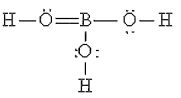
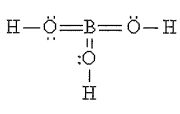
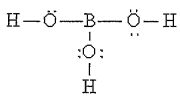
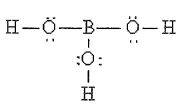
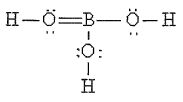
2. The Lewis structure for H₃BO₃ is (A)
(B)
(C)
(D)
(E)
3. The energy expressions for the electrons in the He⁺ ion and the hydrogen atom are
En (H) = -a/n² and En (He⁺) = -4a/n²
Which of the following statements is(are) correct?
I. For the transitions n₁ → n₂, the frequency is larger for H than for He⁺.
II. The first ionization energy of the H atom is smaller than the second ionization energy of the He atom.
III. The 1s orbital in He⁺ is larger (in the sense that the probability density is shifted outward) than the 1s orbital in H. (A) I only (B) II only (C) III only (D) I and II only E) I, II, and III
4. One mole of an ideal gas at 25°C is expanded isothermally from 5.0 L to 10.0 L under such conditions that no work is produced in the surroundings. Which statement is correct? (A)△S
gas
= 0 (B) △S
gas
= Rln2/298 (C) △S
univ
= 0 (D)△S
surr
= 0 (E)△S
gas
=△S
surr
5. Which of the following statements is true? (A) We can determine the exact location of an electron if we know its energy. (B) An electron in a 2s orbital can have the same n, l, and mℓ quantum numbers as an electron in a 3s orbital. (C) Ni has 2 unpaired electrons in its 3d orbitals. (D) In the building up of atoms, electrons occupy the 4f orbitals before the 6s orbitals. (E) Only three quantum numbers are needed to uniquely describe an electron.
6. A strip of copper is placed in a 1 M solution of copper nitrate, and a strip of silver is placed in a 1 M solution of silver nitrate. The two metal strips are connected to a voltmeter by wires, and a salt bridge connects the solutions. The following standard reduction potentials apply:
Ag⁺(aq) + e⁻ → Ag(s) E° = +0.80 V
Cu²⁺(aq) + 2e⁻ → Cu(s) E° = +0.34 V
When the voltmeter is removed and the two electrodes are connected by a wire, which of the following does not take place? (A) Electrons flow in the external circuit from the copper electrode to the silver electrode. (B) The silver electrode increases in mass as the cell operates. (C) There is a net general movement of silver ions through the salt bridge to the copper half-cell. (D) Negative ions pass through the salt bridge from the silver half-cell to the copper half-cell. (E) Some positive copper ions pass through the salt bridge from the copper half-cell to the silver half-cell.
7. Consider the molecular-orbital energy-level diagrams for O₂ and NO. Which of the following is true?
I. Both molecules are paramagnetic.
II. The bond strength of O₂ is greater than the bond strength of NO.
III. NO is an example of a homonuclear diatomic molecule.
IV. The ionization energy of NO is smaller than the ionization energy of NO⁺. (A) I only (B) I and II only (C) I and IV(D) II and III (E) I, II, and IV
【已刪除】
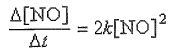
8. The reaction 2NO → N₂ + O₂ has the following rate law:
After a period of 2.0 × 10³ s, the concentration of NO falls from an initial value of 2.8 × 10⁻³ mol/L to 2.0 × 10⁻⁴ mol/L. What is the rate constant, k? (A) 7.2 × 10⁻² M⁻¹/s (B) 1.7 × 10⁴ M⁻²/s (C) 4.0 × 10⁴ M⁻²/s (D) 4.0 × 10⁻⁷ M⁻¹/s (E) 3.6 × 10⁻² M⁻¹/s
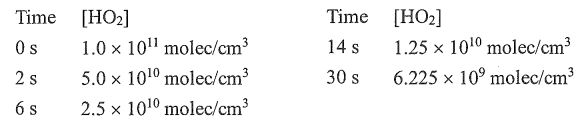
9. The following data were collected for the decay of HO₂ radicals.
Which of the following statements is true? (A) The decay of HO₂ occurs by a first-order process. (B) The half-life of the reaction is 2 ms. (C) A plot of ln[HO₂] versus time is linear with a slope of -k. (D) The rate of the reaction increases with time. (E) A plot of 1/[HO₂] versus time gives a straight line.
10. Which of the following best describes the lanthanide contraction? (A) f-orbitals are more directional than d-orbitals and therefore less effective at screening nuclear charge (B) f-orbitals are more diffuse than d-orbitals and therefore less effective at screening nuclear charge (C) the increase in atomic and ionic radii as one goes from left to right across the lanthanides (D) a and c (E) b and c
11. According to crystal field theory, how many unpaired electrons are present in the complex ion [Fe(H₂O)₆]²⁺? The water molecules are weak field ligands. (A) 1 (B) 2 (C) 3 (D) 4(E) 5
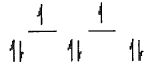
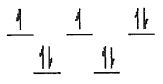
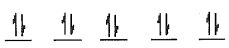
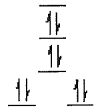
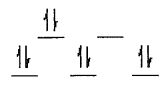
12. A complex ion is a square planar complex. It has a d⁸ electron configuration. What is the most reasonable d orbital scheme for this complex? (A)
(B)
(C)
(D)
(E)
13. Helium effuses through a small opening at a rate of 1×10⁻⁹ mol s⁻¹. An unknown gas at the same temperature and pressure is found to effuse through the same opening at a rate of 3.78×10⁻¹⁰ mol s⁻¹. What is the molecular mass of the unknown gas? (A) 4 g mol⁻¹ (B) 14 g mol⁻¹ (C) 18 g mol⁻¹ (D) 28 g mol⁻¹ (E) 40 g mol⁻¹
14. Aluminum metal crystallizes in a face-centered cubic structure. What is the relationship between the radius of an Al atom (r) and the length of an edge of the unit cell ( E )? (A) r = E/2 (B) r = E/
(C) r = (
/4)E (D) r = 2E (E) r = 4E
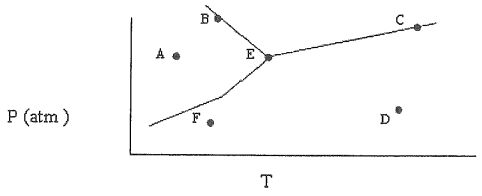
15. Based on the phase diagram shown below, which of the following statements are correct?
I. Sublimation occurs at a point in the transformation that falls along a straight line from point A to point F.
II. C and E represent points where the gas and liquid phases are in equilibrium.
III. ΔH
vap
can be measured at point B.
IV. Molecules at point D have a greater average kinetic energy than those at point F.
V. The temperature at point E is called the critical temperature of the compound.
(A) II, V (B) I, III, IV (C) I, II, III (D) II, IV, V (E) I, II, IV
16. A mixture of solid NaCl and CaCl₂ contains 10.0 g of NaCl, and an unknown amount of CaCl₂. When the entire mixture is dissolved in 1.00 kg of water, the boiling point changes by 0.25 °C. What mass of CaCl₂ was in the original mixture? Kb for water is 0.512 K·kg mol⁻¹. (A) 5.4 g (B) 8.1 g (C) 35.2 g (D) 21.6 g (E) 17.6 g
17. Acetone (mw = 58.08,
= 232 mmHg) and butanone (mw = 72.11,
= 100 mmHg) have the indicated molar masses and vapor pressures. A container holds 1.00 kg of butanone. How much acetone must be added to the butanone to elevate the total vapor pressure over the mixture to 125 mmHg at 25°C? (A) 5.313 kg(B) 290 g(C) 188 g (D) 288 g(E) 94 g
18. The constant pressure heat capacity (c
p
) generally increases with (A) the mass of the molecule (B) the internal degrees of freedom in the molecule (C) the number of atoms in the molecule (D) b and c (E) a and c
19. Which statement is true of a process in which 1 mol of a gas is expanded from state A to state B? (A) When the gas expands from state A to state B, the surroundings are doing work on the system. (B) The amount of work done in the process must be the same, regardless of the path. (C) It is not possible to have more than one path for a change of state. (D) The final volume of the gas will depend on the path taken. (E) The amount of heat released in the process will depend on the path taken.
20. Which of the following coordination compounds will form a precipitate when treated with an aqueous solution of AgNO₃? (A) [Cr(NH₃)₃Cl₃] (B) [Cr(NH₃)₆]Cl₃ (C) [Cr(NH₃)Cl]NO₃ (D) Na₃[Cr(CN)₆] (E) Na₃[CrCl₆]
複選題
21. Which of the following statements about the CO
3
2-
ion is false? (A) The orbitals on the carbon atom are sp² hybridized. (B) The ion is expected to be diamagnetic. (C) One C-O bond is shorter than the others. (D) The ion has a total of 24 electrons. (E) It has a planar molecular geometry.
22. Solid KF has a lattice energy of -804 kJ/mol and a heat of solution (in water) of -15 kJ/mol. RbF has a lattice energy of -768 kJ/mol and a heat of solution (in water) of -24 kJ/mol. Which salt forms stronger attractions with water? (A) KF, because it has a more exothermic lattice energy (B) RbF, because it has a less exothermic lattice energy (C) KF, because it has a more negative heat of hydration (D) RbF, because it has a more negative heat of hydration (E) They form equally strong attractions with water, because they both have negative heats of mixing.
23. Calculate the total number of unpaired electrons in the following complex ions: [Zn(H
2
O)
6
]
2+
, [NiCN
4
]
2-
(square planar), [Co(NH
3
)
6
]
3+
(strong field). (A) 0 (B) 1 (C) 2 (D) 3 (E) 4
24. According to the VSEPR model, the electron pairs around NH
3
and those around CH
4
are arranged (A) differently, because in each case there are a different number of atoms around the central atom. (B) differently, because in each case there are a different number of electron pairs around the central atom. (C) the same, because both nitrogen and carbon are in the second period. (D) the same, because in each case there are the same number of electron pairs around the central atom. (E) differently or the same, depending on the conditions leading to maximum repulsion.
25. For the reaction below, Kp = 1.16 at 700.°С.
CaCO
3
(s)
CaO(s) + CO
2
(g)
If a 24.6-g sample of CaCO
3
is put into a 14.2-L container and heated to 700.°C,
what percent of the CaCO
3
will react to reach equilibrium? (A) 36.9% (B) 83.9% (C) 20.6% (D) 100% (E) 67.0%
26. Calculate [H
+
] in a 0.40 M solution of NaH
2
PO
4
. (For H
3
PO
4
, K
al
= 7.5 × 10
-3
, K
a2
= 6.2 × 10
-8
, K
a3
= 4.8 × 10
-13
) (A) 2.2 × 10
-5
M (B) 1.6 × 10
-4
M (C) 0.40 M (D) 2.5 × 10
-4
M (E) 3.9 × 10
-11
M
27. Silver acetate (AgC
2
H
3
O
2
) is a sparingly soluble salt with K
sp
= 1.9 × 10
-3
. Consider a saturated solution in equilibrium with the solid salt. Compare the effects on the solubility of adding to the solution either the acid HNO3 or the base NH3. (A) Either substance would decrease the solubility. (B) NH3 would increase the solubility, but HNO
3
would decrease it. (C) NH
3
would increase the solubility, but HNO
3
would have virtually no effect. (D) Either substance would increase the solubility. (E) NH
3
would decrease the solubility, but HNO
3
would increase it.
28. The reduction potentials for Au³+ and Ni
2+
are as follows:
Au
3+
+ 3e → Au E° = +1.50 V
Ni
2+
+ 2e
-
→ Ni E°=-0.23 V
Calculate AG° (at 25°C) for the reaction
2Au
3+
+ 3Ni→ 3Ni
2+
+ 2Au (A) -5.00 × 10
2
kJ (B) +5.00 × 10
2
kJ (C) -2140 kJ (D) +1.00 × 10
3
kJ (E) -1.00 × 10
3
kJ
29. Which statement is true of a process in which 1 mol of a gas is expanded from state A to state B? (A) When the gas expands from state A to state B, the surroundings are doing work on the system. (B) The amount of work done in the process must be the same, regardless of the path. (C) It is not possible to have more than one path for a change of state. (D) The final volume of the gas will depend on the path taken. (E) The amount of heat released in the process will depend on the path taken.
30. An ethyl group (CH
3
CH
2
¯) that is attached to a substituent that does not contain a hydrogen atom appears as what in a NMR spectrum? (A) a doublet and a triplet with relative intensities of 2 and 3, respectively (B) a doublet and a triplet with relative intensities of 3 and 2, respectively (C) a triplet and a quartet with relative intensities of 2 and 3, respectively (D) a triplet and a quartet with relative intensities of 3 and 2, respectively (E) none of these
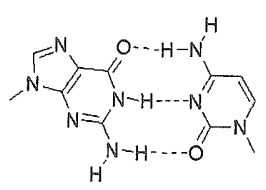
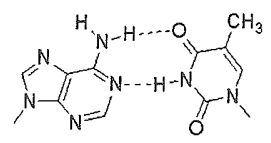
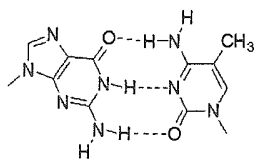
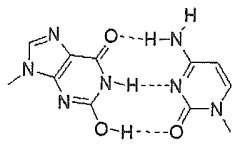
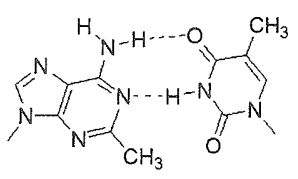
31. Which base-pair is most stable in Watson-Crick DNA Structure? (Image of base pairs) (A)
(B)
(C)
(D)
(E)
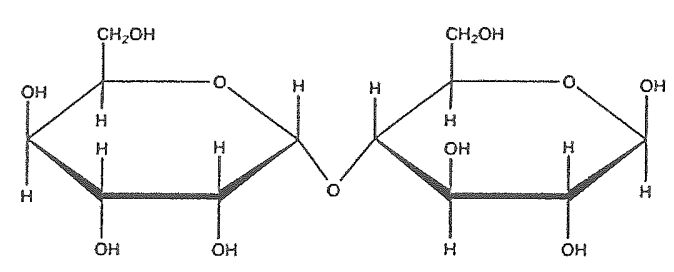
32. The following is a(n) ____ disaccharide with a(n) ____ glycosidic bond. (Image of disaccharide)
(A) α; β(1→4) (B) α; β(1→1) (C) β; α(1→4) (D) β; α(1→1) (E) β; β(1→4)
33. If the following mixture of proteins was applied to a size-exclusion chromatography column, what would be the order of elution?
Proteins with molecular weights: myoglobin (17.7 kDa), hemoglobin (64.5 kDa), lysozyme (14.3 kDa) and triose phosphate isomerase (57.4 kDa) (A) lysozyme, myoglobin, triose phosphate isomerase, hemoglobin (B) triose phosphate isomerase, hemoglobin, lysozyme, myoglobin (C) hemoglobin, myoglobin, lysozyme, triose phosphate isomerase (D) hemoglobin, triose phosphate isomerase, myoglobin, lysozyme, (E) cannot be determined
34. What is the net charge of the pentapeptide Ala-Cys-Ser-Glu-Asn at pH 7? (A) -2 (B) -3 (C) 0 (D) +1 (E) +2
35. The pKa's of arginine's a-Carboxyl group, α-Amino group and side chain are 1.8, 9.0 and 12.5, respectively. Calculate the isoelectric point. (A) 7.8 (B) 7.2 (C) 10.8 (D) 5.4 (E) 10.0
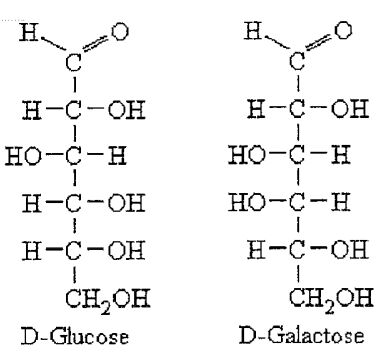
36. The Fischer projections of linear D-glucose and D-galactose are shown below. These two molecules are ____.
(Image of D-glucose and D-galactose) (A) epimers (B) enantiomers (C) anomers (D) structural (constitutional) isomers (E) same compound
37. Consider the following four compounds:
Which of these compounds would have the same physical properties (melting point, boiling point, density, and so on)? (A) I and II (B) I and III (C) II and III (D) III and IV (E) I and IV
38. Radioactive elements decay via first-order kinetics. Consider a certain type of nucleus that has a rate constant of 1.6 × 10⁻² h¯¹. A sample contains 7.9 × 10
8
radioactive nuclides. Calculate the time required for 63% of the nuclides to decompose. (A) 2.9 x 10¹ h (B) 2.7 x 10¹ h (C) 1.3 x 10¹ h (D) 6.2 x 10¹ h (E) 1.3 x 10¯¹ h
39. Consider the following complexes:
I. Pt(NH
3
)
2
Cl
2
(square planar)
II. Rh(en)
3
2+
(en = H
2
N-CH
2
-CH
2
-NH
2
and is bidentate)
III. CoC1
4
2-
(tetrahedral)
Which can exhibit cis-trans isomerism? (A) I (B) II (C) III (D) I, II (E) I, II, III
40. Thyroxine, an important hormone that controls the rate of metabolism in the body, can be isolated from the thyroid gland. If 0.455 g of thyroxine is dissolved in 10.0 g of benzene, the freezing point of the solution is 5.144°C. Pure benzene freezes at 5.444°C and has a value for the molal freezing-point-depression constant of Kf of 5.12°C/m. What is the molar mass of thyroxine? (A) 777,000 g/mol (B) 777 g/mol (C) 2330 g/mol (D) 285 g/mol (E) 3760 g/mol
申論題 (0)
相關試卷
115年 - 115 高雄醫學大學_學生轉系考試試題:普通化學#146461
115年 · #146461
115年 - 115 國立嘉義大學_轉學生招生考試試題_應用化學系:普通化學#143922
115年 · #143922
115年 - 115 國立嘉義大學_轉學生招生考試試題_獸醫學系:普通化學#143851
115年 · #143851
115年 - [無官方正解]115 國立臺灣大學_轉學生招生考試:普通化學(C)#142702
115年 · #142702
115年 - 115 台灣聯合大學系統_學士班轉學生考試試題_A1:普通化學#142701
115年 · #142701
115年 - 115 台灣聯合大學系統_學士班轉學生考試試題_A6:普通化學#142699
115年 · #142699
115年 - [無官方正解]115 國立臺灣大學_轉學生招生考試:普通化學(A)#142644
115年 · #142644
114年 - 114 臺北醫學大學_寒假轉學入學考試試題:普通化學#145030
114年 · #145030
114年 - 114 國立嘉義大學_轉學生招生考試試題:普通化學#143941
114年 · #143941
114年 - 114 國立嘉義大學_轉學生招生考試試題_獸醫學系:普通化學#143721
114年 · #143721
 阿摩線上測驗
登入
 (B)
 (C)
 (D)
 (E)
 (B)
 (C)
 (D)
 (E)
 (C) r = (
 /4)E (D) r = 2E (E) r = 4E
 (A) II, V (B) I, III, IV (C) I, II, III (D) II, IV, V (E) I, II, IV
 = 232 mmHg) and butanone (mw = 72.11,
 CaO(s) + CO2(g)
 (B)
 (C)
 (D)
 (E)
 (A) α; β(1→4) (B) α; β(1→1) (C) β; α(1→4) (D) β; α(1→1) (E) β; β(1→4)
 (Image of D-glucose and D-galactose) (A) epimers (B) enantiomers (C) anomers (D) structural (constitutional) isomers (E) same compound
