所屬科目:研究所、轉學考(插大)-近代物理學
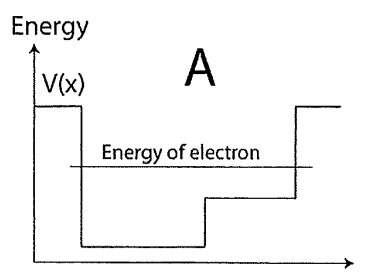
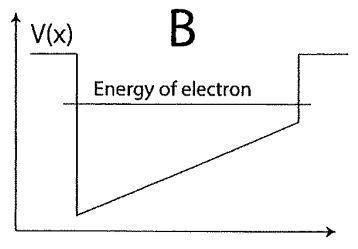
Problem 1What physical situation (in one dimension) does the following time-dependent Schrödinger equationdescribe?where k and e are real, non-zero constants.(A)A particle traveling up a ramp along the x-axis.(B) A particle in a finite square well potential.(C) A particle in an infinite square well potential.(D) An electron moving along the x-axis in the electric field of a proton at x=0.(E) None of the above.
Problem 2Find the correct statement:(A) The Fermi-Dirac distribution can be used to in the analysis of the properties of photons.(B) The peak wavelength of blackbody radiation is inversely proportional to temperature (1/T).(C) The spin of a photon is 1/2.(D) In a quantized system, each quantum state can only contain one photon.(E) At room temperature, the average kinetic energy of gas molecules is proportional to T2.
Problem 3Consider electron states of a particle in a finite quantum well, with the potential energy V(x) definedby V(0 <x < W) = 0 in the well and V(x) = V0 > 0 outside the well. Which of the statements is CORRECT?(A) An eigenstate in this case always describes a bound state in space.(B) The first excited state has an energy E1 with E1 < Vo always.(C) The wave function of ground state can sometimes oscillate with nodal points where the wave function vanishes.(D) For any bound eigenstate in the system, the probability density is nonvanishing in the well and vanishing outside the well.(E) None of the above.
Problem 4Which quantum number (n, l, mi, ms) is not a possible set of a 2p electron?(A) (2, 1, +1, +1/2)(B) (2, 1, +1, -1/2)(C) (2, 1, 0, +1/2)(D) (2, 0, -1, +1/2)(E) (2, 1, -1, -1/2)
Problem 5According to band theory, beryllium, an alkaline earth metal, is predicted to behave as an insulator.However, it acts as a conductor due to:(A) The presence of a half-filled 2s band.(B) The overlap between the filled 2s band and the empty 2p band.(C) The presence of an empty 2p band.(D) The overlap between the filled 2p band and the empty 3s band.(E) The presence of a half-filled 3s band.
Problem 6 Consider the transmission of an incident electron with energy E through the one dimensional step potential barrier V(x) with V(x < 0) = 0 outside the barrier, and V(x > 0) = Vo in the barrier (V0 > 0). Which of the following statements is CORRECT about the transmission coefficient T? (A) If the incident electron comes from x = +infinity, with E> V0,then the corresponding T = 1. (B) If the incident electron comes from x = - infinity, with E >V0, then the corresponding T = 1. (C) If the incident electron comes from x = - infinity, with E<V0, then it has a nonvanishing probability in the barrier as well as T > 0 due to quantum tunneling. (D) Replace V(x) by a potential barrier of finite width, with V(0 < x <W) = Vo in the barrier and V(x) = 0 outside the barrier. An incident electron with E<V0 has T > 0 due to quantum tunneling. (E) None of the above.
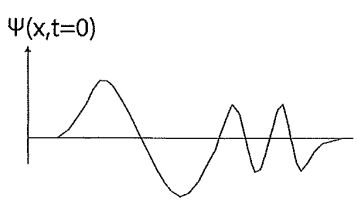
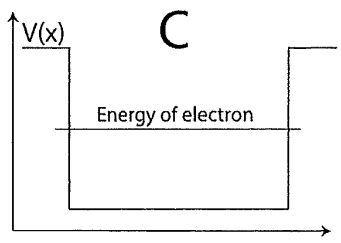
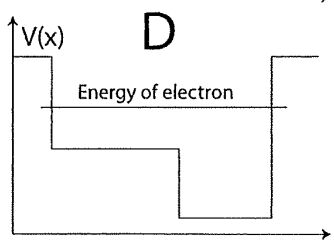
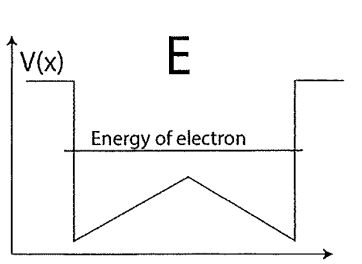
Problem 7An electron is bound in a potential well. The wave function of the electron is:Y(x,t) = v(x)e-iEtn, where φ(x) is shown as below and E is a real number. Which one ofthe following potential wells would fit best to this wave function?(A)(B)(C)(D)(E)
Problem 8 A one-dimensional infinite potential well locating between -0.5 nm to 0.5 nm and contains 10 electrons. It has 10 electrons inside. What is the least energy, in eV, the incident light must have in order to excite a ground-state electron (i.e., at the lowest n quantum value) in this system to the lowest higher state it can occupy when T=0? (A) ~8.7 eV, (B) ~13.6 eV, (C) ~5.61 eV, (D) ~13.2 eV, (E) ~44.9 eV.
Problem 9In Bohr's hydrogen model, if the Coulomb interaction between the electron and the nucleus changes to a power-law potential: V(r) = krN, where k and N are positive constants. Applying Bohr's hypothesis to calculate the energy of hydrogen atom, the energy will be proportional to the quantumnumber n as(A)(B) (C)(D) , and (E) n-2.
Problem 10Which one of the following statements about free bosons, fermions, and classical particles is correct?(A) Bosons possess integer spin and follow the Maxwell-Boltzmann distribution in the low-temperature regime.(B) Fermions are indistinguishable particles that obey the Pauli exclusion principle and follow the FermiDirac distribution in all temperature range.(C) Classical particles can either be distinguishable or indistinguishable depending on the type of atoms or particles.(D) In the low-temperature limit, bosons and fermions cannot occupy the same quantum state, in contrast to classical particles.(E) In Bose-Einstein condensation, particles follow the Bose-Einstein distribution, with most particles occupying either the same excited state or the ground state. This phenomenon can be observed macroscopically.
Problem 11Which of the following statements are correct?(A) A light source with a shorter wavelength could have improved the sensitivity in the MichelsonMorley experiment.(B) In an inertial frame S, if event A occurs prior to event B, then in any inertial frame, event A must occur prior to event B.(C) The twin paradox showed that the twin who returned to Earth was younger than the twin who stayed at home.(D) The Galileo transformations are consistent with Einstein's postulates of relativity.(E) It is possible for the electron beam in a television picture tube to move across the screen at a speed faster than the speed of light.
Problem 12Consider the ground state of an Al atom with Z=13. Find the correct descriptions:(A) The electron configuration is: 1s2 2s2 2p6 2d³.(B) The magnitude of the angular momentumh.(C) The magnitude of the sin angular momentums is (D) The magnitude of the total angular momentumcan be(E) The magnitude of the total angular momentumcan be
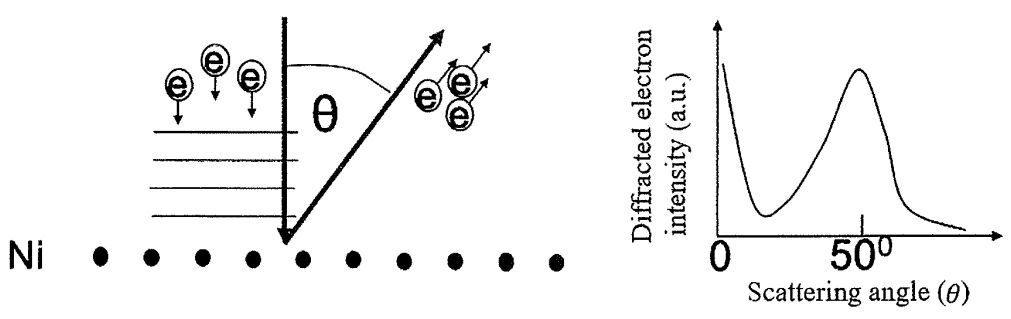
Problem 13:Here is the Davisson and Germer experiment, illustrating electron diffraction from a Ni crystal.Which of the following modifications can increase the diffraction angle?(A) Increase the electron velocity.(B) Decrease the electron velocity.(C) Keep the same velocity but replace the electron with an alpha particle (He+).(D) It is not possible to change the diffraction angle.(E) Use a crystal with a smaller lattice spacing (more dense periodic structure).
Problem 14Which of the following statements are correct regarding Bohr's theory, the Franck-Hertz experiment, and Rutherford's atomic model? (A) In the Franck-Hertz experiment, the accelerating voltage exhibits sudden drops at multiples of 4.9 volts. The energy levels of 4.9 volts and 9.8 volts correspond to transitions to the ground state and the first excited state of mercury atoms, respectively. (B) In Bohr's theory, energy is assumed to be quantized, meaning that the quantum state of a hydrogen atom can only occupy specific, discrete energy levels. (C) Rutherford's atomic model is inconsistent with Maxwell's equations, as accelerating charged particles, such as orbiting electrons, would radiate electromagnetic waves. Consequently, electrons would lose energy and spiral into the atomic nucleus. (D)In Bohr's theory, the relativistic effects on the electron can be negligible. (E) According to Bohr's model, the ratio of the electron's speed in the second excited state to its speed in the fifth excited state is exactly 2.
Problem 15 Which of the following statements are correct? (A) For a collection of hydrogen atoms in the ground state illuminated by ultraviolet light of wavelength 59.0 nm, the kinetic energy of the emitted electrons is 21.0 eV, neglecting a small recoil kinetic energy imparted to the proton. (B) For protons incident on a copper foil 5-µm thick, the proton kinetic energy required to achieve a distance of closest approach of 5.0 fm is about 8.4 meV. (C) The velocity of electron in the n = 3 state of hydrogen is 730 km/s. (D) The shortest wavelength of the Lyman series of singly ionized helium is 22.8 nm. (E) According to Bohr's correspondence principle, the quantum distributions approach the classical distribution when n is large.
Problem 16 It is rational to assume that each copper atom contributes one free electron to the electron gas. While the density of copper is 8.94 × 10³ kg/m³ and its atomic mass is 63.5 u. Please find the correct description below: (A) Formation of the Fermi energy in metals is associated with the fact that electrons are Bosons. (B) The Fermi energy is~7.0 eV. (C) The average electron energy at T = 0 is ~4.2 eV. (D) The average electron energy at T = 0 is 0 eV. (E) Free electrons in cooper don't significantly contribute to the specific heat.
Problem 17 Which of the statements are CORRECT about a particle confined in the 1D infinite potential well V(x) with V(x) = 0 in the well (with well width = W). (A) The ground state energy aligns with the bottom of the well. (B) For the first excited state, the uncertainty in the position is of the order of W. (C) Let 1 = wavelength of the ground state standing wave. Then I is of the order of W. (D) Let p = momentum of the ground state. The p is of the order of 'h/W, with the uncertainty in p being of the same order as p (h = Planck constant). (E) None of the above.
Problem 18Which of the following descriptions are true regarding blackbody radiation, the photoelectric effect, and theoretical models for the specific heat of solids? (A) The energy density spectra of blackbody radiation are independent of the material composition and the shape of the object forming the blackbody. Moreover, a blackbody is not necessarily black in color. (B) In the Rayleigh-Jeans formula, the average energy of electromagnetic (EM) standing waves inside a blackbody was calculated using the equipartition principle, which is incorrect. Additionally, the number of standing waves per frequency is also inaccurate. (C) In the high-temperature limit, the specific heat of solids, as predicted by Einstein's and Debye's models, approaches the classical limit of 3R, where R is the universal gas constant. However, in the low-temperature limit, Einstein's model overestimates the specific heat. (D) Based on Einstein's photon hypothesis, EM waves can be treated as particles whose energy is proportional to their frequency and particle number. Consequently, the energy of EM standing waves inside a blackbody is quantized, which explains the physical origin of Planck's blackbody radiation formula. (E) In the photoelectric effect, the stopping voltage is independent of the intensity of the incident EM wave but depends on its frequency f. The photoelectric current increases with increasing EM wave intensity as long as hf exceeds a certain threshold, where h is Planck's constant.
Problem 19Which of the following statements for a p-n diode are correct? (A) Under the unbiased condition, the Fermi levels in p and n regions are aligned. (B) When no voltage is applied, the thermal electron current and the recombination electron current have the same magnitude but flow in opposite directions, resulting in no net current. (C) Under reverse bias, the recombination current is less than the thermal electron current. (D) When a positive voltage is applied to the p-side, the conventional current flows in the same direction as the electron current. (E) The photon energy emitted by a light-emitting diode corresponds to the energy gap during the transition of carrier under forward bias.
Problem 20 Which of the following statements are CORRECT about energy quanta? (A) Energy quanta of EM waves also carry momentum. (B) Energy of crystal vibrations is continuous or discontinuous depending on the crystal temperature T. (C) Crystal vibrations with high frequencies f>> kBT/ h carry many energy quanta (called phonons). (D) Crystal vibrations with low frequencies f<< kBT/ h carry many energy quanta. (E) None of the above.
 阿摩線上測驗
登入

 (A)
 (B)
 (C)
 (D)
 (E)
 (B)
 (C)
 (D)
 , and (E) n-2.
 h.

 can be

 can be