所屬科目:學士後◆化學
1. In a cathode ray tube (A) electrons pass from the anode to the cathode (B) electrons pass from the cathode to the anode (C) protons pass from the anode to the cathode (D) protons pass from the cathode to the anode
2. Which of the following elements is most likely to be a good conductor of electricity? (A) N (B) S (C) He (D) Fe
3. The scientist who determined the magnitude of the electric charge of the electron was (A) John Dalton (B) Robert Millikan (C) J. J. Thomson (D) Ernest Rutherford
4. Which of the following scientists developed the nuclear model of the atom? (A) John Dalton (B) Robert Millikan (C) J. J. Thomson (D) Ernest Rutherford
5. Which pair of elements would be most likely to form an ionic compound? (A) P and Br (B) Zn and K (C) F and Al (D) C and S
6. Identify the major ionic species present in an aqueous solution of K2SO4. (A) K2+, S6+, O48– (B) K2+, S6+, 4O2– (C) 2K+, S6+, 4O2– (D) 2K+, SO42–
7. Based on the solubility rules, which one of the following compounds should be insoluble in water? (A) AgBr (B) ZnCl2 (C) MgBr2 (D) NaCl
8. Based on the solubility rules, which one of the following should be soluble in water? (A) (NH4)3PO4 (B) Ca3(PO4)2 (C) AlPO4 (D) Ag3PO4
9. Based on the solubility rules, which of the following will occur if solutions of CuSO4(aq) and BaCl2(aq) are mixed? (A) CuCl2 will precipitate; Ba2+ and SO42 – are spectator ions (B) CuSO4 will precipitate; Ba2+ and Cl – are spectator ions (C) BaSO4 will precipitate; Cu2+ and Cl– are spectator ions (D) BaCl2 will precipitate; Cu2+ and SO42 – are spectator ions
10. The common constituent in all acid solutions is (A) H2 (B) H+ (C) OH– (D) H2SO4
11. The oxidation number of S in K2SO4 is (A) +6 (B) +4 (C) +2 (D) –1
12. In the following redox reaction 4NH3 + 3Ca(ClO)2 → 2N2 + 6H2O + 3CaCl2 which element is oxidized and which is reduced? (A) H is oxidized and N is reduced (B) N is oxidized and Cl is reduced (C) N is oxidized and O is reduced (D)Cl is oxidized and O is reduced
13. A 50.0 mL sample of 0.436 M NH4NO3 is diluted with water to a total volume of 250.0 mL. What is the ammonium nitrate concentration in the resulting solution? (A) 21.8 M (B) 0.459 M (C) 2.18 × 10⁻² M (D) 8.72 × 10⁻² M
14. 17.5 mL of a 0.1050 M Na2CO3 solution is added to 46.0 mL of 0.1250 M NaCl. What is the concentration of sodium ion in the final solution? (A) 0.205 M (B) 0.119 M (C) 0.539 M (D) 0.148 M
15. A 250. mL sample of 0.0328M HCl is partially neutralized by the addition of 100. mL of 0.0245M NaOH. Find the concentration of hydrochloric acid in the resulting solution. (A) 0.00700 M (B) 0.0164 M (C) 0.0383 M (D) 0.0230 M
16. 1.40 g of silver nitrate is dissolved in 125 mL of water. To this solution is added 5.00 mL of 1.50M hydrochloric acid, and a precipitate forms. Find the concentration of silver ions remaining in solution. (A) 5.7 × 10⁻³ M (B) 6.34 × 10⁻² M (C) 5.77 × 10⁻² M (D) 0.121M
17. An exothermic reaction causes the surroundings to (A)warm up (B) become acidic (C) expand (D) decrease its temperature
18. Which of the following processes is endothermic? (A) O2(g) + 2H2(g) → 2H2O(g) (B) H2O(g) → H2O(l) (C) 3O2(g) + 2CH3OH(g) → 2CO2(g) + 2H2O(g) (D) H2O(s) → H2O(l)
19. To which one of the following reactions occurring at 25°C does the symbol △H°f[H2SO4(l)] refer? (A) 2H(g) + S(g) + 4O(g) → H2SO4(l) (B) H2(g) + S(g) + 2O2(g) → H2SO4(l) (C) H2SO4(l) → H2(g) + S(s) + 2O2(g) (D) H2(g) + S(s) + 2O2(g) → H2SO4(l)
20. When 0.560 g of Na(s) reacts with excess F2(g) to form NaF(s), 13.8 kJ of heat is evolved at standard-state conditions. What is the standard enthalpy of formation (△H°f) of NaF(s)? (A) 24.8 kJ/mol (B) 570 kJ/mol (C) –24.8 kJ/mol (D) –570 kJ/mol
21. Find the standard enthalpy of formation of ethylene, C2H4(g), given the following data: heat of combustion of C2H4(g) = –1411 kJ/mol; △H°f[CO2(g)] = –393.5 kJ/mol; △H°f[H2O(l)] = –285.8 kJ/mol. (A) 52 kJ/mol (B) 87 kJ/mol (C) 731 kJ/mol (D) 1.41 × 10³ kJ/mol
22. Calculate the standard enthalpy change for the reaction 2C8H18(l) + 17O2(g) → 16CO(g) + 18H2O(l). Given: 2C8H18(l) + 25O2(g) → 16CO2(g) + 18H2O(l) △H° = –11,020 kJ/mol 2CO(g) + O2(g) → 2CO2(g) △H° = –566.0 kJ/mol (A) 10,450 kJ/mol (B) 6,492 kJ/mol (C) 15,550 kJ/mol (D) –6,492 kJ/mol
23. Given the thermochemical equation 2SO2 + O2 → 2SO3, △H°rxn = –198 kJ/mol, what is the standard enthalpy change for the decomposition of one mole of SO3? (A) 198 kJ/mol (B) –99 kJ/mol (C) 99 kJ/mol (D) 396 kJ/mol
24. Which of the following processes always results in an increase in the energy of a system? (A) The system loses heat and does work on the surroundings. (B) The system gains heat and does work on the surroundings (C) The system loses heat and has work done on it by the surroundings. (D) The system gains heat and has work done on it by the surroundings.
25. For which of these reactions will the difference between △H° and △E° be the greatest? (A) 2H2O2(l) → 2H2O(l) + O2(g) (B) CaCO3(s) → CaO(s) + CO2(g) (C) NO(g) + O3(g) → NO2(g) + O2(g) (D) 2C2H6(g) + 7O2(g) → 4CO2(g) + 6H2O(l)
26. The elements in Group 2A are known by what name? (A) transition metals (B) halogens (C) alkali metals (D) alkaline earth metals
27. The general electron configuration for atoms of all elements in Group 5A is (A) ns2np6 (B) ns2np5 (C) ns2np4 (D) ns2np3
28. In what row and group of the periodic table would you find the element with the electron configuration [Kr]5s24d105p2? (A) row 4, group 4A (B) row 4, group 5A (C) row 5, group 4A (D) row 5, group 5A
29. Which of the following make an isoelectronic pair: Cl– , O2–, F, Ca2+, Fe3+? (A) Ca2+ and Fe3+ (B) O2– and F (C) F and Cl– (D) Cl– and Ca2+
30. Which one of the following pairs are isoelectronic? (A) Mn2+ and Ar (B) Zn2+ and Cu2+ (C) Na+ and K+ (D) K+ and Cl–
31. The cobalt(III) ion, Co3+, has how many 3d electrons? (A) 0 (B) 7 (C) 6 (D) 5
32. The successive ionization energies of a certain element are I1 = 589.5 kJ/mol, I2 =1145 kJ/mol, I3= 4900 kJ/mol, I4 = 6500 kJ/mol, and I5 = 8100 kJ/mol. This pattern of ionization energies suggests that the unknown element is (A) K (B) Si (C) As (D) Ca
33. Which of the following elements has the greatest electron affinity (largest positive value)? (A) Mg (B) Al (C) Si (D) P
34. Consider the following reaction 2A + 3F2 → 2AF3. What is the formula for the reaction product if we substitute iodine for fluorine? (A) A2I3 (B) A3I2 (C) AI3 (D) A3I
35. Give the number of lone pairs around the central atom and the molecular geometry of XeF4. (A) 0 lone pairs, tetrahedral (B) 1 lone pair, distorted tetrahedron (seesaw) (C) 1 lone pair, square pyramidal (D) 2 lone pairs, square planar
36. According to the VSEPR theory, the geometry of the SO3 molecule is (A)pyramidal (B)tetrahedral (C)trigonal planar (D)distorted tetrahedron (seesaw)
37. According to VSEPR theory, which one of the following species has a tetrahedral geometry? (A) IF4+ (B) IF4– (C) PCl4+ (D) PCl4–
38. The bond angle in Cl2O is expected to be approximately (A) 90°. (B) 109.5° (C) 120° (D) 145°
39. Indicate the type of hybrid orbitals used by the central atom in BrF3. (A) sp (B) sp2 (C) sp3 (D) sp3d
40. The number of pi bonds in the oxalate ion (C2O42–) is (A) 1 (B) 2 (C) 3 (D) 4
41. Which of the following molecular changes is necessary for mass spectrometry to occur? (A) excitation of an electron from the ground state to higher energy state (B) change of alignment of an electron in a magnetic field (C) change of alignment of a proton in a magnetic field (D) loss of an electron
42. Which of the following m/z values is the molecular ion for 2-butanone? (A) 29 (B) 43 (C) 57 (D) 72
43. Which of the following statements best explains the information we can gain from mass spectrometry? (A) It allows us to determine the number of protons in a compound. (B) It allows us to determine the kinds of functional groups in a compound. (C) It allows us to determine the molecular weight and the mass of some fragments of a compound. (D) It allows us to determine the presence and nature of a carbocation in the compound.
44. What m/z value would you predict for the most stable fragment peak in the mass spectrum of 4-ethylheptane? (A) 128 (B) 127 (C) 113 (D) 99
45. Which of the following is not a major peak in the MS of isopentane? (A) 29 (B) 43 (C) 57 (D) 60
46. Which of the following statements best explains how a hydrocarbon can show an M+2 peak in mass spectrometry? (A) from 13C and 1H (B) from 12C and 2H (C) from a single 3H (D) from two 13C's
47. Which of the following characterizes the unusually intense peak of alkyl chlorides in MS spectrometry? (A) M + 1 peak (B) M + 2 peak (C) base peak (D) parent peak
48. Which compound's mass spectrum shows peaks at M, M+2, and M+4 whose abundances are in a ratio of 1:2:1? (A) chlorocyclohexane (B) 1,2-dichlorocyclohexane (C) 1-bromopentane (D) 1,5-dibromopentane
49. Which of the following m/z values is the base peak for benzyl alcohol? (A) 77 (B) 108 (C) 91 (D) 17
50. Which of the following compounds exhibits the pattern of m/z values shown below? 41, 43, 57, 87, 101, 116 (A) propyl bromide (B) isopropyl bromide (C) sec-butyl isopropyl ether (D) 2-hexanol
51. Which of the following is the base peak for the compound below? (A) 92 (B) 77 (C) 57 (D) 43
52. The mass spectra of alcohols often fail to exhibit detectable M peaks but instead show relatively large ________ peaks. (A) M+1 (B) M+2 (C) M-17 (D) M-18
53. An acylium ion is often produced as a fragment in the MS of which of the following class of organic compounds? (A) ketones (B) ethers (C) alkyl halides (D) alcohols
54. Give the ion that corresponds a m/z ratio of 31 in a mass spectrum of 1-butanol. (A) (B) (C) (D)
55. Give the ion that corresponds to a m/z ratio of 56 in a mass spectrum of 1-butanol. (A) (B) (C) (D)
56. Which of the following normally occurs in a molecule when a photon of infrared light is absorbed? (A) An electron moves to an orbital of higher potential energy (B) The vibration energy increases (C) An electron changes alignment in a magnetic field (D) The molecule gains an electron
57. In the electromagnetic spectrum, ________ frequencies, ________ wavenumbers, and ________ wavelengths are associated with high energy. (A) high, small, long (B) low, large, short (C) low, small, short (D) high, large, short
58. Which of the infrared regions is considered to be the fingerprint region? (A) 4000cm-1 - 1000cm-1 (B) 4000μm - 1000μm (C) 2200μm - 1000μm (D) 1000cm-1 - 400cm-1
59. Which of the infrared regions is considered to be the fingerprint region? (A) 4000cm-1 - 1000cm-1 (B) 1000cm-1 - 400cm-1 (C) 2200μm - 1000μm (D) 4000μm - 1000μm
60. Which of the following is not a common bending vibration of a CH2 group? (A) flip (B) rock (C) scissor (D) twist
61. Which molecule below has a significant band in the IR at 3400 cm-1 (strong and broad)? (A) CH3CH2CH2OH (B) CH3C≡CCH2CH3 (C) CH3CH2CH(NH2)CH3 (D) (CH3)3N
62. Which molecule below has a significant band in the IR at 2220 cm-1 (medium)? (A) CH3CH2CH2OH (B) CH3C≡CCH2CH3 (C) CH3CH2CH(NH2)CH3 (D) CH3CO2CH2CH3
63. Which molecule below has a significant band in the 1720 - 1780 cm-1 range of its IR spectrum? (A) CH3CH2CH2OH (B) CH3C≡CCH2CH3 (C) CH3CH2CH(NH2)CH3 (D) CH3CO2CH2CH3
64. Which of the following carbonyl groups exhibits the highest wavenumber in infrared spectroscopy? (A) I (B) II (C) III (D) IV
65. Which compound would be expected to show intense IR absorption at 2710 and 1705 cm-1? (A) CH3COCH2CH3 (B) PhCOCH3 (C) PhCHO (D) CH2=CHCOCH3
66. Which of the following functional groups typically exhibits a carbonyl stretch at the lowest frequency? (A) amide (B) ester (C) ketone (D) aldehyde
67. Which of the following species has a characteristic broad absorption at 3200-3500 cm-1 in its IR spectrum? (A) PhCH2CN (B) PhCH2N(CH3)2 (C) PhCH2CO2CH3 (D) PhCH2CH2OH
68. Which of the following carbon-hydrogen bonds exhibits the lowest wavenumber for a C-H stretch in infrared spectroscopy? (A) I (B) II (C) III (D) IV
69. Which compound would be expected to show intense IR absorption at 3300 cm-1? (A) CH3CCCH3 (B) butane (C) 1-butene (D) CH3CH2CCH
70. Which compound's carbonyl stretch occurs at the greatest wavenumber? (A) CH3CH2CH2CHO (B) CH3COCH2CH3 (C) CH3CH2CONH2 (D) CH3CH2CO2CH3
71. Which molecule below has two significant bands in the IR at 2720 cm-1 and 2820 cm-1 (medium)? (A) CH3COCH2CH (B) CH3CH2CO2CH3 (C) CH3CH2CH2CHO (D) CH2=CHCH2CH3
72. Which of the following compounds exhibits the highest λmax in UV spectra? (A) I (B) II (C) III (D) IV
73. Which of the following compounds absorbs the longest wavelength of UV-visible light? (A) -2-butene (B) 1-hexene (C) (Z)-1,3-hexadiene (D) -1,3,5-hexatriene
74. In the infrared spectrum, a compound of formula C4H8O gave an absorption band at 1720 cm-1, but no bands at 2720 - 2830 and 3400 cm-1. What is the compound? (A) 2-butanone (B) butanal (C) cis-2-butenol (D) trans-2-butenol
75. How many signals would you expect to see in the 1H NMR spectrum of the following compound? (A) 2 (B) 3 (C) 4 (D) 5
76. How many signals would you expect to see in the 1H NMR spectrum of the following compound? (A) 3 (B) 4 (C) 5 (D) 6
77. How many signals would you expect to see in the 1H NMR spectrum of the following compound? (A) 1 (B) 2 (C) 3 (D) 4
78. If a chemical shift of an NMR signal is 7.2 ppm measured in a 60 MHz NMR spectrometer, how many Hz would this signal be from the TMS signal? (A) 8.3 Hz (B) 432 Hz (C) 0.12 Hz (D) 72 Hz
79. Using a 60 MHz spectrometer, the protons in dichloromethane appear at 5.30 ppm. When the same sample is placed in a 100 MHz instrument, where does the signal appear? (A) 8.33 ppm (B) 3.18 ppm (C) 5.30 ppm (D) cannot be determined from information given
80. Which of the following methyl groups will exhibit the most downfield (highest) chemical shift in 1H NMR spectroscopy? (A) I (B) II (C) III (D) IV
 阿摩線上測驗
登入
阿摩線上測驗
登入
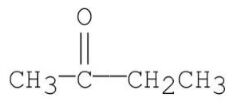 (A) 29 (B) 43 (C) 57 (D) 72
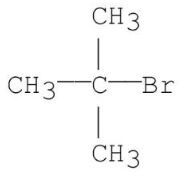 (A) 92 (B) 77 (C) 57 (D) 43
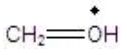 (B)
(B)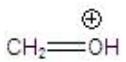 (C)
(C)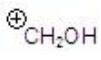 (D)
(D)
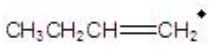 (B)
(B)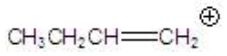 (C)
(C)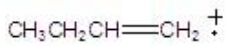 (D)
(D)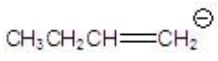
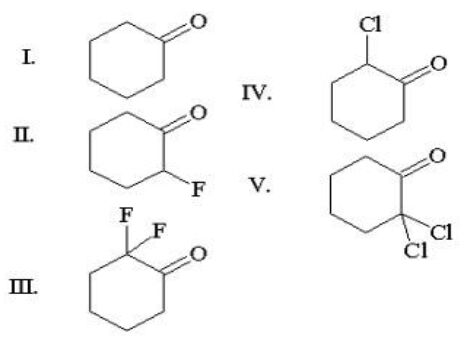 (A) I (B) II (C) III (D) IV
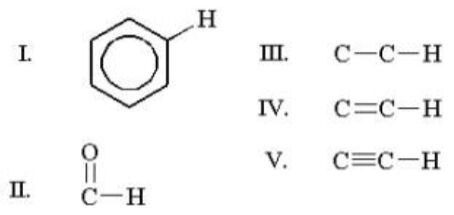 (A) I (B) II (C) III (D) IV
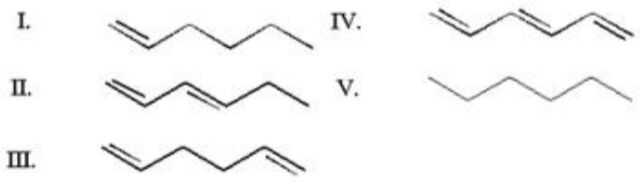 (A) I (B) II (C) III (D) IV
 -2-butene (B) 1-hexene (C) (Z)-1,3-hexadiene (D)
  -1,3,5-hexatriene
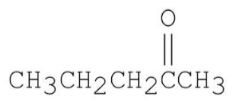 (A) 2 (B) 3 (C) 4 (D) 5
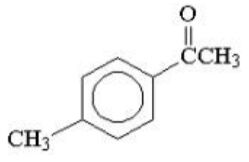 (A) 3 (B) 4 (C) 5 (D) 6
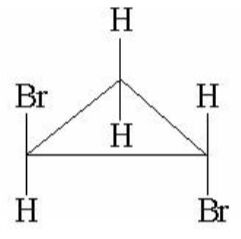 (A) 1 (B) 2 (C) 3 (D) 4
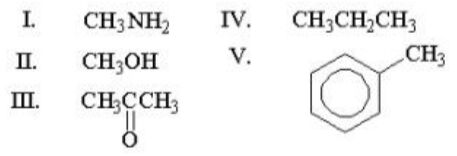 (A) I (B) II (C) III (D) IV