所屬科目:研究所、轉學考(插大)◆綜合化學
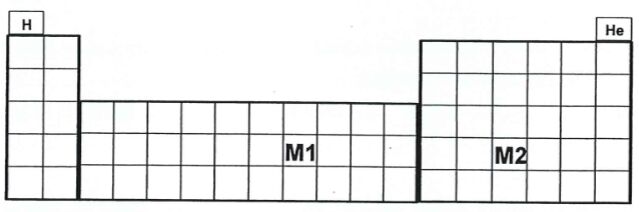
1. In the Periodic Table, what are the element symbols for M1 and M2?
(A) M1 is Ru, M2 is As (B) M1 is Rh, M2 is As (C) M1 is Ru, M2 is Sb (D) M1 is Rh, M2 is Sb (E) M1 is Pd, M2 is As
2. If the oxidation state of Cl in hypochlorous acid is a. The oxidation state of N in nitrous acid is b. Question, what is the sum of a+b? (A) 2 (B) 3 (C) 4 (D) 5 (E) 6
3. If the oxidation state of Rb in rubidium peroxide is c. The oxidation state of Cl in sodium hypochlorite is d. Question, what is the sum of c+d? (A) 2 (B) 3 (C) 4 (D) 5 (E) 6
4. Potassium chromate is produced by the reaction of solid chromite ore $(\mathrm{FeCr_2O_4})$ with solid potassium carbonate and gaseous oxygen at high temperatures. The other products of the reaction are solid iron(III) oxide and gaseous carbon dioxide. In a particular experiment $169~\mathrm{kg}$ of chromite ore, $298~\mathrm{kg}$ of potassium carbonate, and $150~\mathrm{kg}$ of oxygen were sealed in a reaction vessel and reacted at a high temperature.
a FeCr₂O₄ (s) + b K₂CO₃ (s) + c O₂ (g) → d K₂CrO₄ (s) + e Fe₂O₃ (s) + f CO₂ (g)
Which compound is the limiting reagent? (A) O₂ (B) K₂CO₃ (C) K₂CrO₄ (D) Fe₂O₃ (E) FeCr₂O₄
5. Continue from question 4, what is the yield (kg) of potassium chromate, if 100%? (A) 283 (B) 293 (C) 303 (D) 313 (E) 323
6. A 0.3 mole HA aqueous solution (1L; if HA with $K_{\mathrm{a}} = 1 \times 10^{-6}$) was added 0.15 mole NaOH, what is the pH of this solution? (A) 7 (B) 6 (C) 5 (D) 4 (E) 3
7. Balance the following oxidation-reduction reaction, which occurs in basic solution.
$$ 1 \mathrm{P}_{4} + \mathrm{a H}_{2} \mathrm{O} + \mathrm{b OH}^{-} \rightarrow \mathrm{c HPO}_{3}^{2-} + \mathrm{d PH}_{3} $$
Question, what is the total number of a + b ? (A) 3 (B) 4 (C) 5 (D) 6 (E) 7
8. A 1.0 M HA (weak acid) solution was added some NaA (sodium salt of HA), how does the pH of this new HA solution change? (A) Unchanged (B) Become larger (C) Become smaller (D) Maintain at pH=7 (E) Cannot decide
9. For a yellow-orange gas X, which will partially undergo trimerization to give a colorless gas $(X_{3})$ at $25^{\circ}C$.
3 X (yellow gas) → X₃ (colorless gas)
If it was found that as the reaction temperature increases, the color of the two gaseous mixtures is getting darker. Which statement is correct? (A) The trimerization reaction is an endothermic and also exothermic reaction. (B) Cannot determine it is endothermic reaction or exothermic reaction. (C) The trimerization reaction is an exothermic reaction. (D) The trimerization reaction is an endothermic reaction. (E) All is correct.
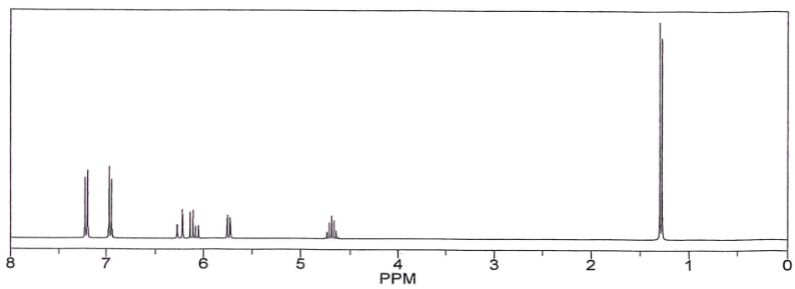
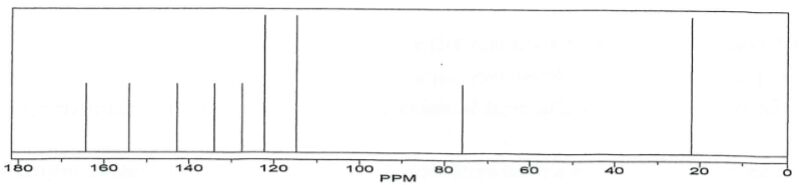
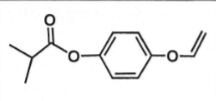
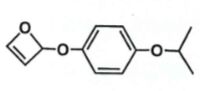
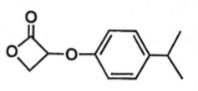
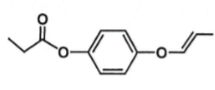
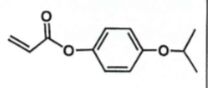
10. What is the best structure for $\mathrm{C{12}H{14}O_3}$ which with the following NMR data? $^{1}\mathrm{H}$ NMR: $\delta 7.3$ (2 H, d, $J = 7\mathrm{Hz}$), 6.9 (2 H, d, $J = 7\mathrm{Hz}), 6.5 (1 H, dd, $J = 15 & 3 Hz), 6.2 (1 H, dd, J = 15 & 10 Hz), 5.7 (1 H, dd, $J = 10 & 3 Hz), 4.7 (1 H, septet, $J = 7\mathrm{Hz}$), 1.3 (6 H, d, J = 7\mathrm{Hz}$). $^{13}\mathrm{C}$ NMR also attached, as shown below.
(A) (B) (C)(D) (E)
11. Which metal is most likely the active center for catalyzing hydroxylation? (A) Fe (B) Mg (C) Zn (D) Al (E) Ca
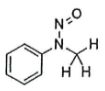
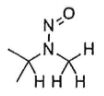
12. Which n-nitrosamine is likely more carcinogenic? (A)(B)(C)(D)(E)
13. Choose the property of a reaction that a catalyst CANNOT affect. (A) rate constant (B) elementary steps (C) reaction order (D) Gibbs free energy difference between reactant and product (E) intermediates
14. Fluoroantimonic acid is formed by reacting hydrogen fluoride with antimony pentafluoride. The resulting mixture is complex but can be simplified as shown in the equilibrium below. Choose the INCORRECT statement regarding this reaction. $$ \mathrm{SbF_5} + 2 \mathrm{HF} \rightleftharpoons \mathrm{SbF_6^-} + \mathrm{H_2F^+} $$ (A) HF acts as a Lewis base (B) HF acts as a Brønsted acid (C) HF acts as a Lewis acid (D) HF acts as a Brønsted base (E) $\mathrm{SbF_5}$ acts as a Lewis acid
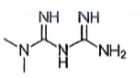
15. Metformin is the first-line medication for treating type 2 diabetes. Its conjugate acid has a $\mathsf{pK}_{\mathsf{a}}$ of 12.4. Calculate the ratio of protonated Metformin to neutral Metformin in the bloodstream $(\mathsf{pH} \approx 7.4)$.
(A) $10^{5}$ (B) $10^{3}$ (C) 10 (D) $10^{-3}$ (E) $10^{-5}$
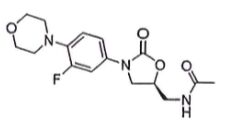
16. Linezolid is an antibiotic used for the treatment of infections caused by Gram-positive bacteria that are resistant to other antibiotics. Choose its correct chemical formula.
(A) $\mathrm{C_{15}H_{18}FN_3O_4}$ (B) $\mathrm{C_{15}H_{20}FN_3O_4}$ (C) $\mathrm{C_{16}H_{20}FN_3O_4}$ (D) $\mathrm{C_{16}H_{21}FN_3O_4}$ (E) $\mathrm{C_{16}H_{22}FN_3O_4}$
17. Which reaction is more likely to be zero order with respect to the reactant? (A) isomerization of glucose using NaOH (B) hydrogenation of butadiene on Pt (C) degradation of formaldehyde by heating (D) self-condensation of acetone using NaOH (E) Elimination of cyclohexanol using H2SO4
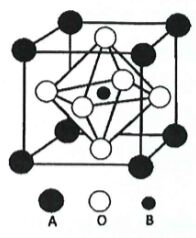
18. The unit cell of the perovskite is shown below. The lattice points consist of some A, B cations, and oxygen anions, whose radii are denoted as rA, rB, and ro, respectively. Based on its structure, choose the INCORRECT statement.
(A) The formula is ABO₃ (B) There is one octahedral hole in this unit cell (C) The length of the unit cell is $2r_{\mathrm{A}}$ (D) The unit cell can be expressed in another form (E) A and B could be Ba and Ti, respectively.
19. Select the correct name for the coordination compound with the formula: $\mathsf{K}_3[\mathsf{Fe}(\mathsf{C}_2\mathsf{O}_4)_3]$. (A) Potassium trioxalate ferrate(III) (B) Potassium tris(oxalato)iron(III) (C) Potassium tris(oxalato)ferrate(III) (D) Potassium trioxalate iron(III) (E) Tripotassium tris(oxalato)ferrate(III)
20. An aqueous solution was prepared by dissolving 0.05 moles of aluminum sulfate in 1.00 kg of water. The freezing point of this solution is determined to be $-0.391^{\circ}\mathrm{C}$. (Kf for water is $1.86^{\circ}\mathrm{C} \cdot \mathrm{kg} / \mathrm{mol}$). Calculate the van't Hoff factor (i) for aluminum sulfate. (A) 5 (B) 4.2 (C) 3.6 (D) 2.1 (E) 1
21. At $100^{\circ}\mathrm{C}$ and 1 atm, $100\mathrm{g}$ sodium azide (hint: a compound with a chemical formula of $\mathrm{NaN_7}$) was completely inflated, what is the volume (liters) of the nitrogen gas released from this sample? (A) >121 (B) 101-120 (C) 81-100 (D) 61-80 (E) 41-60
22. Cerium(IV) ion is a strong oxidizing agent that accepts one electron to produce cerium(III) ion. A solution containing an unknown concentration of $Sn^{2+}$ ions was titrated with a solution containing $Ce^{4+}$ ions, which oxidize the $Sn^{2+}$ ions to $Sn^{4+}$ ions. In one titration $1.00\ \mathrm{L}$ of the unknown solution required $46.45\ \mathrm{mL}$ of a $0.1050\ \mathrm{M}\ Ce^{4+}$ solution to reach the stoichiometric point. $$ a\ Ce^{4+}(aq) + b\ Sn^{2+}(aq) \longrightarrow c\ Ce^{3+}(aq) + d\ Sn^{4+}(aq) $$ What is the closest concentration of $Sn^{2+}$ ions in the unknown solution? (A) $2.4 \times 10^{-3}$ (B) $2.4 \times 10^{-2}$ (C) $2.7 \times 10^{-3}$ (D) $2.7 \times 10^{-2}$ (E) $3.0 \times 10^{-3}$
23. For a $\mathrm{H}_2\mathrm{CO}_3$ solution at $25^{\circ}\mathrm{C}$, what is the fractions (in %) of HCO3- at pH 9.00?
H2CO3(aq)⇌H+(aq)+HCO3-(aq) Ka1=4.3×10⁻⁷
HCO3-(aq) ⇌H+(ag)+CO3-(aq) Ka2 =4.8 x 10⁻¹¹
(A) < 20 (B) 20-39 (C) 40-69 (D) 70-90 (E) >90
24. If $\mathrm{H}_3\mathrm{A}$ is a triprotic acid with $k_{a1} = 1 \times 10^{-4}$, $k_{a2} = 1 \times 10^{-8}$, $k_{a3} = 1 \times 10^{-14}$.
What is the equilibrium concentrations of $[\mathrm{HA}^{2-}]$ in a $1.0\ \mathrm{M}\ \mathrm{H}_3\mathrm{A}$ aqueous solution? (A) $1 \times 10^{-7}$ (B) $1 \times 10^{-6}$ (C) $1 \times 10^{-10}$ (D) $1 \times 10^{-9}$ (E) $1 \times 10^{-8}$
25. A 50.0-mL sample of $0.10\ \mathrm{M}\ \mathrm{HCN}$ (if $K_a = 7 \times 10^{-10}$) is titrated with $0.10\ \mathrm{M}\ \mathrm{NaOH}$, what is the pH of the solution at the halfway point in the titration? (Select the closest pH) (A) $\sim 9$ (B) $\sim 10$ (C) $\sim 11$ (D) $\sim 12$ (E) $\sim 8$
26. What is the pH of a $1.0\ \mathrm{M}$ solution of $\mathrm{NaH_2PO_4}$? (For $\mathrm{H_3PO_4}$, $K_{a1} = 7.5 \times 10^{-3}$, $K_{a2} = 6.2 \times 10^{-8}$, and $K_{a3} = 4.8 \times 10^{-13}$). Select the closest pH. (A) $\sim 6$ (B) $\sim 5.5$ (C) $\sim 4$ (D) $\sim 4.5$ (E) $\sim 5$
27. What is the solubility (M) of solid AgCI in a 10.0 M NHs solution?
AgCI(s)+2NH3(aq) ⇌Ag(NH3)2+ (aq)+CI -(aq) If K=2.8 X 10⁻³
Select the closest solubility (M).
(A)~0.3 (B)~0.4 (C)〜0.5 (D)~0.6 (E)~0.7
28. For a reaction: A $\longrightarrow$ B(g) + C(g) was studied at two temperature and the following values of k were obtained. (Hint: Arrhenius equation: $ = A e?/RT). What is the value of Ea for this reaction?
Select the closest Ea (in kJ/mol). (A) ~80 (B) ~100 (C) ~120 (D) ~140 (E) ~160
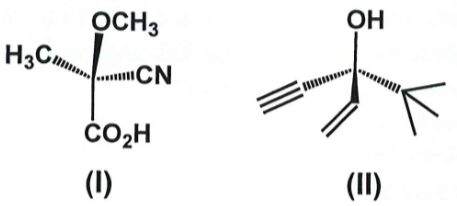
29. Select the right configuration assignment ($R$ or $S$) for the following two organic compounds.
(A) Compound I is S and compound II is R (B) Compound I is R and compound II is S (C) Compound I is R and compound II is R (D) Compound I is S and compound II is S (E) Can not determine
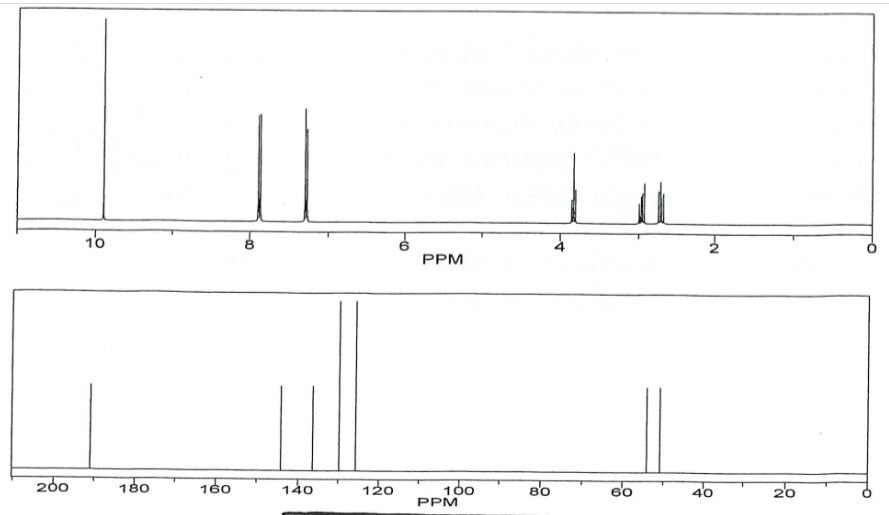
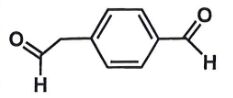
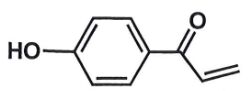
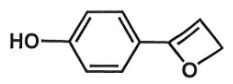
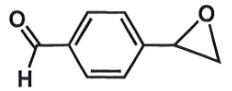
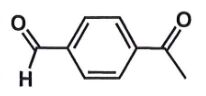
30. What is the best structure for $\mathbf{C_9H_8O_2}$ which with the following NMR data? $^{1}\mathrm{H}$ NMR data.: $\delta$ 9.89 (1 H, s), 7.88 (2 H, d, $J = 7\mathrm{Hz}$), 7.29 (2 H, d, $J = 7\mathrm{Hz}$), 3.83 (1 H, t, $J = 7\mathrm{Hz}$), 2.96 (1 H, dd, J = 7 & $3.5\mathrm{Hz}$), 2.71 (1 H, dd, J = 7 & $3.5\mathrm{Hz}$). $^{13}\mathrm{C}$ NMR also attached, as shown below.
(A)(B)(C)(D)(E)
31. A partially oxidized silicon wafer is analyzed using X-ray photoelectron spectroscopy. The sample is irradiated with a monochromatic Al Kα with a wavelength of 0.83 nm. The detector records electrons with two kinetic energies: 1387.3 eV and 1383.3 eV. Which of the following statements corresponds to the binding energy (BE) and the chemical species (the work function of the spectrometer can be neglected)? (A) BE = 99.3 eV for Si⁴⁺; BE = 103.3 eV for Si⁰ (B) BE = 99.3 eV for Si⁰; BE = 103.3 eV for Si⁴⁺ (C) BE = 1387.3 eV for Si⁰; BE = 1383.3 eV for Si⁴⁺ (D) BE = 1387.3 for Si⁴⁺; BE = 1383.3 eV for Si⁰ (E) BE = 4 eV for both Si⁴⁺ and Si⁰.
32. Green hydrogen is hydrogen produced by the electrolysis of water using renewable electricity. Using a solar cell to electrolyze water, calculate the volume of green hydrogen (assuming as an ideal gas) produced by applying a current of 2.5 A for 30 min in an ambient environment (273 K, 1 atm). (A) 131 mL (B) 262 mL (C) 393 mL (D) 522 mL (E) 655 mL
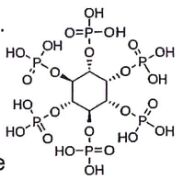
33. Phytic acid (PA) is a natural product abundant in some edible plants. It is soluble in water, but forms insoluble precipitates (FePA) when it interacts with iron ions, thereby affecting iron absorption in the body. Choose the INCORRECT statement regarding the change of thermodynamic properties ($\Delta G_{\text{soln}}$, $\Delta H_{\text{soln}}$, and $\Delta S_{\text{soln}}$) during the dissolution of PA and FePA.
(A) $\Delta G_{\text{soln}} < 0$ for PA (B) $\Delta G_{\text{soln}} > 0$ for FePA (C) $\Delta H_{\text{soln}} < 0$ for PA (D) $\Delta S_{\text{soln}} < 0$ for PA (E) $\Delta S_{\text{soln}} > 0$ for FePA
34. The first allotrope of nitrogen was successively synthesized and confirmed using spectroscopic methods this year. It is a linear molecule composed of six nitrogen atoms. Predict its Lewis structure that fulfills the octet rule, and choose the correct statement regarding the bond length. $$ \mathrm{N}^{1}\square \mathrm{N}^{2}\square \mathrm{N}^{3}\square \mathrm{N}^{4}\square \mathrm{N}^{5}\square \mathrm{N}^{6} $$ (A) The five bonds have the same length (B) The bonds between $\mathrm{N}^{1}\mathrm{N}^{2}$ and $\mathrm{N}^{5}\mathrm{N}^{6}$ are the longest (C) The bond between $\mathrm{N}^{3}\mathrm{N}^{4}$ is the longest (D) The bonds between $\mathrm{N}^{2}\mathrm{N}^{3}$ and $\mathrm{N}^{4}\mathrm{N}^{5}$ are the longest (E) There is no single bond in this structure
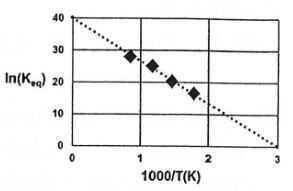
35. The equilibrium constant $(K_{\mathrm{eq}})$ of one reaction is measured at four different temperatures, and the regression data are plotted. Choose the INCORRECT statement regarding the thermodynamic properties of this reaction.
(A) $\Delta H^{\circ} \approx 1.1 \cdot 10^{5} \ \mathrm{J} \cdot \mathrm{mol}^{-1}$(B) $\Delta S^{\circ} \approx 330 \ \mathrm{J} \cdot \mathrm{K}^{-1} \cdot \mathrm{mol}^{-1}$ (C) $\Delta G^{\circ}$ increases when lowering the temperature(D) $K_{\mathrm{eq}}$ increases when increasing the temperature(E) $\Delta G^{\circ} \approx 58 \ \mathrm{kJ/mol}$ at $700 \ \mathrm{K}$
36. Enzymes ( E ) can catalyze reactions through the formation of an enzyme-substrate intermediate (ES). Then ES decomposes into product (P) along with the release of free E. The total enzyme concentration is constant throughout the process, where $[\mathrm{E}]_{\mathrm{t}} = [\mathrm{E}] + [\mathrm{ES}]$. The mechanism can be expressed below: $$ E + S \underset{k_{-1}}{\overset{k_1}{\rightleftharpoons}} ES \underset{k_{-2}}{\overset{k_2}{\rightleftharpoons}} E + P $$ Assuming the decomposition of ES is irreversible, and the concentration of ES is small and remains steady during the whole process, what is the maximum rate $(r_{\max})$ of this reaction? (A) $r_{\max} = k_1[\mathrm{E}]_{\mathrm{t}}$ (B) $r_{\max} = k_2[\mathrm{E}]_{\mathrm{t}}$ (C) $r_{\max} = k_1[\mathrm{E}][\mathrm{S}]$ (D) $r_{\max} = k_2[\mathrm{ES}]$ (E) $r_{\max} = \dfrac{k_1k_2}{k_{-1}}[\mathrm{ES}]$
37. A transition metal complex with a form as $\left[\mathrm{MCl}_4\right]^{2-}$ undergoes a ligand exchange reaction by adding ammonia, resulting in a M(NH3)63+ complex. Choose the LEAST possible statement regarding this reaction. (A) M can be Zn (B) The complex becomes diamagnetic after the reaction (C) The color of the complex changes after the reaction (D) The geometry of the complex changes after the reaction (E) The reaction cannot proceed in $\mathbf{N}_2$ environment
38. 2D materials are crystalline solids comprising a single layer of atoms. The most well-known 2D material is graphene, which is in the form of a plane of $\mathfrak{sp}^2$-bonded C atoms. Using the graphene structure as a hint, select the LEAST possible element that can form a 2D material. (A) Si (B) B (C) P (D) Bi (E) S
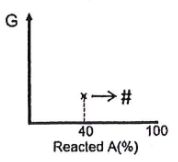
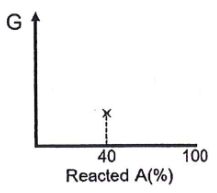
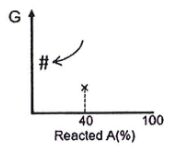
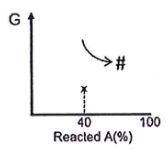
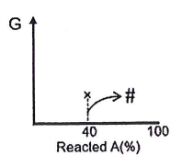
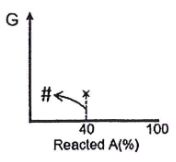
39. 10 moles of gaseous reactant A dimerize to B in a syringe isothermally. The total Gibbs free energy (G) of the equilibrium state is marked in the right graph. Assuming both A and B behave like an ideal gas, predict the change in G of this system after pressing the piston (the new equilibrium state is marked as #).
(A)(B) (C)(D)(E)
40. What is the maximum number of electrons in an atom whose quantum numbers fulfill these conditions: n = 5, $\ell = 2$, $m_{\ell} > 0$. (A) 12 (B) 10 (C) 8 (D) 4 (E) 6
 阿摩線上測驗
登入
 (A) M1 is Ru, M2 is As (B) M1 is Rh, M2 is As (C) M1 is Ru, M2 is Sb (D) M1 is Rh, M2 is Sb (E) M1 is Pd, M2 is As
 (A)
 (B)
 (C)
 (D)
 (E)
 (B)
 (C)
 (D)
 (E)

 (A) $10^{5}$ (B) $10^{3}$ (C) 10 (D) $10^{-3}$ (E) $10^{-5}$
 (A) $\mathrm{C_{15}H_{18}FN_3O_4}$ (B) $\mathrm{C_{15}H_{20}FN_3O_4}$ (C) $\mathrm{C_{16}H_{20}FN_3O_4}$ (D) $\mathrm{C_{16}H_{21}FN_3O_4}$ (E) $\mathrm{C_{16}H_{22}FN_3O_4}$
 (A) The formula is ABO₃ (B) There is one octahedral hole in this unit cell (C) The length of the unit cell is $2r_{\mathrm{A}}$ (D) The unit cell can be expressed in another form (E) A and B could be Ba and Ti, respectively.

 (A)
 (B)
 (C)
 (D)
 (E)
 (A) $\Delta G_{\text{soln}} < 0$ for PA (B) $\Delta G_{\text{soln}} > 0$ for FePA (C) $\Delta H_{\text{soln}} < 0$ for PA (D) $\Delta S_{\text{soln}} < 0$ for PA (E) $\Delta S_{\text{soln}} > 0$ for FePA
 (B)
 (C)
 (D)
 (E)