所屬科目:研究所、轉學考(插大)◆普通物理學
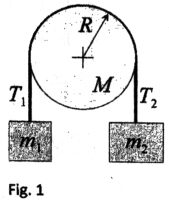
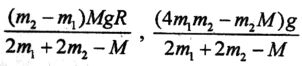
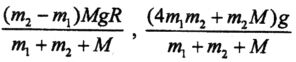
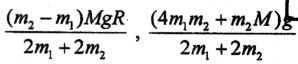
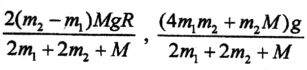
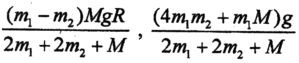
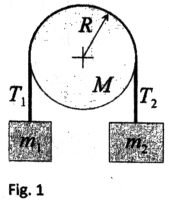
1. As shown in Fig. 1, the mass of block 1 is m₁, and the mass of block 2 is m₂, where m₁ < m₂. The radius and mass of the frictionless pulley are R and M, respectively, so the rotational inertia is MR²/2. The pulley is fastened to the ceiling. The massless cord cannot slip on the pulley. The system is released from rest. The torque τ on the pulley and the tension T₂ are
(A) (B) (C) (D)(E)
2. For the same system shown in Fig. 1, which statement shown below is correct?
(A) The quantities of the acceleration of block 1 and block 2 are different. (B) The system's center of mass won't move at all. (C) T₁ is smaller than T₂. (D) The system's angular momentum will be conserved. (E) The system's kinetic energy is equal to the sum of the kinetic energies of m₁ and m₂.
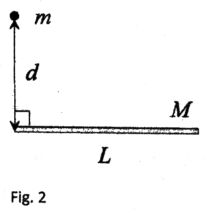
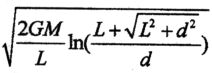
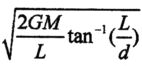
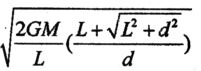
3. A particle of mass m located at a distance d from one end of a uniform rod, as in Fig. 2. The mass of the rod is M, and the length is L. Find the "escape speed" of the particle.
(A)(B)(C) (D) (E)
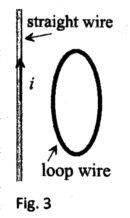
4. A long straight wire is in the plane of a loop wire, as shown in Fig. 3. The straight wire initially carries no current. While the current i is smoothly increasing from zero, the current in the rectangle loop is
(A) zero (B) clockwise (C) counterclockwise (D) clockwise in the left side and counterclockwise in the right side (E) counterclockwise in the left side and clockwise in the right side.
5. The current i is from left to right in the conductor as shown in Fig. 4. The magnetic field B is upward and point S is at a higher potential than point T. The charge carriers are
(A) positive (B) neutral (C) negative (D) absent (E) unable to be identified
6. Two far apart charged metal spheres of radius R₁ and R₂ are connected by a long wire in electrostatic equilibrium. The electric potentials and the surface charge densities on them are V₁, V₂ and σ₁, σ₂, respectively. Choose the correct statement. (A) V₁ > V₂, σ₁ > σ₂ (B) V₁ < V₂, σ₁ < σ₂ (C) (D) V₁ = V₂, R₁σ₁ = R₂σ₂ (E) R₁V₁ = R₂V₂, σ₁ = σ₂
7. The resistivity of pure silicon at 20°C is 2.5×10³ Ω·m, and the temperature coefficient of resistivity is −70×10⁻³ K⁻¹. What's the resistivity of pure silicon at 30°C? (A) 1.8×10³ Ω·m (B) −4.25×10³ Ω·m (C) −0.75×10³ Ω·m (D) 4.25×10³ Ω·m (E) 0.75×10³ Ω·m
8. As the circuit in Fig. 5, the resistance of each resistor is 2 Ω. The currents i₁, i₂ through the batteries are
(A) +0.66 A, −0.66 A (B) +0.5 A, 0 A (C) +1.0 A, +0.5 A (D) +0.66 A, −0.5 A (E) −0.66 A, 0 A
9. The electric flux of E = (2,3,6) N/C through one 2.0 m² area on xy plane is (A) 6 N·m²/C (B) 4 N·m²/C (C) 9 N·m²/C (D) 3 N·m²/C (E) 12 N·m²/C
10. In an "adiabatic" process, which statement is correct about the heat Q, the work done W, and the internal energy ΔEint in an ideal gas system? (A) Q > 0, W > 0, ΔEint = 0 (B) Q < 0, W > 0, ΔEint = 0 (C) Q = 0, W = ΔEint (D) Q = 0, W = −ΔEint (E) None in above.
11. As shown in Fig. 6, an electrical hot plate inside a chamber generates heat in a rate of P = 100 W. One of the chamber walls is made of copper with thermal conductivity kCu = 401 W/m·K. The other walls are fiber wool which are nearly thermal insulated with kfiber = 0.048 W/m·K. The copper wall thickness is 3 mm, and the cross-section area is 0.1 cm². If the temperature outside the chamber is TL = 20 °C, in condition of thermal equilibrium, the temperature TH inside the chamber is
(A) 24.8 °C (B) 34.8 °C (C) 58.8 °C (D) 84.8 °C (E) 94.8 °C
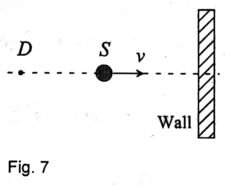
12. As shown in Fig. 7, a moving point source S with speed v = 20 m/s heading toward the wall on the right generates sound wave with frequency 50 KHz. The speed of sound in air is 340 m/s. What's the beat frequency heard at D.
(A) 2.95 KHz (B) 1.45 KHz (C) 0.50 KHz (D) 5.90 KHz (E) 8.53 kHz
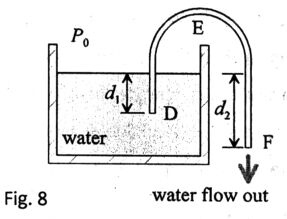
13. As shown in Fig. 8, water flows out from F in speed v (m). The density of water is ρ (kg/m³) and negligible viscosity. The cross-sectional area of the tube is A (m²), which is much smaller than that of tank. The atmospheric pressure is P₀ (Pa or N/m²). Which statement is correct?
(A) (B) Pressure at D is ρgd₁ (C) If the water flows, pressure at E inside the tube must be zero. (D) Water flows only when d₂ > d₁. (E) Whether water flows or not is independent of the distance between E and the upper surface of water.
14. The average speed v and molecular diameter d of five ideal gases are given below. The number of molecules per unit volume is the same for all of them. Which gas has the greatest mean free path? (A) v = 4v₀ and d = d₀/5 (B) v = 2v₀ and d = d₀/3 (C) v = v₀ and d = d₀ (D) v = v₀/2 and d = 3d₀ (E) v = v₀/4 and d = 5d₀
15. Which statement about electromagnetic wave in vacuum is correct? ( and are the electric field and magnetic field of the EM wave, respectively.) (A) The traveling direction is determined by × . (B) Both and oscillate sinusoidally but they travel in opposite directions. (C) and are in phase. (D) EM wave is a longitudinal wave. (E) and can be separated by polarizer.
16. The focal length of a thin convex lens (凸透鏡) is fair in air, or fwater in water. Which statement is correct? (A) The focal length of a lens is determined by the surface curvatures only, so fair is equal to fwater. (B) fair is smaller than fwater. (C) It will be possible that a concave lens (凹透鏡) in water becomes a convex lens. (D) Both fair and fwater are independent on the frequency of incident light. (E) None in above.
17. The uncertainty in position of an electron in a certain state is 5 × 10⁻¹⁰ m. The uncertainty in its momentum (in kg·m/s) must be: (A) less than 10⁻²⁶ (B) less than 10⁻²² (C) greater than 10⁻²⁴ (D) greater than 10⁻²² (E) greater than 10⁻²⁰
18. A stopping potential of 4.2 V is needed for radiation whose wavelength is 200 nm. The work function in eV of the material is (A) 4 (B) 3 (C) 5 (D) 6 (E) 2
19. Polarization experiments provide evidence that (A) light is a longitudinal wave. (B) light is a stream of particles. (C) light is a transverse wave. (D) the polarized light is monochromatic. (E) polarized light propagates faster than un-polarized light.
20. A transverse wave travels along a string according to the equation y(x,t) = 0.05 sin(0.4πx + 3πt + π/3). (x, y in meters, t in seconds). What is the speed of propagation of the wave, in m/s? (A) 1.2 (B) 4.0 (C) 7.5 (D) 9.0 (E) 12.0
 阿摩線上測驗
登入
 (A)
 (B)
 (C)
 (D)
 (E)
 (A) The quantities of the acceleration of block 1 and block 2 are different. (B) The system's center of mass won't move at all. (C) T₁ is smaller than T₂. (D) The system's angular momentum will be conserved. (E) The system's kinetic energy is equal to the sum of the kinetic energies of m₁ and m₂.
 (A)
 (B)
 (C)
 (D)
 (E)
 (A) zero (B) clockwise (C) counterclockwise (D) clockwise in the left side and counterclockwise in the right side (E) counterclockwise in the left side and clockwise in the right side.
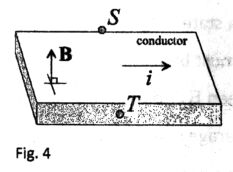 (A) positive (B) neutral (C) negative (D) absent (E) unable to be identified
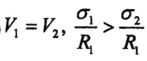 (D) V₁ = V₂, R₁σ₁ = R₂σ₂ (E) R₁V₁ = R₂V₂, σ₁ = σ₂
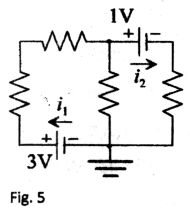 (A) +0.66 A, −0.66 A (B) +0.5 A, 0 A (C) +1.0 A, +0.5 A (D) +0.66 A, −0.5 A (E) −0.66 A, 0 A
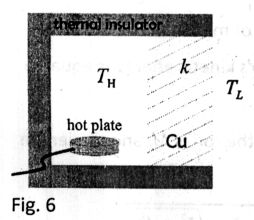 (A) 24.8 °C (B) 34.8 °C (C) 58.8 °C (D) 84.8 °C (E) 94.8 °C
 (A) 2.95 KHz (B) 1.45 KHz (C) 0.50 KHz (D) 5.90 KHz (E) 8.53 kHz
 (A)
 (B) Pressure at D is ρgd₁ (C) If the water flows, pressure at E inside the tube must be zero. (D) Water flows only when d₂ > d₁. (E) Whether water flows or not is independent of the distance between E and the upper surface of water.
 and
 are the electric field and magnetic field of the EM wave, respectively.) (A) The traveling direction is determined by
 ×
 . (B) Both
 and
 oscillate sinusoidally but they travel in opposite directions. (C)
 and
 are in phase. (D) EM wave is a longitudinal wave. (E)
 and
 can be separated by polarizer.