所屬科目:研究所、轉學考(插大)◆普通物理學
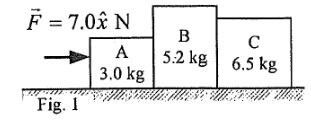
1. As shown in Fig. 1, the force $\vec{F}=7.0\hat{x} N$, and all three blocks move without friction. Find the force on block A from block B. (A) -7.0 N (B) -6.3 N (C) -5.6 N (D) -4.9 N (E) None
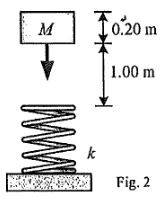
2. As shown in Fig.2, one block of mass M=2.00 kg is 1.00 m above the top of a massless spring. The force constant of the spring is k=200 N/m. This block is released from rest onto a spring, which is then compressed vertically. What is the maximum compression length of the spring? ($g=9.8 m/s^{2}$) (A) 0.55 m (B) 0.45 m (C) 0.36 m (D) 0.10 m (E) None
3. The position of a rock (mass 2.5 kg) is given by $\vec{r}=0.020t^{3}\hat{x}+2.2t\hat{y}-0.060t^{2}\hat{z}$ in meter. Find the torque about z-axis at $t=2.0 s$? (A) $-0.66\hat{x}+0.048\hat{y}-2.64\hat{z} N\cdot m$ (B) $-0.66\hat{x}+0.048\hat{y} N\cdot m$ (C) $0.144\hat{z} N\cdot m$ (D) $-2.64\hat{z} N\cdot m$ (E) None
4. A thin stick with length d and mass m is rotated continuously at a rate of one revolution per minute about the axis through the point at 0.1d from one end. Which statement is correct? (A) The angular momentum is $73\pi md^{2}/9000 kg\cdot m^{2}/s$. (B) The angular momentum is 0. (C) The torque is $\pi md^{2}/30 N\cdot m$. (D) The torque is $2\pi md^{2} N\cdot m$. (E) None
5. Which of the light energies listed below is the greatest? (elementary charge: $1.60\times10^{-19} C$, Plank constant: $6.63\times10^{-34} m^{2}\cdot kg/s$, speed of light: $3.00\times10^{8} m/s$) (A) $3.06\times10^{-19} J$ (B) $6.00\times10^{14} Hz$ (C) 2.76 eV (D) $1.25\times10^{4} cm^{-1}$ (E) 100 nm
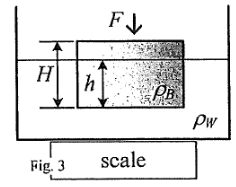
6. As shown in Fig.3, a block of density $\rho{B}$ floats in a fluid of density $\rho{w}$ with a submerged depth of h in static equilibrium. The block has height H and face area A. The fluid container is placed upon a scale. If the block is pushed downward by a force F (with its upper face remaining above the fluid surface), which statement correctly describes the change in the scale reading? (A) It increases more than F. (B) It equals to F. (C) It increases but smaller than F. (D) It equals to the buoyant force of the block. (E) It equals to 0. (Figure 3 shows a block floating in a fluid, with a force F pushing down on it. The fluid container is on a scale.)
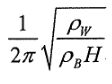
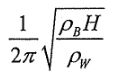
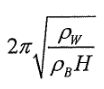
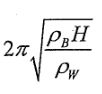
7. For the system in previous question, if the block is released from a submerged depth between h and H, what is its oscillation frequency? (A) (B) (C) (D) (E) None
8. The coefficient of volume expansion of gasoline is 0.000950 K-1. A person bought 50.0 liters of gasoline at 40℃. What's the volume of this gasoline at 5℃ (A) 47.0 liter (B) 48.3 liter (C) 49.2 liter (D) 51.7 liter (E) None
9. One traveling wave is described as y(x,t)=6cos(2\pi t+5\pi x+\pi/7), the numerical constants are in SI units. Which statement is correct? (A) The traveling direction is(B) The wavelength is 0.4 m and the frequency is 1.0 Hz. (C) The maximum transverse speed of string element is 12\pi m/s. (D) All (E) None
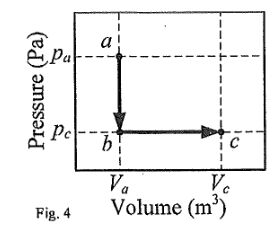
10. 1 mole of an ideal monatomic gas goes from a to c in Fig.4, where $p_a = 8$ Pa, $p_c = 3$ Pa, $V_a = 2$ m3, and $V_c = 7$ m3. In the path of $a \rightarrow b \rightarrow c$, work $\dot{W}$ is done by the gas, and heat Q is added to the gas. Which statement is correct? (A) $W = -15 J (B) Q = 22.5 J (C) Internal energy decreases. (D) All (E) None
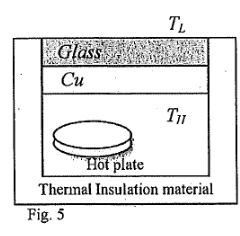
11. As shown in Fig.5, the top side of a chamber is covered fully by a glass plate (1.2 mm thick) and a copper plate (5 mm thick). The top face area is 20 cm2. The remaining sides of the chamber consist of thermal insulation materials. One 40 watt hot plate is placed in this chamber. In thermal equilibrium at TL= 25 °C, what's the temperature TH? (thermal conductivity: kCu = 401 W/(m·K), kGlass = 0.8 W/(m·K))(A) 35.65 °C (B) 55.25 °C (C) 75.15 °C (D) 95.85 °C (E) 155.05 °C
12. A non-uniform electric field \(\vec{E} = 3x \hat{i} + y \hat{j} + 5\hat{k}\) V/m pierces the cubic Gaussian surface shown in the Fig.6. What's the total charge inside the cube? (A) \(32\varepsilon_0\) C (B) \(16\varepsilon_0\) C (C) 0 (D) \(8\varepsilon_0\) C (E) None
13. There is an electric potential V(x,y,z)=7xy² in volt, and a +0.2 C charged particle moves from 2î+9ĵ+6k̂ to 5î-2ĵ+7k̂. What's the work done by the electric field? (A) -1216 J (B) 1216 J (C) -198.8 J (D) 198.8 J (E) None
14. A neutral metal strip, initially at rest, moves with a constant velocity \( \vec{v} \) through a uniform magnetic field \( \vec{B} \) as in Fig.7. Which statement is correct? (A) No work is done on the charges in the strip. (B) All charges don't move because \( v \) is constant. (C) According to Newton's 1st Law, electrons move to the end of the strip. (D) Only the electrons move to the right, and the strip remains neutral. (E) None
15. Mean free time is the average time interval between collisions. Five ideal gas systems with various molecular diameters d and average speeds v are listed below. All gas systems have the same number density. Which system has the greatest mean free time? (A) d=5d₀, v=v₀ (B) d=4d₀, v=2v₀ (C) d=3d₀, v=3v₀ (D) d=2d₀, v=4v₀ (E) d=d₀, v=5v₀
16. As in Fig.8, one capacitor consists of two parallel metal plates (of separation \(d\) and area \(A\)) and a dielectric slab (dielectric constant \(\kappa\)) of thickness \(0.6d\). What is the capacitance of the capacitor? (A) \(\frac{\kappa\epsilon_0 A}{d(0.4\kappa+0.6)}\) (B) \(\frac{\kappa\epsilon_0 A}{d(0.4+0.6\kappa)}\) (C) \(\frac{\kappa\epsilon_0 Ad}{0.4+0.6\kappa}\) (D) \(\frac{\kappa\epsilon_0 Ad}{0.4\kappa+0.6}\) (E) None
17. As in Fig.9, initially all capacitors are uncharged and switch S is open. Which statement is correct? (A) Just after the switch S is closed, the current through the 30 Ω resistor is 2.5 A. (B) Just after the switch S is closed, the current through the 15 Ω resistor is 0. (C) After the switch S has been closed for a very long time, the current through the 15 Ω resistor is 2.0 A. (D) After the switch S has been closed for a very long time, the voltage across the 30 Ω resistor is 2.0 A. (E) None
18. A single circular wire loop of radius 0.2 m and resistance 2 Ω is placed in a time-dependent magnetic field B as given in Fig.10. The plane of the loop is perpendicular to B. What is the current induced in the loop? (A) 0.019 A at t=0.5 s (B) 1.5 A at t=1.0 s (C) It reaches a maximum within t=2.0 to 4.0 s. (D) 0.03 A within t=4.0 to 6.0 s (E) None
19. A parallel plate capacitor (without a dielectric) is connected in series to a resistor and an AC voltage source. Considering a point between the two plates of the capacitor, which statement is correct? (A) No magnetic field exists because there are no moving charges. (B) Electromagnetic waves are constantly propagating outward between the plates. (C) The direction of the magnetic field is reverse during charging and discharging of the capacitor. (D) The direction of the magnetic field is the same during charging and discharging of the capacitor. (E) Both ( B ) and ( D ) are correct.
20. Which of the following statements is correct if the index of refraction of the medium around the optical components changes? The medium is uniform and isotropic. (A) The wavelength of light in a glass plate changes. (B) The focal length of a convex mirror changes. (C) The index of refraction of a lens changes. (D) The size of a single slit diffraction pattern changes, but that of a double slit does not. (E) The transmittance of light through a glass plate changes.
 阿摩線上測驗
登入
 (A) -7.0
 N (B) -6.3
 N (C) -5.6
 N (D) -4.9
 N (E) None
 (A) 0.55 m (B) 0.45 m (C) 0.36 m (D) 0.10 m (E) None
 (A) It increases more than F. (B) It equals to F. (C) It increases but smaller than F. (D) It equals to the buoyant force of the block. (E) It equals to 0. (Figure 3 shows a block floating in a fluid, with a force F pushing down on it. The fluid container is on a scale.)
 (B)
 (C)
 (D)
 (E) None
 (B) The wavelength is 0.4 m and the frequency is 1.0 Hz. (C) The maximum transverse speed of string element is 12\pi m/s. (D) All (E) None
 (A) $W = -15 J (B) Q = 22.5 J (C) Internal energy decreases. (D) All (E) None
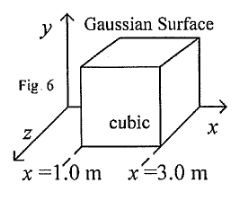 (A) \(32\varepsilon_0\) C (B) \(16\varepsilon_0\) C (C) 0 (D) \(8\varepsilon_0\) C (E) None
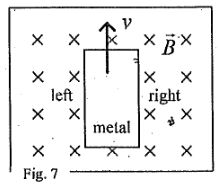 (A) No work is done on the charges in the strip. (B) All charges don't move because \( v \) is constant. (C) According to Newton's 1st Law, electrons move to the end of the strip. (D) Only the electrons move to the right, and the strip remains neutral. (E) None
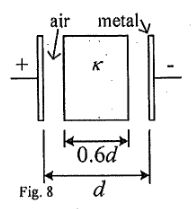 (A) \(\frac{\kappa\epsilon_0 A}{d(0.4\kappa+0.6)}\) (B) \(\frac{\kappa\epsilon_0 A}{d(0.4+0.6\kappa)}\) (C) \(\frac{\kappa\epsilon_0 Ad}{0.4+0.6\kappa}\) (D) \(\frac{\kappa\epsilon_0 Ad}{0.4\kappa+0.6}\) (E) None
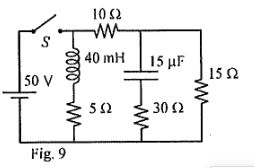 (A) Just after the switch S is closed, the current through the 30 Ω resistor is 2.5 A. (B) Just after the switch S is closed, the current through the 15 Ω resistor is 0. (C) After the switch S has been closed for a very long time, the current through the 15 Ω resistor is 2.0 A. (D) After the switch S has been closed for a very long time, the voltage across the 30 Ω resistor is 2.0 A. (E) None
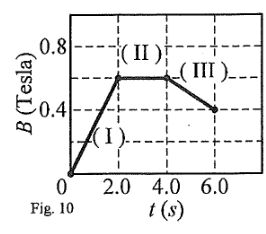 (A) 0.019 A at t=0.5 s (B) 1.5 A at t=1.0 s (C) It reaches a maximum within t=2.0 to 4.0 s. (D) 0.03 A within t=4.0 to 6.0 s (E) None