所屬科目:研究所、轉學考(插大)◆普通物理學
(1) [10 points] Consider a uniform massive spring of mass m and spring constant k. The spring is attached to a wall on one end while the other end is attached to an object of mass M. The system rests horizontally on a frictionless surface. What is the angular frequency of small-amplitude oscillations for this system?(A) \(\sqrt{\frac{k}{m+M}}\)(B) \(\sqrt{\frac{k}{M+m/3}}\)(C) \(\sqrt{\frac{k}{M+2m/3}}\)(D) \(\sqrt{\frac{k}{M+2m}}\)(E) \(\sqrt{\frac{k}{2M+m}}\)
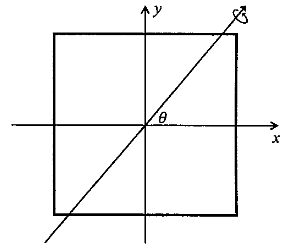
(2) [10 points] Consider a uniform thin square plate of mass M and side length L lying in the xy-plane. What is the moment of inertia of the plate about an axis that passes through the center of the plate, lying in the xy-plane at an angle θ with the x-axis?(A) \(\frac{1}{12}ML^{2}\)(B) \(\frac{1}{6}ML^{2}\sin^{2}\theta\)(C) \(\frac{1}{24}ML^{2}(1+\cos^{2}\theta)\)(D) \(\frac{1}{16}ML^{2}\sin 2\theta\)(E) \(\frac{1}{9}ML^{2}(1+\sin^{2}\theta)\)
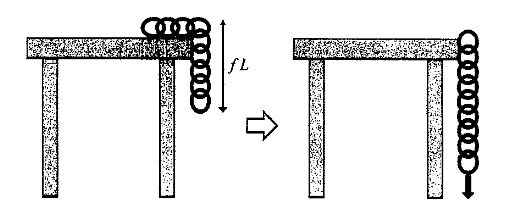
(3) [10 points] Consider an inextensible chain of mass M and length L resting on a frictionless table. A fraction f of its length is hanging vertically over the edge. The chain is released from rest and slides off the table due to its own weight. What is the velocity of the chain right after the entire chain slides off the table? The gravitational acceleration is g.(A) \(\sqrt{gL(1-f)}\)(B) \(\sqrt{gL(1-3f)}\)(C) \(\sqrt{gL(3-f)}\)(D) \(\sqrt{2gL(1-f)}\)(E) \(\sqrt{gL(1-f^{2})}\)
(4) [10 points] What is the gravitational potential of an infinitely large and infinitely thin plate with a surface density (i.e., mass per area) of $\sigma$ located in the $z=0$ plane? The gravitational constant is $G$.(A) $\pi G\sigma|z|$(B) $\pi G\sigma$(C) $\pi G\sigma z^{2}$(D) $2\pi G\sigma|z|$(E) $G\sigma/|z|$
(5) [10 points] A particle of rest mass of m and a velocity of v=0.8~c (where c is the speed of light) in the lab frame collides inelastically (i.e., the two particles stick together after the collision) with another particle of the same mass that is at rest. What is the rest mass (or invariant mass) of the composite particle after collision?(A) $\sqrt{10}m$(B) 2m/3(C) 2m(D) 8m/3(E) $4m/\sqrt{3}$
(7) [10 points] The Bohr radius is the characteristic size of a hydrogen atom, which can be expressed by a combination of fundamental constants. Choose the correct expression for the Bohr radius. Here, $\hbar$ is the reduced Planck constant, k is the Coulomb constant, $m_{e}$ is the electron mass, $e$ is the electron charge, and $G$ is the gravitational constant.(A) $\frac{\hbar^{2}}{km_{e}e^{2}}$(B) $\frac{G\hbar^{2}m_{e}}{k^{2}e^{2}}$(C) $\frac{\hbar^{2}}{Gm_{e}^{3}e^{2}}$(D) $\frac{\hbar^{2}}{m_{e}^{2}e^{2}\sqrt{Gk}}$(E) $\sqrt{\frac{\hbar^{2}}{Gm_{e}e^{2}}}$
(8) [10 points] Consider a positively charged particle with charge q and mass m initially at rest in a uniform electric field of $E{0}$ along the +y-axis and a uniform magnetic field $B{0}$ along the +z-axis (i.e., the electric and magnetic fields are perpendicular to each other). Once released, the particle undergoes a cycloid motion under the Lorentz force. What is the maximum displacement of the particle along the y-axis?(A) $\frac{mE{0}}{qB{0}^{2}}$(B) $\frac{2mE{0}}{qB{0}^{2}}$(C) $\frac{mE{0}}{2qB{0}^{2}}$(D) $\frac{mE{0}}{qB{0}^{3}}$(E) $\frac{mE{0}}{\sqrt{2}qB{0}^{2}}$
(9) [10 points] A charged particle with charge q and mass m is initially at the origin with a initial velocity $v=v_{0}\hat{z}$ along the z-axis. The particle is in a nonuniform magnetic field: $B(x,y)=-y\hat{x}+x\hat{y}$. What is the work done by the magnetic field along the trajectory when the particle moves a distance L along the z direction?(A) $mv_{0}^{2}/2$(B) $mv_{0}^{2}/L$(C) 0(D) $mv_{0}^{2}/q$(E) $v_{0}^{2}L/q$
(10) [10 points] An electron is confined in an infinite 1D potential well. Suppose the infinite potential well is suddenly lowered to a finite height $U_{0}$ that is still significantly larger than the initial ground-state energy. How would the de Broglie wavelength λ and kinetic energy of the electron E change accordingly?(A) Both increase(B) Both decrease(C) λ increases and E decreases(D) λ decreases and E increases(E) λ increases and E remains unchanged
 阿摩線上測驗
登入