所屬科目:研究所、轉學考(插大)◆普通物理學
1. A bottle contains oxygen gas. At 20°C, only translational and rotational motions of the oxygen molecules contribute to the specific heat. Cv and Cp are denoted as the molar specific heat at constant volume and pressure, respectively. Assume that the gas behaves like an ideal gas. What is the theoretical prediction Cp/Cv within the framework of the equipartition of energy? (A) 3/5 (B) 7/5 (C) 5/2 (D) 7/2.
2. The wave function of a propagating sinusoidal wave along x direction is generally written as the form y(x,t) = Asin(kx − ωt) What is the wave speed v? (A) v = (B) v = ωk (C) v = k/ω (D) v = ω/k
3. Consider an atom having energy levels labeled E1, E2, E3, .... The atom is in an excited state with an energy level E3, and it makes a transition back to a lower energy level E1. What is the frequency of the emitting photon? [h is denoted as the Planck constant] (A) (E3 − E1)/h (B) (E3 − E1)h (C) (E3 − E1)/h² (D) (E3 − E1)h³
4. An isolated charged capacitor of capacitance C0 has horizontal plates. A dielectric of dielectric constant K is inserted such that the capacitor is filled with the dielectric material. What is the resulting capacitance? (A) C0 (B) C0/K (C) KC0 (D) (K−1)C0
5. An isolated solenoid has self-inductance L0. A magnetic material of relative permeability Km is inserted in the solenoid such that it is filled with the magnetic material. What is the resulting self-inductance? (A) L0 (B) L0/Km (C) KmL0 (D) (Km−1)L0
6. The sound level is defined as β = 10log10(I/I0), where I0 = 1.00×10⁻¹² (W/m²). A point source emits sound waves with an average power output of 7.5×10⁻⁹ W. Calculate the sound level 10 meters from the source and the sound level 15 meters from the source. What is the difference in sound level (in decibels). (A) 0 (B) 2.44 (C) 3.52 (D) 4.79
7. The sound frequency of a train whistle is f = 450 Hz. Suppose that the speed of the train is u = 150 (km/hr) and the speed of sound is v = 343 (m/s). When the train approaches or recedes, the train whistle sounds higher or lower in frequency. Calculate the difference in frequency between the approaching and receding train whistle. (A) 151 Hz (B) 142 Hz (C) 130 Hz (D) 111Hz
8. Consider a piano string fixed at both ends. Its fundamental frequency is 470 Hz. The tension of the piano string is increased by 1.5 % and the mass density is unchanged. Find the new fundamental frequency. (A) 464 Hz (B) 473 Hz (C) 489 Hz (D) 492 Hz
9. A 0.73 mole sample of hydrogen gas is at 400 K. According to the theoretical Maxwell-Boltzmann speed distribution, in thermal equilibrium, we can observe the most probable speed vmp and average speed vavg. Find the theoretical value of the ratio vavg/vmp. [The mass of a hydrogen atom is 1.67×10⁻²⁷ kg and the Boltzmann constant is 1.38×10⁻²³ J/K.] (A) 1.13 (B) 1.41 (C) 1.57 (D) 1.73
10. The number of collisions a molecule makes per second is called collision frequency. At one atmosphere and 0 °C, estimate the collision frequency of air molecules. [The diameter of an air molecule under one atmosphere and 0 °C is approximately 3×10⁻¹⁰ (m), the average molecular speed is approximately 460 (m/s), and the molecular number density is approximately 2.7×10²⁵ molecules/m³]. (A) 3.5×10⁵ (collisions/s) (B) 3.5×10⁷ (collisions/s) (C) 3.5×10⁹ (collisions/s) (D) 3.5×10¹¹ (collisions/s)
11. Define the ratio of the specific heat γ = Cp/Cv, where Cp and Cv are the molar specific heat of an ideal gas at constant pressure and constant volume, respectively. A team of researchers measures the γ value of a new gas. Which of the following γ values is impossible? (A) 1.22 (B) 1.78 (C) 1.65 (D) 1.35
12. In a cylinder, a sample of an ideal gas undergoes an adiabatic process from the state (Pi,Vi) to (Pf,Vf) where P is the pressure and V is the volume. The sample-1 is a monatomic gas, and the sample-2 is a diatomic gas. The work done on the gas is W1 for sample-1 and W2 for sample-2. What is the value of the ratio W1/W2? (A) 1 (B) 5/2 (C) 3/5 (D) 2/3
13. The object is a distance d0 from the reflecting side of the concave spherical mirror of focal length f = 15 (cm). The spherical mirror produces an image of an object with magnification m = −3.2. Find the distance d0. (A) 19.7 cm (B) 20.3 cm (C) 18.2 cm (D) 22.4 cm
14. Light of wavelength 750 (nm) passes through a single slit of width a. It creates a central diffraction peak that is 100 (cm) wide on a screen 25(cm) away. How wide is the single slit? That is, a = ? (A) 3.75×10⁻⁴ (mm) (B) 9.34×10⁻⁴ (mm) (C) 5.42×10⁻⁴ (mm) (D) 8.38×10⁻⁴ (mm)
15. A team of researchers would like to design a double-slit apparatus such that the pattern contains precisely seven fringes in the central diffraction peak. The slit width a and separation d are related by d = na. Which one of the following value n is impossible? (A) n = 3.1 (B) n = 3.9 (C) n = 4.2 (D) n = 4.0
16. Water flows through a pipe of radius 7 (cm) at a rate of 520 (g/min). Find the flow speed of the water in the pipe. [density of water is 1 g/cm³] (A) 3.38 cm/min (B) 4.22 cm/min (C) 2.72 cm/min (D) 5.81 cm/min
17. As shown in the figure, water flows continuously out of a faucet with an inner diameter d=4 (cm) at an initial speed v0 = 1.6 (m/s). What is the diameter r of the water stream at a distance h = 60 (cm) below the outlet? (A) 4.0 cm (B) 1.5 cm (C) 3.2 cm (D) 2.6 cm
18. As shown in the figure, two identical containers are filled with liquids of the same density ρ = 1200 (kg/m³) and are connected by a communicating tube. A valve in the middle of the tube maintains the liquid height at h1=15 (cm) on the left and h2 = 7 (cm) on the right. After the valve is opened, the liquid flows until it comes to rest. Calculate the magnitude of the work done by gravity. [The cross-sectional area of both containers is 28.2 (cm²) and the gravitational acceleration is g = 9.8 m/s²] (A) 1.6×10⁻² Joule (B) 5.3×10⁻² Joule (C) 2.6×10⁻² Joule (D) 7.1×10⁻² Joule
19. A projectile with mass m=0.5 (kg) is launched from the ground at an upward angle, such that the initial vertical component of velocity is vy0 = 15 (m/s) and the horizontal component of velocity is vx0 = 24 (m/s). The trajectory of this projectile is given by , where î and ĵ are unit vectors corresponding to +x and +y direction, respectively. Determine the torque acting on the projectile about the origin. [The unit vector k̂ is defined as k̂ = î × ĵ] (A) (−173.5t)k̂ (B) (−117.6t)k̂ (C) (−192.6t²)k̂ (D) (−123.0t²)k̂
20. A horizontal spring has a spring constant k = 345 (N/m). We compress it from its uncompressed length x = 0 to x = −13 (cm). A block with 3.32 (kg) is placed against the spring, and the spring is released. Find the speed of the block when the block returns to its uncompressed length. (A) 2.76 m/s (B) 4.53 m/s (C) 5.64 m/s (D) 1.33 m/s
21. Bob stands at a distance 15 (m) away from a point sound source with an average power output of 250 (W). The point sound source moves toward the observer with constant speed u = 120 (km/hr). Suppose that the speed of sound is v = 343 (m/s). Calculate the wave intensity observed by Bob. (A) 0.057 W/m² (B) 0.092 W/m² (C) 0.080 W/m² (D) 0.032 W/m²
22. As shown in the figure (a), an object with a mass of m=2.4 kg slides down an inclined plane with an inclination angle of θ=32°, where the acceleration is denoted as a0. Now, consider figure (b), the same object is tied to a thin string; the other end of which is wound around a fixed cylindrical drum of radius R=12(cm) that can rotate. The cylinder has a mass of M=1.5 kg. The acceleration of the object as it slides down the incline is denoted as a. Find the ratio a/a0 [The moment of inertia of the cylinder is I = MR²/2 and the gravitational acceleration is g = 9.8 m/s²]. (A) 0.33 (B) 0.76 (C) 0.24 (D) 0.57
23. An electron stays in an infinitely deep square well potential of width L = 2.1×10⁻¹⁰ (m). Suppose that the electron is in the ground state and the probability of finding the electron in a region Δx is given by P0 = |ψ|² Δx, where ψ is the ground state wave function obtained from the Schrodinger equation. Calculate the probability P0 of finding the electron in a region of width Δx = 1.2×10⁻¹² (m) at the center of the well. (A) 1.1×10⁻² (B) 3.9×10⁻⁴ (C) 5.2×10⁻⁶ (D) 8.2×10⁻⁸
24. A parallel-plate capacitor (plate area is A = 6.0 m² and the two plates are separated by d = 5.0 mm), filled with a dielectric with the dielectric constant K=3.2, is connected to a 120 Volt battery. After the capacitor is fully charged, the battery is then disconnected. Calculate the work required to remove the dielectric. [The permittivity of free space is ε0 = 8.85×10⁻¹² C²/Nm²]. (A) 0 Joule (B) 4.1×10⁻⁴ Joule (C) 2.2×10⁻⁴ Joule (D) 5.4×10⁻⁴ Joule
25. A 45-eV electron is incident on a square barrier of height 55eV. Suppose that the barrier width is 0.2 (nm). Estimate the probability that the electron tunnels through the barrier. [The electron mass is 9.11×10⁻³¹ (kg), and the Planck constant ℏ = h/2π = 1.055×10⁻³⁴ (J·s). You also need the result 1eV = 1.6×10⁻¹⁹ J.] (A) 1.5×10⁻³ (B) 2.4×10⁻⁵ (C) 3.3×10⁻⁷ (D) 7.1×10⁻⁹
 阿摩線上測驗
登入
 (B) v = ωk (C) v = k/ω (D) v = ω/k
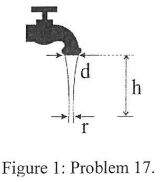 (A) 4.0 cm (B) 1.5 cm (C) 3.2 cm (D) 2.6 cm
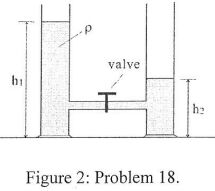 (A) 1.6×10⁻² Joule (B) 5.3×10⁻² Joule (C) 2.6×10⁻² Joule (D) 7.1×10⁻² Joule
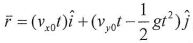 , where î and ĵ are unit vectors corresponding to +x and +y direction, respectively. Determine the torque acting on the projectile about the origin. [The unit vector k̂ is defined as k̂ = î × ĵ] (A) (−173.5t)k̂ (B) (−117.6t)k̂ (C) (−192.6t²)k̂ (D) (−123.0t²)k̂
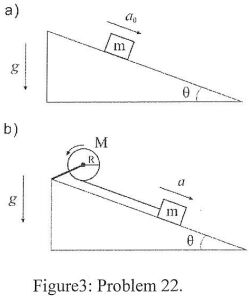 (A) 0.33 (B) 0.76 (C) 0.24 (D) 0.57