所屬科目:研究所、轉學考(插大)◆普通物理學
1. The wave function of a transverse wave propagating on a rope is given by: y(x,t)=4 sin(0.5x+30t), where x and y are measured in meters, and t is in seconds. Find the velocity of a particle on the rope at x = 2 m and t = 0.4 s. (A) 100.52 m/s (B) 108.84 m/s (C) 116.88 m/s (D) 124.19 m/s (E) None of the above.
2. A 0.30 kg rocket in a fireworks display is launched from rest and follows an erratic flight (飛行不穩定) path to reach point P, which is 35 m above the starting point. During the flight, 600 J of work is done on the rocket by the non-conservative force generated by the burning propellant (燃燒推進劑). Ignoring air resistance and the mass lost due to the burning propellant, find the speed of the rocket at point P. (g =9.8 m/s²) (A) 51.97 m/s (B) 53.16 m/s (C) 55.29 m/s (D) 57.56 m/s (E) 59.42 m/s
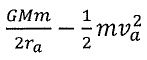
3. A satellite of mass m is in orbit around a planet with mass M and radius R. The satellite is initially in an elliptical orbit. At its closest approach (perigee), the distance from the satellite to the center of the planet is rp and its speed is vp. At its farthest point (apogee), the distance from the satellite to the center of the planet is ra and its speed is va. Assume that as the satellite reaches apogee, a force is applied to change its speed, allowing the satellite to enter a circular orbit at radius ra. Calculate the work required to change the satellite's orbit to a circular orbit at ra. GMm (A) (B)(C) (D) (E)
4. A truck of mass M, including four solid cylindrical tires, requires power to accelerate at a given rate. Each tire can be approximated as a solid cylinder with mass m and radius R. Derive an expression for the power needed to accelerate the truck as a function of its mass M, the mass of each tire m, the truck's speed v, and its acceleration a. Your answer should contain M, m, v, and a. (A) (M+2m)va (B) (M+m)va (C) (M+2m)(y/a) (D) (M+m)(v/a) (E) None of the above.
5. A massless pulley with radius R=0.5 m and moment of inertia M=2.0 kg m² is used in a system where a rope is attached to two masses. One end of the rope is connected to a mass m1=3.0 kg, which hangs vertically, while the other end is attached to a mass m2=5.0 kg that lies on a frictionless horizontal surface. The system is initially at rest, and we assume the rope does not slip on the pulley. Calculate the acceleration of m1. (A) 5.75m/s2 (B) 4.63m/s2 (C) 3.28m/s2 (D) 2.84m/s2 (E) 1.84m/s2
6. Two sine waves with opposite phases but the same amplitude of A=0.1 m and frequency f=5 Hz are traveling in opposite directions along a string, forming a standing wave. The mass per unit length of the string is μ=0.02 kg/m. Determine the kinetic energy per unit length of the string at the moment when the two waves completely overlap, causing the string to appear as a straight line. (A) 0.194J/m (B) 0.264J/m (C) 0.395J/m (D) 0.413J/m (E) 0.528J/m
7. A doctor uses ultrasound to monitor blood flow in a patient's artery. The ultrasound device emits a 4.0 MHz wave, which reflects off moving red blood cells. The observed frequency shift due to the motion of the blood cells is 120 Hz. Assume the speed of sound in blood is approximately v =1540 m/s. Calculate the speed u of the blood cells. (A) 1.53cm/s (B) 2.31cm/s (C) 3.12cm/s (D) 4.97cm/s (E) 5.73cm/s
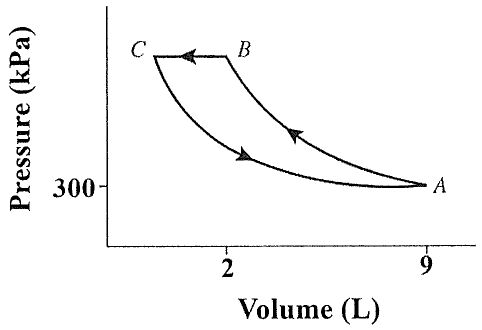
8. A 9.0-L ideal gas with y=1.4 is initially at 320 K and 300 kPa. The gas is compressed adiabatically until its volume becomes 2.0 L, then cooled at constant pressure back to 320 K, and finally allowed to expand isothermally to its original state, as shown in the figure. What is the net work done on the gas during one cycle?
(A) 8988 J (B) 9028 J (C) 9146 J (D) 9257 J (E) None of the above.
9. Find the increase in entropy of 2.00 kg of ice originally at -5.0°C that is warmed to0°C and then melted to form water at 0°C. (A) 2196 J/K (B) 2284 J/K (C) 2359 J/K (D) 2418 J/K (E) 2524 J/K
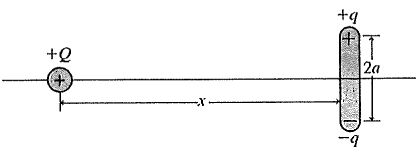
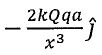
10. A dipole with charges ±q and separation 2a is located a distance x from a point charge +Q, oriented as shown in right figure. Find expressions for the net force on the dipole, in the limit x>>a.
(A) (B) (C) (D)(E)
11. In an LC oscillating circuit, the initial energy is stored entirely in the capacitor, which is fully charged to a maximum charge Q = 2 µC. The circuit has: Capacitance C= 5 µF, Inductance L = 0.1 H. The charge q on the capacitor when the energy in the electric field is one-third of the energy in the magnetic field. Please find that the time required to reach this condition, expressed in terms of the oscillation period T. (A) T/2 (B) T/3 (C) T/4 (D) T/5 (E) T/6
12. A voltage difference V is applied between the two inputs V1 and V2 in the circuit diagram below. The capacitors have the following values: C1=5.0 pF, C2=4.0 pF, and C3=8.0 pF. The voltage relationships between the points are defined as: =V1-V2, =V2-V3, and=V1-V3. Calculate the amount of charge Q3 in pC unit when =180 V.
(A) 884 (B) 960 (C) 1016 (D) 1145 (E) None of the above.
13. As shown in the right figure, take &0 = 24 V, R1 =6.0 , R2 = 12, and R3 = 3.0Ω. Write the current I1 for a long time after the switch is closed.
(A) 1.7 A (B) 2.9 A (C) 3.7 A (D) 4.3 A (E) 5.5 A R3
14. Consider an RLC series circuit with a resistor R=100 , an inductor L=0.2 H, and a capacitor C=50 µF, connected to a sinusoidal voltage source V(t)=V0cos(ωt) with V0=10 V. Using the phasor method, find the resonant frequency of the circuit. (A) 21.5Hz (B) 32.8Hz (C) 40.6Hz (D) 50.3Hz (E) 62.7Hz
15. A solenoid is wound with 1200 turns on5.0 cm ↓ a cylindrical form 5.0 cm in diameter and 60 cm long. The windings carry a current I in the direction shown in the diagram. The current produces a magnetic field of magnitude 5.2 mT near the center of the solenoid. Calculate the current I in the solenoid windings. Use T m/A.
(A) 1.69 A (B) 2.07 A (C) 3.64 A (D) 4.02 A (E) 5.53 A U
16. You're designing a spectrometer that needs a minimum angular separation of Omin = 6° between the second-order (m = 2) lines of hydrogen (Ha) at 656 nm and potassium (K) at 769 nm. What is the line spacing d for an optical grating that can achieve the required angular separation? (A) 2.159 µm (B) 3.302 µm (C) 4.473 um above. (D) 5.589 µm (E) None of the
17. In a Michelson interferometer, one arm is 55.0 cm long and is enclosed in a box that can be evacuated. Initially, the box contains air, which is gradually pumped out, causing a change in the optical path length in that arm. During the evacuation process, 520 bright fringes pass by a point in the viewer. The interferometer uses light with a wavelength of 600 nm. What is the refractive index of air? (A) 1.000293 (B) 1.000162 (C) 1.000096 (D) 1.00028 (E) 1.00006
18. In a double-slit experiment, the wavelength λ of the light source is 520 nm, the slit separation d is 25 µm, and the slit width a is 5 µm. Consider both the interference of the light from the two slits and the diffraction of the light through each slit. How many bright interference fringes are within the central peak of the diffraction envelope? (A) 9 (B) 10 (C) 11 (D) 12 (E) 13
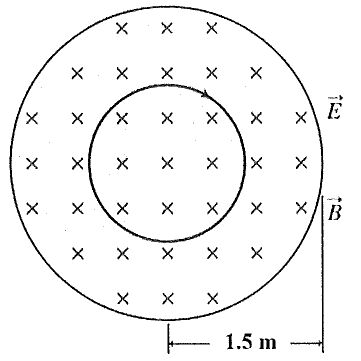
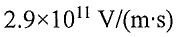
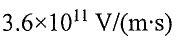
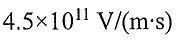
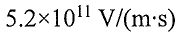
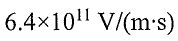
19. An electric field points into the page and occupies a circular region of radius 1.5 m, as shown in the right figure. There are no electric charges in the region, but a magnetic field forms closed loops pointing counterclockwise around the electric field region. The magnetic field strength 1.0 m from the center of the region is 2.5 µТ. What's the rate of change of the electric field?
(A)(B) (C)(D) (E)
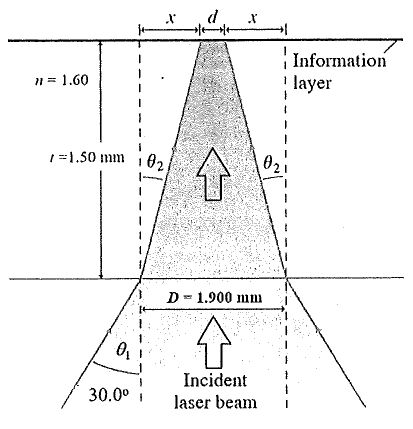
20. A laser beam reads information from a compact disc with an initial diameter of1.900 mm as it strikes the disc. The laser forms a cone with a half-angle θ1=30.0° (as shown in the figure). The beam then passes through a 1.50 mm thick layer of plastic with a refractive index of 1.60 before reaching the reflective information layer near the disc's top surface. What's the beam diameter d at the information layer?
(A) 726 µm (B) 846 µm (C) 914 µm (D) 1056 µm (E) 1168 µm
 阿摩線上測驗
登入
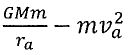 (B)
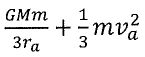 (C)
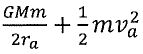 (D)
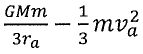 (E)
 (A) 8988 J (B) 9028 J (C) 9146 J (D) 9257 J (E) None of the above.
 (A)
 (B)
 (C)
 (D)
 (E)

 =V1-V2,
 =V2-V3, and
 =V1-V3. Calculate the amount of charge Q3 in pC unit when
 =180 V.
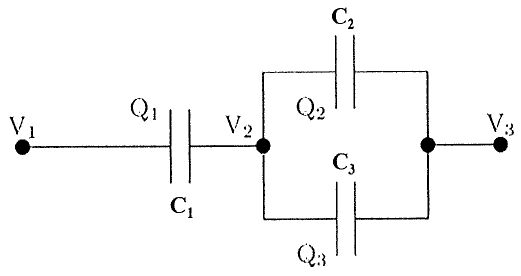 (A) 884 (B) 960 (C) 1016 (D) 1145 (E) None of the above.
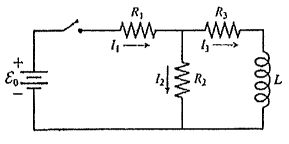 (A) 1.7 A (B) 2.9 A (C) 3.7 A (D) 4.3 A (E) 5.5 A R3
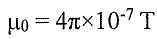 T m/A.
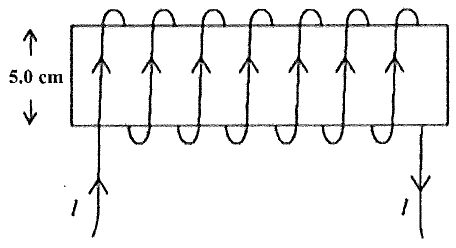 (A) 1.69 A (B) 2.07 A (C) 3.64 A (D) 4.02 A (E) 5.53 A U
 (A)
 (B)
 (C)
 (D)
 (E)
 (A) 726 µm (B) 846 µm (C) 914 µm (D) 1056 µm (E) 1168 µm