所屬科目:研究所、轉學考(插大)◆普通物理學
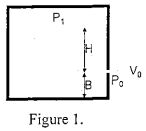
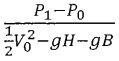
1. See Fig.1, the wall of an enclosed tank is drilled a small hole whose diameter is much smaller than the diameter of the tank. The hole is open to the atmosphere of pressure P0. The air above the liquid is maintained at a pressure P1. While the speed of the leaking fluid from the hole is V0, please derive the liquid density in terms of gravitational constant g, the depth H from liquid top to the hole, and depth B from the hole to the tank bottom, P1 and P0. (A)(B)(C)(D)
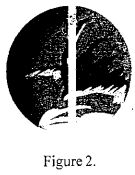
2. Mark Watney is testing a crazy idea in Mars (see Fig.2). In order to get a free ride through Mars due to gravity, a team dig a straight tunnel from north pole to the south pole. Let's assume Mars is a perfect sphere with mass of 6.42×10²³ kg and radius of 3400 km and neglect the air resistance. How long will a round trip take for Mark Watney when he jumps into the tunnel with zero initial velocity? The gravitational constant G = 6.67×10⁻¹¹ Nm²/kg². (A) 10 hours (B) 400 minutes (C) 23 hours (D) 100 minutes
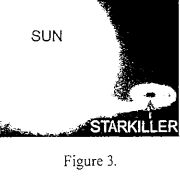
3. In movie StarWars XX, "new StarKiller" base is a super big weapon charged by adiabatically absorbing the nearby SUN as demonstrated in Fig. 3. Basically, scientists figure out a way to compress the WHOLE sun into the size of new StarKiller base via an adiabatic process. While keeping the Entropy of sun's ideal monatomic gas constant in the whole charging process, what is the final temperature Tf of the sun gas inside the StarKiller? All parameters you need are: Sun radius R, Sun initial temperature Ti, StarKiller radius r. Both Sun and new StarKiller base are assumed to be uniform spheres, and so the degrees of freedom is three. (A)(B)(C)(D)
4. Which of following physical quantities has no uncertainty? (A) the height of Taipei 101 (B) the speed of light in vacuum (C) the age of the universe (D) the diameter of a proton
5. Bruce Lee's height is 170.3 cm and body weight is 63.31 kg. Please calculate Bruce Lee's body mass index (BMI) in SI unit. The BMI's formula reads BMI =. (A) 21.83 kg/m² (B) 21.8 kg/m² (C) 2.18×10⁻³ kg/cm² (D) 2.18295×10⁻³ kg/cm²
6. Figure 4 depicts an electromagnetic wave transmitter. In order to transmit at wavelength of 6 cm in vacuum, an engineer uses a RLC circuit with two capacitances C1 = 0.7 pF, C2 = 0.3 pF and an inductance L1 = 0.2 nH. Please calculate the value of the second inductance L2. (A) 18 μH (B) 0.8 μH (C) 0.8 nH (D) 180 nH
7. Which of the following equations of electric field and magnetic field has never been experimentally observed? (A)<0 (B)<0 (C) <0 (D)<0
8. With a device of nuclear magnetic resonance, one observes that a signal of radio-frequency of frequency f is absorbed by a proton in a uniform magnetic field of 0.5 T. Given the magnetic moment of a proton is 1.4×10⁻²⁶ J/T and Planck constant h = 6.626×10⁻³⁴ J·s, please calculate f. (A) 21 MHz (B) 30 MHz (C) 21 GHz (D) 30 GHz
9. The frequency of the hydrogen H1 line is 1.42 GHz which is observed frequently in radio astronomy. A H1 line emitted by a distant astronomical object is observed at 0.765 GHz due to Doppler redshift. Given the Hubble constant H = 17×10-3 m/s/ly, where ly stands for light year's law v = HR, where v is the recessional velocity of the astronomical object, to estimate the distance R between Earth and the recessional astronomical object. (A) 9.7×10⁹ ly (B) 1.7×10⁶ ly (C) 3.7×10³ ly (D) 7 ly
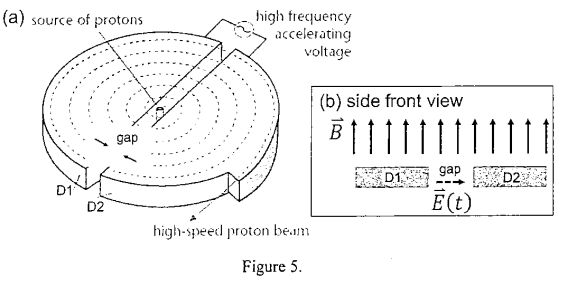
10. Figure 5 illustrates a particle accelerator called cyclotron. It is composed of two hollow metal semicircular containers D1 and D2, and a source of charged particle, e.g., proton, at the center. A high frequency alternating electric potential is applied to D1 and D2, which will generate an alternating electric field in the gap between D1 and D2. A uniform and static magnetic field B is applied vertically to bend the trajectory of a charged particles in a cyclotron. In order to accelerate the charged particle, at each time when the particle passes the gap, one has to change the direction of . Please calculate the angular frequency of the alternating electric voltage in terms of particle mass m, charge e, magnitude of the static magnetic field . (A)(B)(C)(D)
 阿摩線上測驗
登入
 (A)
 (B)
 (C)
 (D)
 (A) 10 hours (B) 400 minutes (C) 23 hours (D) 100 minutes
 (A)
 (B)
 (C)
 (D)

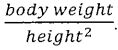 . (A) 21.83 kg/m² (B) 21.8 kg/m² (C) 2.18×10⁻³ kg/cm² (D) 2.18295×10⁻³ kg/cm²
 and magnetic field
 has never been experimentally observed? (A)
 <0 (B)
 <0 (C)
 <0 (D)
 <0
 in the gap between D1 and D2. A uniform and static magnetic field B is applied vertically to bend the trajectory of a charged particles in a cyclotron. In order to accelerate the charged particle, at each time when the particle passes the gap, one has to change the direction of
 . Please calculate the angular frequency of the alternating electric voltage in terms of particle mass m, charge e, magnitude of the static magnetic field
 .
 (A)
 (B)
 (C)
 (D)
