所屬科目:研究所、轉學考(插大)◆普通化學
1. Which of the following is not a unit in the SI system?(A) Ampere (B) Candela(C) Kelvin (D) Meter (E) Calorie
2. The density of gasoline is 0.7025 g/mL at 20°C. When gasoline is added to water:(A) It will float on top. (B) It will sink to the bottom. (C) It will mix so, youcan't see it.(D) The mixture will improve the running of the motor. (E) None of thesethings will happen.
3. When 87.7 is added to 73.841, the result should be reported with _____significant figures. And when 87.7 is divided by 73.841 the result should bereported with ______ significant figures.(A) 3,3 (B) 4,3 (C) 3,5 (D) 4,4 (E) 6,5
4. Which of the following salts is insoluble in water?(A) Na2S (B) K2CO3 (C) Pb(NO3)2 (D) CaCl2 (E) All of these are solublein water.
5. You have separate solutions of HCl and H2SO4 with the same concentrations interms of molarity. You wish to neutralize a solution of NaOH. Which acid solutionwould require more volume (in mL) to neutralize the base?(A) The HCl solution. (B) The H2SO4 solution.(C) You need to know the acid concentrations to answer this question.(D) You need to know the volume and concentration of the NaOH solution toanswer this question.(E) C and D
6. In which of the following does iodine have the lowest oxidation state?(A) LiIO3 (B) IO2 (C) I2O (D) NH4I (E) I2
7. Which of the following statements is correct?(A) The internal energy of a system increases when more work is done by thesystem than heat was flowing into the system.(B) The internal energy of a system decreases when work is done on the systemand heat is flowing into the system.(C) The system does work on the surroundings when an ideal gas expandsagainst a constant external pressure.(D) All statements are true.(E) All statements are false.
8. In the lab, you mix two solutions (each originally at the same temperature) andthe temperature of the resulting solution decreases. Which of the following istrue?(A) The chemical reaction is releasing energy. (B) The energy released isequal to s × m × △T.(C) The chemical reaction is absorbing energy. (D) The chemical reaction isexothermic.(E) More than one of these.
9. Which of these is an isoelectronic series?(A) Na+, K+, Rb+, Cs+ (B) K+, Ca2+, Ar, S2– (C) Na+, Mg2+, S2–, Cl–(D) Li, Be, B, C (E) none of these (A-D)
10. Which of the following best describes an orbital?(A) Space where electrons are unlikely to be found in an atom.(B) Space which may contain electrons, protons, and/or neutrons.(C) The space in an atom where an electron is most likely to be found.(D) Small, walled spheres that contain electrons.(E) A single space within an atom that contains all electrons of that atom.
11. Consider the ionization energy (IE) of the magnesium atom. Which of thefollowing is not true?(A) The IE of Mg is lower than that of sodium. (B) The IE of Mg is lower thanthat of neon.(C) The IE of Mg is lower than that of beryllium. (D) The IE of Mg is higherthan that of calcium(E) The IE of Mg is lower than that of Mg+.
12. In which pair do both compounds exhibit predominantly ionic bonding?(A) SCl6 and HF (B) Na2SO3 and NH3 (C) KI and O3(D) LiF and H2O (E) LiBr and MgO
13. Which of the following statements concerning lattice energy is false?(A) It is often defined as the energy released when an ionic solid forms from itsions.(B) MgO has a larger lattice energy than NaF.(C) The lattice energy for a solid with 2+ and 2– ions should be two times that fora solid with 1+ and 1– ions.(D) MgO has a larger lattice energy than LiF.(E) All of these are true.
14. What type of structure does the XeOF2 molecule have?(A) pyramidal (B) tetrahedral (C) T-shaped (D) trigonal planar (E)octahedral
15. Which of the following molecules (or ions) has a dipole moment?(A) CO2 (B) CO32– (C) NH4+ (D) PF3 (E) two of them
16. The hybridization of the carbon atom in the cation CH3+ is:(A) sp2 (B) sp3 (C) dsp (D) sp (E) none of these
17. For solid ammonium perchlorate (NH4ClO4) , NH4+, Ka= 5.6 10–10; for ClO4–, Kb10–21. How would you predict the property of its aqueous solution?(A) acidic (B) basic (C) neutral (D) cannot tell (E) none of these (A-D)
18. You have equal masses of different solutes dissolved in equal volumes of solution.Which of the solutes would make the solution having the highest molarconcentration?(A) NaOH (B) KCl (C) KOH (D) LiOH (E) all the same
19. When a hydrogen electron goes from n = 2 to n = 1, the energy of the lightemitted is equal to what fraction of its ground-state ionization energy?(A) 3/4 (B) 1/2 (C) 1/4 (D) 1/8 (E) 1/9
20. Consider the following representation of a 2p-orbital:Which of the following statements best describes the movement of electrons in ap-orbital?(A) The electrons move along the outer surface of the p-orbital, similar to afigure “8” type of movement.(B) The electrons move within the two lobes of the p-orbital, but never beyondthe outside surface of the orbital.(C) The electrons are concentrated at the center (node) of the two lobes.(D) The electrons are only moving in one lobe at any given time.(E) The electron movement cannot be exactly determined.
21. The hybridization of the central atom in XeF5+ is:(A) sp (B) sp2 (C) sp3 (D) dsp3 (E) d2sp3
22. If four orbitals on one atom overlap four orbitals on a second atom, how manymolecular orbitals will form?(A) 1 (B) 4 (C) 8 (D) 16 (E) none of these
23. When comparing Be2 and H2:I. Be2 is more stable because it contains both bonding andantibonding valence electrons.II. H2 has a higher bond order than Be2.III. H2 is more stable because it only contains σ1s electrons.IV.H2 is more stable because it is diamagnetic, whereas Be2 isparamagnetic.(A) I, II (B) III only (C) II, III (D) II, III, IV (E) III, IV
24. For the following molecules, how many of them would decrease the bond order ifyou add one electron to the neutral molecule? B2, C2, P2, F2(A) 0 (B) 1 (C) 2 (D) 3 (E) 4
25. A species has the following MO configuration: (σ1s)2(σ1s*)2(σ2s)2(σ2s*)2(σ2p)2(σ2p)2This substance is(A) paramagnetic with one unpaired electron (B) paramagnetic with twounpaired electrons(C) paramagnetic with three unpaired electrons (D) paramagnetic withfour unpaired electrons(E) diamagnetic
26. Choose the correct statement about the diagram below.(A) The diagram is qualitativelycorrect for water.(B) The diagram shows that the melting point of the solid increases withincreasing pressure.(C) The diagram shows the triple point above 1 atm pressure.(D) The diagram could represent the phase diagram of CO2.(E) None of the above statements is correct.
27. For each of the following pairs of substances, select the one expected to have thelower melting point: I. H2O, H2S II. HCl, NaCl III. CH4, C3H8(A) H2O, HCl, C3H8 (B) H2O, NaCl, C3H8 (C) H2O, HCl, CH4(D) H2S, HCl, CH4 (E) H2S, NaCl, CH4
28. Which of the following intermolecular forces exist in all solid substances?(A) Dispersion forces (B) Dipole-dipole forces (C) Covalent bonding(D) Hydrogen bonding (E) Ion-induced dipole forces
29. A solution of hydrogen peroxide is 23.6% H2O2 by mass and has a density of 1.11g/cm3. The molarity of the solution is:(A) 7.23 M (B) 0.262 M (C) 7.70 M (D) 8.03 M (E) none of these
30. How many of the following help determine whether or not a solution forms?I. the polarities of the solute and solventII. the densities of the solute and solventIII. the probability of the mixed state (of the solution)IV.the energies needed for the solution formation to occurV. the state of matter of the solute (solid, liquid, gas)(A) 1 (B) 2 (C) 3 (D) 4 (E) 5
31. Two liquids form a solution and release a quantity of heat. How does the pressureabove the solution compare to that predicted by Raoult's law?(A) It will be greater. (B) It will be less. (C) It will be the same.(D) It will show positive deviation. (E) None of these.
32. The observed van't Hoff factor for an electrolyte is less than the expected factorbecause of _________.(A) electrolytic repulsion (B) complete dissociation (C) coagulation(D) ion pairing (E) gelation
33. Ethylenediamine (en) is a bidentate ligand. What is the coordination number ofcobalt in [Co(en)2Cl2]Cl?(A) 4 (B) 5 (C) 6 (D) 7 (E) 8
34. Which of the following complexes shows geometrical isomerism?(A) [Cu(NH3)4]Cl2 (B) [Co(NH3)6]Cl3 (C) [Co(NH3)5Cl]Cl2(D) K[Co(NH3)2Cl4] (E) none of these
35. The complex ions of Zn2+ are all colorless. The most likely explanation for this is:(A) Zn2+ is paramagnetic.(B) Zn2+ exhibits “d orbital” splittings in its complexes such that they absorb allwavelengths in the visible region.(C) Since Zn2+ is a d10 ion, it does not absorb visible light even though the “dorbital” splittings are correct for absorbing visible wavelengths.(D) Zn2+ is not a transition metal ion.(E) None of these is correct.
36. What is the sum of all isomers (geometrical and optical) that the complex ionCo(en)2Cl2+ exhibits?(A) 0 (B) 1 (C) 2 (D) 3 (E) 4
37. Fluoride ion ranks low in the spectrochemical series and produces a weak crystalfield in complex ions. Based on this information, predict the number of unpairedelectrons in CoF64–.(A) 0 (B) 1 (C) 2 (D) 3 (E) 4
38. The color of a transition metal complex results from:(A) bending vibrations (B) stretching vibrations (C) transition of an electronbetween d orbitals(D) transition of an electron between an s and a p orbital (E) nuclear magneticresonance
39. The phenomenon called __________ contraction is responsible for the greatsimilarity in atomic size and chemistry of 4d and 5d elements.(A) transition (B) coordination (C) lanthanide (D) isomeric (E)none of these
40. Identify the strongest base.(A) CH3O– (B) CH3OH (C) CN– (D) H2O (E)NO3–
 阿摩線上測驗
登入
阿摩線上測驗
登入

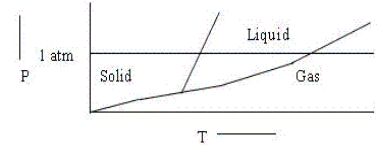 (A) The diagram is qualitativelycorrect for water.(B) The diagram shows that the melting point of the solid increases withincreasing pressure.(C) The diagram shows the triple point above 1 atm pressure.(D) The diagram could represent the phase diagram of CO2.(E) None of the above statements is correct.