所屬科目:學士後西醫-化學
18. How many chiral centers are in this molecule? (A) 0 (B) 1 (C) 2 (D) 3 (E) 4
19. Which of the following statements is incorrect? (A) A triple bond is composed of two π bonds and one σ bond. (B) π bonds result from the head-to-head overlap of atomic orbitals. (C) Free rotation does not occur about a double bond. (D) π bonds have electron density on the inter-nuclear axis. (E) More than one of these statements are incorrect.
22. A chemist wishes to separate benzoic acid from 4-hydroxybenzaldehyde. Which is the best method to achieve this separation? (A) Partitioning the mixture between diethyl ether and water. (B) Partitioning the mixture between diethyl ether and 1 M aqueous NaHCO3. (C) Partitioning the mixture between diethyl ether and 1 M aqueous NaOH. (D) Partitioning the mixture between diethyl ether and 1 M aqueous HCl. (E) Recrystallizing the mixture in diethyl ether.
23. The reaction system has already reached equilibrium. Which of the following statements is correct? (A) Additional H2O(g) added to the system will shift to the left to obtain the equilibrium. (B) As an exothermic reaction, the system will shift to the right to attain the equilibrium when temperature increases. (C) When carbon dioxide is removed, the system will shift to the left to achieve the equilibrium. (D) When volume of the reaction container is decreased, the system will shift to the right to reach the equilibrium. (E) Addition of helium gas into the reaction system will have no effects on its equilibrium.
28. The figure below is a cross section of the electron probability distribution for an orbital. What are n and l values for this orbital? (A) n = 3, = 1 (B) n = 2,= 0 (C) n = 2, = 1 (D) n = 3, l = 2 (E) n = 2, = 2
61. Which of the following solution has shown the correct titration curve? (A) NH3 (B) CO32- (C) HCN (D) PO4 3- (E) NaOH
64. Of the following eleven compounds, how many of them have aromatic character? (A) 3 (B) 4 (C) 5 (D) 6 (E) 7
66. According to the Bohr Model, please use the equation below and calculate the minimum energy required to remove the electron from a He+ ion in its first excited state. (A) 2.178 x 10⁻¹⁸ J (B) 5.445 x 10⁻¹⁹ J (C) 8.712 x 10⁻¹⁸ J (D) 4.356 x 10⁻¹⁸ J (E) 1.089 x 10⁻¹⁸ J
70. Please balance the following equation (o, p, q, x, y, z are reaction coefficients). What is the sum of all coefficients (o + p + q + x + y + z) ? (A) 18 (B) 20 (C) 22 (D) 24 (E) 26
71. For the reaction A + B products, the following data were obtained: What is the experimental rate law? (A) Rate = k[A] (B) Rate = k[B] (C) Rate = k[A][B] (D) Rate = k[A]2 [B] (E) Rate = k[A][B]2
72. In the blood of an adult human, there are approximately 2.64 ✖ 1013 red blood cells with a total of 2.90 g of iron. On the average, how many iron atoms in each red blood cell? (Fe = 55.85 g/mol) (A) 5.19 ✖ 10–2 (B) 4.72 ✖ 1011 (C) 1.09 ✖ 10–13 (D) 9.10 ✖ 1012 (E) 1.18 ✖ 109
75. When the permanganate ion, MnO4ˉ, acts as an oxidizing agent which forms different products depending on the pH of the solution. Which species corresponding to the conditions listed below is correct? (A) A (B) B (C) C (D) D (E) E
78. An unknown concentration of NH3 solution is titrated by HCl solution. The color change for indicators at different pH values are shown in the table below. Which of the following indicators is the best for this titration? (A) phenolphthalein (B) alizarine yellow R (C) methyl red (D) crystal violet (E) thymol blue
79. HNO2(l) + NaCl(s) → HCl(g) + NaNO2(s) Calculate the ΔH° value for the reaction above based on the information below. (A) –78.5 kJ (B) –157 kJ (C) 0 kJ (D) 78.5 kJ (E) 157 kJ
80. The crystal field diagram for a linear transition metal complex ML2 where the ligands lie along the z axis is shown below. Which of the following statements is correct? (A) A orbital is dx 2 -y 2 (B) B orbital and C orbital are dxz and dyz (C) A orbital is dxy (D) B orbital and C orbital are dx 2 -y 2 and dz 2 (E) A orbital is dz 2
81. Consider the following complexes: (en=H2N–CH2–CH2–NH2 and is bidentate) .Which can exhibit cis-trans isomerism? (A) I (B) I and II (C) I, II, and III (D) I, II, III, and IV (E) I, II, and IV
82. Four solutions have violet, blue, yellow and green color, respectively. Each solution contains the following compounds: I. [Cr(H2O)4Cl2]Cl, II. [Cr(H2O)5Cl]Cl2, III. [Cr(H2O)6]Cl3, IV. [Cr(ethylenediamine)3]Cl3. Please use the following table to predict the color for each solution. (A) I: green; II: blue; III: violet; IV: yellow (B) I: yellow; II: violet; III: blue; IV: green (C) I: green; II: yellow; III: violet; IV: blue (D) I: green; II: violet; III: blue; IV: yellow (E) I: violet; II: blue; III: green; IV: yellow
83. Which of the following statements is the best to describe the results of attempted separation by fractional distillation of the two isomers of 1,2-dichloroethene? (A) They can be separated by fractional distillation, with isomer 1 boiling at the lower temperature. (B) They can be separated by fractional distillation, with isomer 2 boiling at the lower temperature. (C) They cannot be separated by fractional distillation because both isomers have the same boiling point. (D) They cannot be separated by fractional distillation because they interconvert rapidly at the distillation temperature. (E) They cannot be separated by fractional distillation because they have the same molecular weight and reactivity.
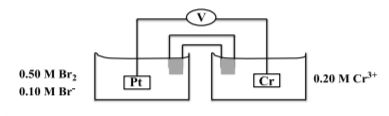
87. Consider the galvanic cell shown below (the contents of each half-cell are written beneath each compartment). The standard reduction potentials are as follows: Which of the following statements about this cell is incorrect? (A) The value of E° for this cell is 1.82 V (B) Electrons flow from the Cr electrode to the Pt electrode. (C) Reduction occurs at the Cr electrode. (D) The cell is not at standard conditions. (E) The value of E for this cell at 25°C should larger than 1.82 V.
88. A galvanic cell consists of two half-reactions:What is the maximum work can be obtained from this cell at standard condition? (Faraday constant = 96500 C mol‒1 ) (A) 173.7 kJ (B) 347.4 kJ (C) 569.4 kJ (D) 113.9 kJ (E) None of the above.
 阿摩線上測驗
登入
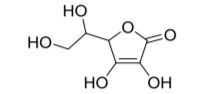 (A) 0 (B) 1 (C) 2 (D) 3 (E) 4
 (A) Partitioning the mixture between diethyl ether and water. (B) Partitioning the mixture between diethyl ether and 1 M aqueous NaHCO3. (C) Partitioning the mixture between diethyl ether and 1 M aqueous NaOH. (D) Partitioning the mixture between diethyl ether and 1 M aqueous HCl. (E) Recrystallizing the mixture in diethyl ether.
 has already reached equilibrium. Which of the following statements is correct? (A) Additional H2O(g) added to the system will shift to the left to obtain the equilibrium. (B) As an exothermic reaction, the system will shift to the right to attain the equilibrium when temperature increases. (C) When carbon dioxide is removed, the system will shift to the left to achieve the equilibrium. (D) When volume of the reaction container is decreased, the system will shift to the right to reach the equilibrium. (E) Addition of helium gas into the reaction system will have no effects on its equilibrium.
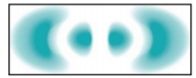 (A) n = 3,
 = 1 (B) n = 2,
 = 0 (C) n = 2,
 = 1 (D) n = 3, l = 2 (E) n = 2,
 = 2
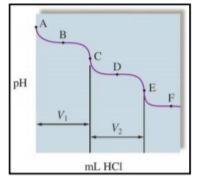 (A) NH3 (B) CO32- (C) HCN (D) PO4 3- (E) NaOH
 (A) 3 (B) 4 (C) 5 (D) 6 (E) 7
 (A) 2.178 x 10⁻¹⁸ J (B) 5.445 x 10⁻¹⁹ J (C) 8.712 x 10⁻¹⁸ J (D) 4.356 x 10⁻¹⁸ J (E) 1.089 x 10⁻¹⁸ J
 (A) 18 (B) 20 (C) 22 (D) 24 (E) 26
 What is the experimental rate law? (A) Rate = k[A] (B) Rate = k[B] (C) Rate = k[A][B] (D) Rate = k[A]2 [B] (E) Rate = k[A][B]2
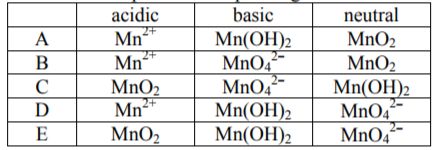 (A) A (B) B (C) C (D) D (E) E
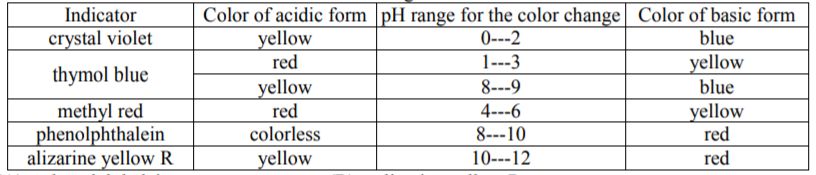 (A) phenolphthalein (B) alizarine yellow R (C) methyl red (D) crystal violet (E) thymol blue
 (A) –78.5 kJ (B) –157 kJ (C) 0 kJ (D) 78.5 kJ (E) 157 kJ
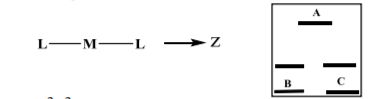 (A) A orbital is dx 2 -y 2 (B) B orbital and C orbital are dxz and dyz (C) A orbital is dxy (D) B orbital and C orbital are dx 2 -y 2 and dz 2 (E) A orbital is dz 2
 Which can exhibit cis-trans isomerism? (A) I (B) I and II (C) I, II, and III (D) I, II, III, and IV (E) I, II, and IV
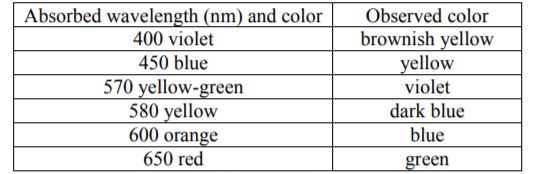 (A) I: green; II: blue; III: violet; IV: yellow (B) I: yellow; II: violet; III: blue; IV: green (C) I: green; II: yellow; III: violet; IV: blue (D) I: green; II: violet; III: blue; IV: yellow (E) I: violet; II: blue; III: green; IV: yellow
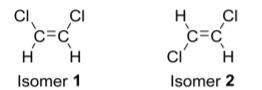 (A) They can be separated by fractional distillation, with isomer 1 boiling at the lower temperature. (B) They can be separated by fractional distillation, with isomer 2 boiling at the lower temperature. (C) They cannot be separated by fractional distillation because both isomers have the same boiling point. (D) They cannot be separated by fractional distillation because they interconvert rapidly at the distillation temperature. (E) They cannot be separated by fractional distillation because they have the same molecular weight and reactivity.
 Which of the following statements about this cell is incorrect? (A) The value of E° for this cell is 1.82 V (B) Electrons flow from the Cr electrode to the Pt electrode. (C) Reduction occurs at the Cr electrode. (D) The cell is not at standard conditions. (E) The value of E for this cell at 25°C should larger than 1.82 V.
 What is the maximum work can be obtained from this cell at standard condition? (Faraday constant = 96500 C mol‒1 ) (A) 173.7 kJ (B) 347.4 kJ (C) 569.4 kJ (D) 113.9 kJ (E) None of the above.