所屬科目:學士後西醫-化學
1.Which equation correctly describes the change in Gibbs free energy for a reaction at non-standard conditions? (A) AG = AG° + RT ln(Q) (B) AG = ΔΗ - TAS (C) AG = -RT ln(K) (D) AG = RT In(Q/K) (E) AG = AG° - RT ln(K)
2.In a system at equilibrium, how are AG and the equilibrium constant K related? (A) AG = 0; K = 1 (B) AG° = -RT ln(Q/K) (C) AG > 0; K < 1 (D) AG = RT ln(K) (E) AG° = -RT ln(K)
3.What is the primary effect of adding a catalyst to a reversible reaction at equilibrium? (A) Increases the forward rate only. (B) Shifts the equilibrium constant. (C) Alters the reaction enthalpy. (D) Increases the activation energy required for the reaction. (E) Increases the rates of both forward and reverse reactions equally.
4.Who did not contribute the Atomic Theory? (A) John Dalton (B) Emil Fischer (C) Ernest Rutherford (D) James Chadwick (E) J. J. Thomson
5.Indicate which of the following sets of quantum numbers (n, l, ) in an atom is acceptable: (A) (1, 0, 2, -1/2) (B)(C)(D)(E) (3, 2, 1, 1)
6.Phenyl Grignard reagent reacts with 2-methylpropanal to form a secondary alcohol. The <sup>1</sup>H NMR spectrum of 2-methylpropanal displays the two methyl groups as equivalent (a single doublet at δ 1.1). However, in the product alcohol (a racemic mixture), the <sup>1</sup>H NMR now shows two distinct 3H doublets, one at δ 0.75 and one around δ 1.0. Why do the two methyl groups in the product have different NMR chemical shifts? What is the term applied to such protons? (A) The presence of the hydroxyl group creates an asymmetric center, making the methyl groups homotopic. (B) The formation of a chiral center in the product makes the two methyl groups diastereotopic, meaning they experience different chemical environments. (C) The hydroxyl group participates in hydrogen bonding, causing different splitting patterns for the methyl groups, which are now homotopic. (D) The two methyl groups in the product remain chemically equivalent, and the observed difference in NMR chemical shifts is due to rotational averaging. (E) The steric hindrance of the bulky phenyl group shields one methyl group, making them enantiotopic rather than diastereotopic.
7.What does the pre-exponential factor in the Arrhenius equation represent? (A) Activation energy. (B) Reaction probability. (C) Temperature dependence. (D) Molecular orientation during collisions. (E) Frequency of collisions.
8.How does enzyme turnover number (k<sub>cat</sub>) relate to reaction velocity? (A) Determines the maximum reaction velocity when the enzyme is saturated with substrate. (B) Reflects the enzyme's catalytic efficiency relative to substrate concentration. (C) Is directly proportional to the rate constant for enzyme-substrate binding. (D) Indicates the fraction of substrate molecules converted to product per second. (E) Describes the maximum catalytic rate normalized by the enzyme’s molecular weight.
9.A researcher is studying an enzyme-catalyzed reaction and observes that adding a certain compound decreases the reaction rate without affecting the substrate binding at the active site. Which mechanism most likely explains this observation? (A) The compound increases substrate affinity. (B) The compound stabilizes the enzyme’s active form. (C) The compound induces a conformational change, reducing enzyme activity. (D) The compound decreases the reaction rate by irreversibly inhibiting the enzyme. (E) The compound physically blocks the active site, preventing substrate binding.
10.The following NMR spectrum corresponds to a compound with the molecular formula . Propose a structure and explain how it is consistent with the observed absorptions. (A)Ⅰ (B)Ⅱ(C)Ⅲ(D)Ⅳ(E)Ⅴ
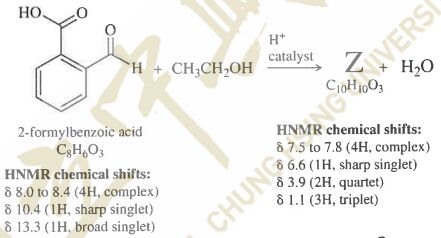
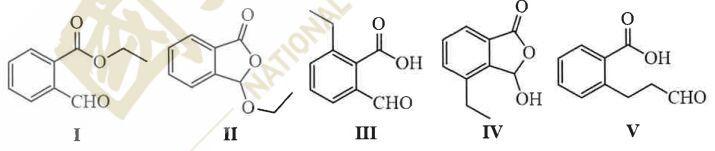
11.A chemist attempted to synthesize the ethyl ester of 2-formylbenzoic acid, but the spectral data of the product did not match her expectations. The IR spectrum of product Z showed an ester carbonyl absorption, but no aldehyde absorption and no OH absorption. The 1H NMR data are provided. What is the structure of Z? (A) I (B) II (C) III (D) IV (E) V
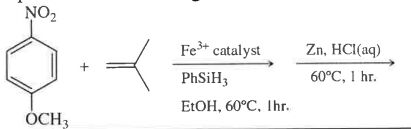
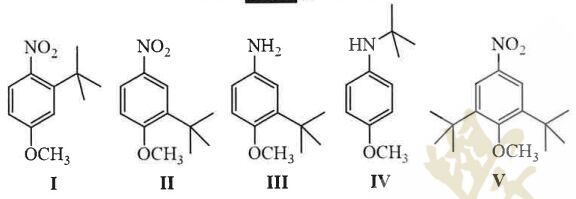
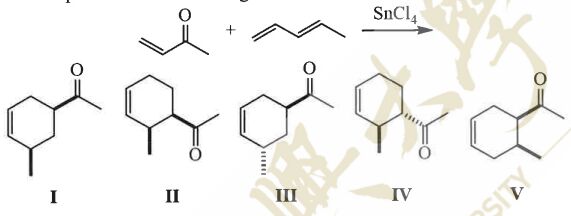
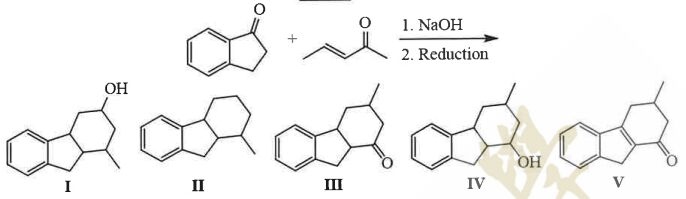
12.Please predict the final product of the following reactions. (A)Ⅰ(B)Ⅱ(C)Ⅲ(D)Ⅳ(E)Ⅴ
13.Which statement best describes the thermodynamic principle related to the entropy of a perfect crystal at absolute zero? (A) The internal energy of the system remains constant. (B) The entropy of a system approaches a constant minimum as the temperature approaches absolute zero. (C) A perfect crystal at absolute zero has zero entropy. (D) Heat cannot spontaneously flow from a colder body to a hotter body. (E) The molecular motion of the system ceases completely at absolute zero.
14.Which condition is maintained during a reversible isothermal expansion of an ideal gas? (A) Internal energy is constant, and heat equals work. (B) Enthalpy increases, and heat is absorbed. (C) Gibbs free energy increases, and work is done. (D) Entropy decreases, and heat is released. (E) The pressure of the system remains constant throughout the process.
15.What is the shape of the PV graph for a constant-volume process? (A) Parabolic. (B) Horizontal line. (C) Vertical line. (D) Exponential curve. (E) Linear with a positive slope.
16.What adjustments does the van der Waals equation make to the ideal gas law? (A) Accounts for temperature effects. (B) Corrects for non-ideal gas behaviors by including terms for intermolecular forces and finite molecular size. (C) Modifies heat capacity to account for variable energy distribution. (D) Introduces terms to describe deviations in the compressibility factor. (E) Includes a proportionality constant to relate pressure and volume more accurately.
17.What determines the half-life of a first-order reaction? (A) Reactant concentration. (B) Temperature. (C) Activation energy. (D) Both temperature and activation energy. (E) Molecular size of the reactant.
18.Please predict the product of the following reaction. (A) I (B) II (C) III (D) IV (E) V
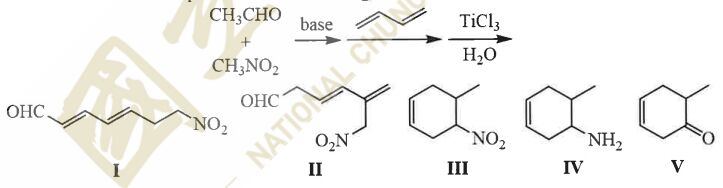
19.Please indicate the final product of the following reactions. (A) I (B) II (C) III (D) IV (E) V
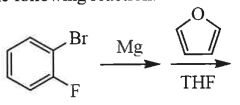
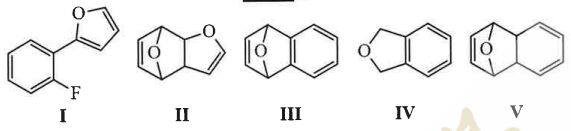
20.Please provide the product of the following reaction. (A)Ⅰ(B)Ⅱ(C)Ⅲ(D)Ⅳ(E)Ⅴ
21.How does increasing the ionic strength of a solution affect the activity coefficient of ions? (A) Decreases for all ions. (B) Increases for all ions. (C) Depends on ion size and charge. (D) Remains constant. (E) Becomes negligible at very high ionic strengths.
22.In mass spectrometry, what is the primary function of a quadrupole? (A) Fragment molecules. (B) Separate ions based on mass-to-charge ratio. (C) Ionize neutral molecules. (D) Detect ions. (E) Focus ion beams for improved resolution.
23.What is the Beer-Lambert law limitation for high concentrations? (A) Absorbance decreases linearly. (B) Stray light causes deviations. (C) Band broadening occurs. (D) Nonlinear absorbance-concentration relationship. (E) Path length variations amplify errors.
24.Which type of enzyme inhibition can be reversed by adding more substrate? (A) Non-competitive. (B) Competitive. (C) Uncompetitive. (D) Irreversible. (E) Mixed.
25.Which of the following rules corresponds to the statement: "No two electrons in the same atom can have the same four quantum numbers"? (A) Hund's rule (B) Pauli exclusion principle (C) Bohr’s model (D) quantum theory (E) photoelectric effect
26.Which orbital is correct? (A) 3f (B) 2d (C) 2p (D) 1p (E) 1d
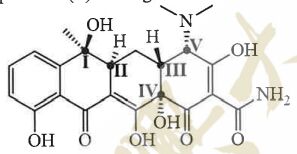
27.Which configuration corresponds to (R) in the given molecule (A) I (B) II (C) III (D) IV (E) V
28.Which hydrolysis does not produce a carboxylic acid? (A) I (B) II (C) III (D) IV (E) V
29.What principle underlies chromatography's separation of compounds? (A) Partitioning between phases. (B) Absorption of light. (C) Electrochemical redox reactions. (D) Differential molecular interactions. (E) Mass-to-charge ratio differences.
30.In UV-Vis spectroscopy, the absorbance of light is proportional to: (A) Wavelength. (B) Concentration and path length. (C) Temperature. (D) Molecular weight. (E) Molar extinction coefficient.
31.A protein mixture contains three proteins with molecular weights of 15 kDa, 50 kDa, and 120 kDa. You need to separate them effectively based on molecular weight for downstream analysis. Which chromatographic technique would be the most appropriate? (A) Ion exchange chromatography. (B) Size-exclusion chromatography. (C) Affinity chromatography. (D) Gas chromatography. (E) Reverse-phase chromatography.
32.How does entropy change during the mixing of two different ideal gases? (A) Decreases due to uniformity. (B) Increases due to increased randomness. (C) Increases due to heat spontaneously flowing into the system from the surroundings. (D) Remains constant at equilibrium. (E) Depends on both the molar ratio and initial pressure of the gases.
33.What is the relationship between the equilibrium constant (K) and temperature for an exothermic reaction? (A) K decreases with increasing temperature. (B) K increases with increasing temperature. (C) K remains constant regardless of temperature. (D) K depends only on activation energy. (E) K is inversely proportional to the enthalpy change.
34.Which statement about the reaction energy diagram is incorrect? (A) I: Reactants (B) II: Transition state (C) III: Activated complex (D) IV: Transition state (E) V: Products
35.Please predict the final product of the following reactions. (A)Ⅰ(B)Ⅱ(C)Ⅲ(D)Ⅳ(E)Ⅴ
36.Please provide the IUPAC name for the given molecule. (A) 1,2-dimethylcyclopentene (B) 2,3-dimethylcyclopentene (C) 1,2-dimethylcyclopent-2-ene (D) 1,5-dimethylcyclopentene (E) 1,5-dimethylcyclopent-4-ene
37.Which molecule is most likely to undergo an substitution reaction? (A) tert-Butyl bromide (B) Isopropyl chloride (C) Methyl iodide (D) Phenyl chloride (E) Chloroform
38.Which of the following is a typical 1,2-addition reaction? (A) Diels-Alder reaction (B) Grignard reagent reaction with aldehydes (C) Friedel-Crafts alkylation (D) Esterification (E) Amide hydrolysis
39.Which compound does not react with Tollens' reagent? (A) Formaldehyde (B) Benzaldehyde (C) Formic acid (D) Acetic acid (E) D-Glucose
40. Which statement is true about the SnI reaction mechanism?(A) The reaction rate is proportional to the nucleophile concentration.(B) A carbocation intermediate is formed.(C) It favors primary alkyl halides.(D) The reaction occurs in a coplanar manner.(E) A strong base is required.
41.Which factors influence the equilibrium constant (K) of a chemical reaction? (A) Temperature. (B) Pressure (for gas-phase reactions; real gas). (C) Concentration of reactants and products. (D) Catalyst presence. (E) Reaction enthalpy.
42.Under which conditions will real gases deviate most from ideal gas behavior? (A) High temperature and low pressure. (B) Low temperature and high pressure. (C) Presence of significant intermolecular forces. (D) Low molar volume of the gas. (E) Large molecular size of gas particles.
43.In an enzymatic reaction, which factors can alter the reaction velocity at saturating substrate concentrations? (A) Enzyme concentration. (B) Temperature. (C) Presence of competitive inhibitors. (D) pH changes outside the enzyme’s optimal range. (E) Presence of non-competitive inhibitors.
44.Under which conditions is an enzyme most likely to exhibit maximum catalytic efficiency? (A) At its optimal temperature. (B) At its optimal pH. (C) In the absence of allosteric regulators. (D) In the presence of competitive inhibitors. (E) At saturating substrate concentrations.
45.When performing high-performance liquid chromatography (HPLC), what factors can lead to tailing peaks? (A) Use of low-pressure mobile phase delivery. (B) Strong interaction between analyte and stationary phase. (C) Use of a non-polar solvent with a polar stationary phase. (D) Insufficient column temperature control. (E) Overloading the sample injection volume.
 阿摩線上測驗
登入
 ) in an atom is acceptable: (A) (1, 0, 2, -1/2) (B)
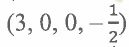 (C)
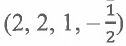 (D)
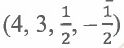 (E) (3, 2, 1, 1)
 . Propose a structure and explain how it is consistent with the observed absorptions.
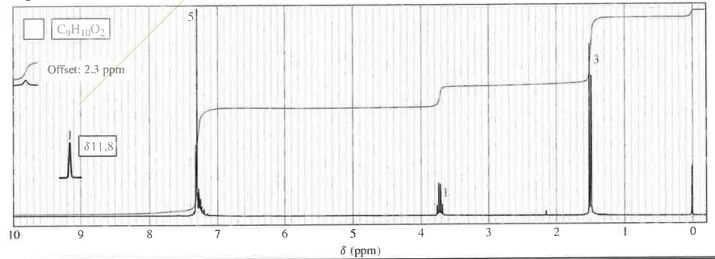

 (A) I (B) II (C) III (D) IV (E) V

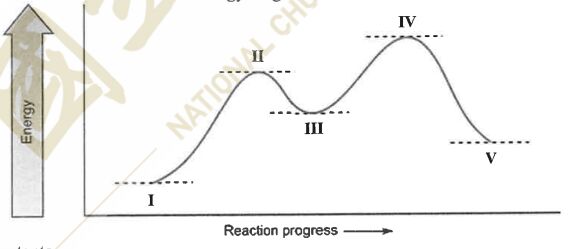 (A) I: Reactants (B) II: Transition state (C) III: Activated complex (D) IV: Transition state (E) V: Products
 (A) 1,2-dimethylcyclopentene (B) 2,3-dimethylcyclopentene (C) 1,2-dimethylcyclopent-2-ene (D) 1,5-dimethylcyclopentene (E) 1,5-dimethylcyclopent-4-ene
 substitution reaction? (A) tert-Butyl bromide (B) Isopropyl chloride (C) Methyl iodide (D) Phenyl chloride (E) Chloroform