所屬科目:研究所、轉學考(插大)◆普通物理學
1. Which of the following is a correct unit for Newton's gravitational constant? (A) (B) (C) (D)
2.Which physical quantity in a system is conserved if the only force exerted on the system is aconserved force?(A) momentum (B) angular momentum (C) mechanical energy (D) energy potential
3. If a free electron with charge -e and mass m moving at speed v enters a region with a magnetic field and makes a circular motion of radius r, what is the magnitude of the magnetic field? (A) (B) (C) (D)
4. It is known that water is considered incompressible. However, the water stream from the faucet is usually narrower at the bottom than at the top. Which of the following mechanisms best explains this phenomenon? (A) electric force (B) magnetic force (C) mass conservation (D) momentum conservation
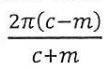
5. An ant of mass m rests on a stationary wheel of radius r with inertia I = cr2 before moving counterclockwise with speed v. If the rotational friction of the wheel is negligible, how much angle does the wheel turn when the ant passes its original spot on the wheel for the first time? (A) (B) (C) (D)
6. Assuming the exit speed of cannonballs is always the same when fired from the cannon. If the angle of the cannon is φ when aiming at a target 800 m away, what is the condition on angleθ when aiming at 300 m away?(A) sin(2θ) =sin(2φ) (B) cos(θ) =cos(φ) (C) tan(θ) =tan(φ) (D) tan(θ) =tan(φ)
7. The heat capacity of object A is three times that of object B, and the initial temperatures of object A and object B are 300 K and 600 K, respectively. What is the final temperature of both objects if they are in thermal contact and isolated from the environment? (A) 430 K (B) 525 K (C) 400 K (D) 375 K
8. Which of the following descriptions about an inelastic collision is true?(A) momentum is not conserved, but kinetic energy is conserved.(B) total mass is not conserved, but momentum is conserved.(C) neither kinetic energy nor momentum is conserved.(D) momentum is conserved, but kinetic energy is not conserved.
9. A stationary source of sound emits a sound wave of frequency f. If a flight flies toward the source at the speed of sound, what frequency does the flight observe? (A)f/2 (B)f (C) 2f (D) cannot hear the sound
10. An 40-N uniform plank leans against a frictionless wall (as shown in Fig. 1). What is the torque (about point P) applied to the plank by the wall?(A) 60 m.N (B) 30 m N (C) 120 m N (D) 80 m N
11. A wooden ball floats in a fluid of density 13.5 g/mL with 20% of its volume under the fluid. What is the density of the wood? (A) 5.0 g/ml (B) 2.7 g/mL (C) 10.8 g/mL (D) 3.4 g/mL
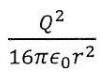
12. Two identical conducting spheres with one carrying charge Q and the other neutral. What is the magnitude of the electrostatic force between the conducting spheres after they touch each other and then separate by distance r? (A) (B) (C) (D)
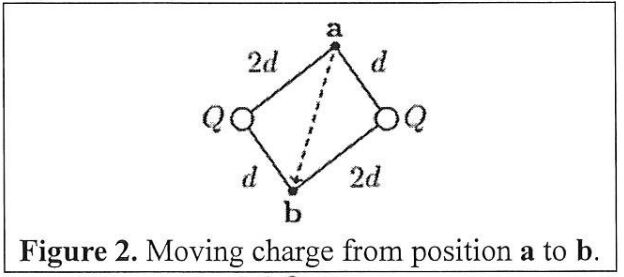
13. What is the total work to move a point charge of charge q from point a to point b shown in Fig.2? (The other two charges in the system both carry charge Q.) (A) (B) (C) 0 (D)
14. A 5.0 kg package is moving at a speed of 20.0 m/s vertically upward when it explodes into threе fragments: a 1.00 kg fragment is shot upward with an initial speed of 10.0 m/s and a 2.00 kg fragment is shot horizontally with an initial speed of 10.0 m/s. What is the total kinetic energy provided by the explosion? (A) 8.0 x 10²J (B) 5.7 x 10² J (C) 2.8 x 10³ J (D) 1.3 x 10³ J
15. Two parallel wires, 4.0 cm apart, both carry currents of 2.0 A in the same direction. What is the force per unit length of one wire on the other? (µo = 1.3 x 10⁻⁶ N. A-2) (A) 2.0 x 10⁻⁵ N/m, attractive (B) 1.1 x 10⁻⁵ N/m, attractive (C) 2.0 x 10⁻⁵ N/m, repulsive (D) 1.1 x 10⁻⁵ N/m, repulsive
16. The magnitude of the magnetic field outside of a long ideal solenoid of n turns per unit length with current I is: (A) 0 (B) μ0nl (C) (D)
17. A particle with charge q is brought from far away to a point near an electric dipole. No total work is done if the final position of the particle is on: (A) a line that is perpendicular to the dipole moment. (B) the line through the charges of the dipole. (C) a line that makes an angle of 45° with the dipole moment. (D) none of the above.
18. The effective resistance from a to b in Fig.3 is 4.0 2.What is the resistance of individual resistors in the circuit? (The resistances of all the individual resistors are the same.) (A) 4.02(B)2.0 Ω (C) 8.0 Ω (D) 0.8 2
19. As shown in Fig. 4, an m1 = 1.0 kg block is placed on top of an m2 = 8.0 kg block, which lies on a frictionless surface. The coefficient of kinetic friction between the two blocks is 0.20; they are connected via a pulley and a string. A hanging block of mass m3 = 6.0 kg is connected to the mass m2 block via another pulley and string. Both strings are massless and the pulleys are frictionless. What is the acceleration magnitude of the blocks? (Gravitational acceleration g =9.8 m/s²) m1 m2 M3 Figure 4. A system composed of three blocks, strings, and pulleys. (A) 3.7 m/s² (B) 2.7 m/s² (C) 9.7 m/s2 (D) 8.0 m/s²
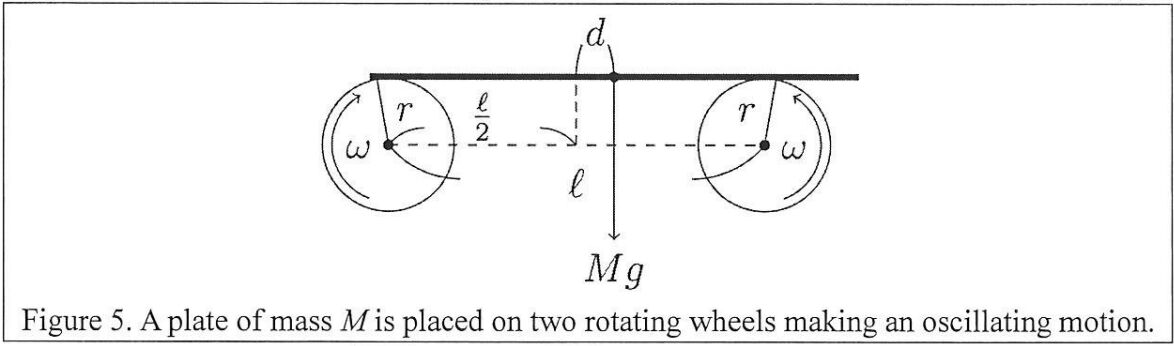
20. A uniform plate of mass M is placed on two fast-rotating identical wheels of radius r. The coefficients of kinetic friction between the plate and both wheels are μ, the distance between the centers of the two wheels is , the wheel on the right (left) rotates counterclockwise (clockwise) with angular speed ω (see Fig. 5), and the gravitational acceleration is denoted g. If the mass center of the plate is displaced by d from the center of the two wheels, what is the frequency the plate oscillates with? (Assuming the plate is so heavy that it always stays on the wheels.)(A) ω (B) (C) (D)
 阿摩線上測驗
登入
 (B)
 (C)
 (D)

 (B)
 (C)
 (D)

 (B)
 (C)
 (D)

 sin(2φ) (B) cos(θ) =
 cos(φ) (C) tan(θ) =
 tan(φ) (D) tan(θ) =
 tan(φ)
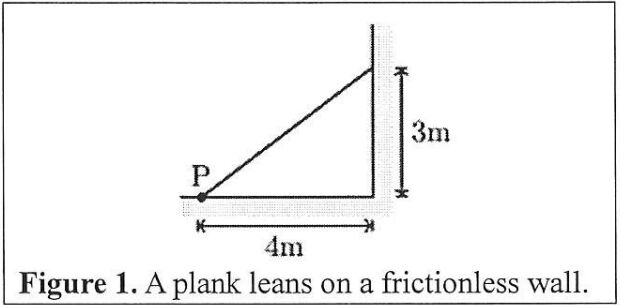 (A) 60 m.N (B) 30 m N (C) 120 m N (D) 80 m N
 (B)
 (C)
 (D)
 (A)
 (B)
 (C) 0 (D)

 (D)

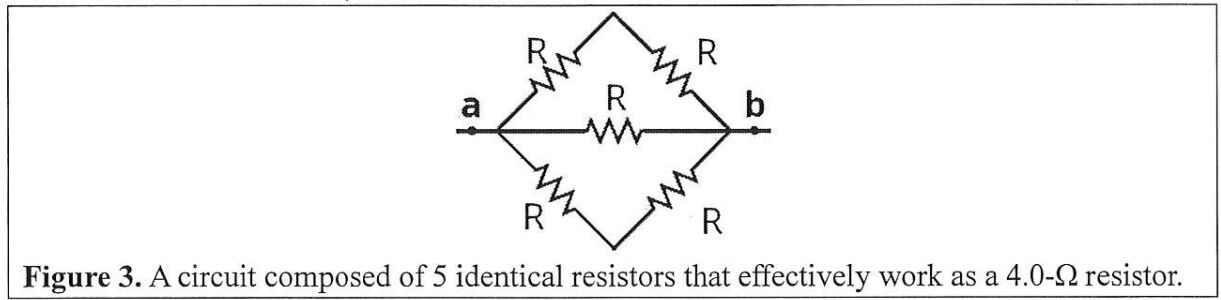 (A) 4.02(B)2.0 Ω (C) 8.0 Ω (D) 0.8 2
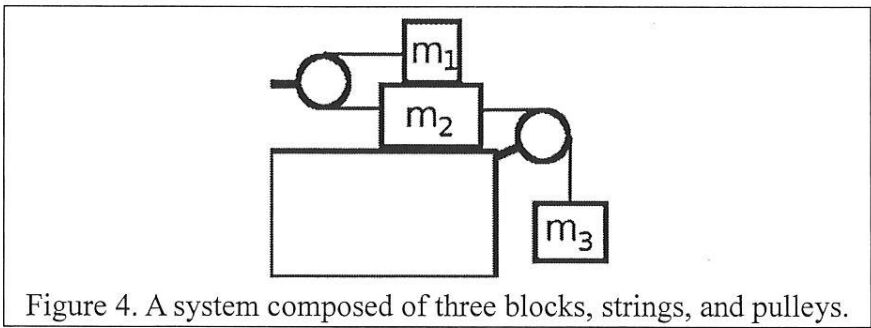 (A) 3.7 m/s² (B) 2.7 m/s² (C) 9.7 m/s2 (D) 8.0 m/s²
 , the wheel on the right (left) rotates counterclockwise (clockwise) with angular speed ω (see Fig. 5), and the gravitational acceleration is denoted g. If the mass center of the plate is displaced by d from the center of the two wheels, what is the frequency the plate oscillates with? (Assuming the plate is so heavy that it always stays on the wheels.)
 (A) ω (B)
 (C)
 (D)
