所屬科目:研究所、轉學考(插大)◆普通物理學
1. A block of mass m is initially moving to the right on a horizontal frictionless surface at a speed v. It then compresses a spring of spring constant k. At the instant when the kinetic energy of the block is equal to the potential energy of the spring, the spring is compressed a distance of: (A)\( v\sqrt{\frac{m}{2k}} \) (B)\( \frac{1}{2}mv^2 \) (C)\( \frac{1}{4}mv^2 \) (D)\( \frac{mv^2}{4k} \) (E)\( \frac{1}{4}\sqrt{\frac{mv}{k}} \)
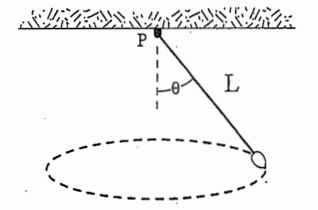
2. A hanged ball moves in a horizontal circle, as shown in the figure below. The length of the string is L, and the gravitational acceleration is g. What is the period of this circular motion? (A)\( 2\pi\sqrt{\frac{L\cos\theta}{g}} \) (B)\( \sqrt{\frac{L\cos\theta}{g}} \) (C)\( \frac{1}{2\pi}\sqrt{\frac{L\cos\theta}{g}} \) (D)\( 2\pi\sqrt{\frac{L}{g}}\cos\theta \) (E)\( \frac{1}{2\pi}\sqrt{\frac{L}{g}}\cos\theta \)
3. An object of mass m is initially at rest on a frictionless horizontal plane. If a constant power P acts on this object for t duration, how far will it travel during this interval? (A)\( \sqrt{\frac{8Pt^3}{9m}} \) (B)\( \sqrt{\frac{Pt^3}{8m}} \) (C)\( \sqrt{\frac{8Pt^3}{9m}} \) (D)\( \sqrt{\frac{Pt^3}{m}} \) (E)\( \sqrt{\frac{5Pt^3}{2m}} \)
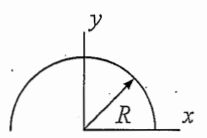
4. Where is the center of mass of the thin semicircular ring (mass M)? (A) (0, (B)\( (0,) (C)\( (0,) (D)\( (0,) (E)( π0,)
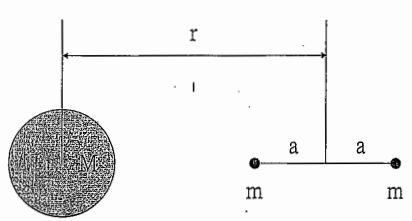
5. A dumbbell has a massless rod and a rod length of 2a. It is placed next to a solid sphere. What is the force difference (the tidal force) between the two particles? (A)\( \frac{4GMa}{5r^3} \) (B)\( \frac{4GMa}{r^3} \) (C)\( \frac{GMa}{r^3} \) (D)\( \frac{GMm}{r^3} \) (E)\( \frac{4GMma}{r^3} \)
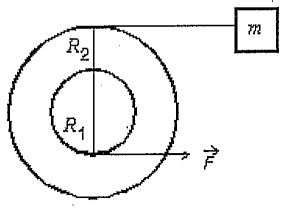
6. A small disk of radius \( R_1 \) is fastened coaxially to a larger disk of radius \( R_2 \). The combination is free to rotate on a fixed axle, which is perpendicular to a horizontal frictionless table top, as shown in the overhead view below. The rotational inertia of the combination is I. A string is wrapped around the larger disk and attached to a block of mass m, on the table. Another string is wrapped around the smaller disk and is pulled with a force \( \overrightarrow{F} \) as shown in fig. below. The tension in the string pulling the block is: (A)\( \frac{mR_1F}{R_2} \) (B)\( \frac{mR_1R_2F}{I - mR_2^2} \) (C)\( \frac{mR_1R_2F}{I + mR_2^2} \) (D)\( \frac{mR_1R_2F}{I - mR_1R_2} \) (E)\( \frac{mR_1R_2F}{I + mR_1R_2} \)
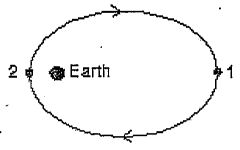
7. A satellite is in elliptical orbit around Earth as shown. If L denotes the magnitude of its angular momentum and K denotes kinetic energy: (A)\( L_2 > L_1 \) and \( K_2 > K_1 \) (B)\( L_2 > L_1 \) and \( K_2 = K_1 \) (C)\( L_2 = L_1 \) and \( K_2 = K_1 \) (D)\( L_2 < L_1 \) and \( K_2 = K_1 \) (E)\( L_2 = L_1 \) and \( K_2 > K_1 \)
8. A simple pendulum is suspended from the ceiling of an elevator. The elevator is accelerating upwards with acceleration a. The period of this pendulum, in terms of its length L, g and a is: (A)\( 2\pi\sqrt{L/g} \) (B)\( 2\pi\sqrt{\frac{L}{g+a}} \) (C)\( 2\pi\sqrt{\frac{L}{g-a}} \) (D)\( 2\pi\sqrt{La} \) (E)\( \frac{1}{2\pi}\sqrt{g/L} \)
9. A point source emits sound waves with a power output of 100 watts. What is the sound level (in dB) at a distance of 10 m? (A)139 (B)119 (C)129 (D)109 (E)10
10. Two harmonic waves traveling in opposite directions interfere to produce a standing wave described by \( y = 2\sin(\pi x)\cos(3\pi t) \) where x is in m and t is in s. What is the distance (in m) between the first two antinodes? (A)8 (B)2 (C)4 (D)1 (E)0.5
11. The temperature of n moles of an ideal monatomic gas is increased by T at constant pressure. The energy Q absorbed as heat, change \( E_{int} \) in internal energy, and work W done by the environment are given by: (A)\( Q = \frac{5}{2}nRT \), \( E_{int} = 0 \), \( W = -nRT \) (B)\( Q = \frac{5}{2}nRT \), \( E_{int} = \frac{5}{2}nRT \), \( W = -\frac{3}{2}nRT \) (C)\( Q = \frac{5}{2}nRT \), \( E_{int} = \frac{5}{2}nRT \), \( W = 0 \) (D)\( Q = \frac{3}{2}nRT \), \( E_{int} = 0 \), \( W = -nRT \) (E)\( Q = \frac{5}{2}nRT \), \( E_{int} = \frac{3}{2}nRT \), \( W = -nRT \)
12. Work done in an isobaric process by an ideal gas is (A)\( nRT2\ln(V2/V1) (B)\( nRT_1(1-V1/V2) (C)\( nRT_1\lnV1/V2) (D)\( nRT_1(1-V2/V1)
13. During a reversible adiabatic expansion of an ideal gas, which of the following is NOT true? (A)\( pV^{\gamma} = \text{constant} \) (B)\( pV = nRT \) (C)\( TV^{\gamma-1} = \text{constant} \) (D)\( W = -pdV \) (E)\( pV = \text{constant} \)
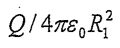
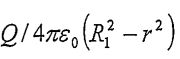
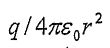
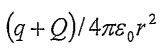
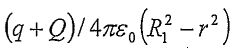
14. Positive charge Q is placed on a conducting spherical shell with inner radius \( R_1 \) and outer radius \( R_2 \). A point charge q is placed at the center of the cavity. The magnitude of the electric field at a point outside the shell, a distance r from the center, is: (A) (B) (C)(D)(E)
15. A charge of +3.0 μC is distributed uniformly along the circumference of a circle with a radius of 20 cm. How much external energy is required to bring a charge of 25μC from infinity to the center of the circle? (A)5.4 J (B)3.4 J (C)4.3 J (D)2.7 J (E)6.8 J
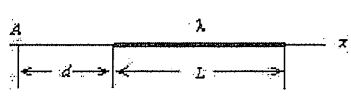
16. A wire of uniform charge density λ and length L lies along the x axis as shown in Figure. What is the electric potential at point A? [k=1/(4πε)] (A)\( k\lambda\ln[1+d/L] \) (B)\( k\lambda\ln[1+L/d] \) (C)\( k\lambda L/d \) (D)\( k\lambda d/L \) (E)\( k\lambda d(L+d) \)
17. A dipole of dipole moment p is placed in a uniform electric field E. The maximum potential energy difference that can occur as the dipole is rotated is: (A)0 (B)pE (C)2pE (D)πpE
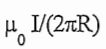
18. The semicircular wire of radius R connects two straight wire segments. If a current I follows along the wire, the magnetic field at the center of the semicircular wire due to the current in the semicircular wire is: (A)(B)(C) (D)
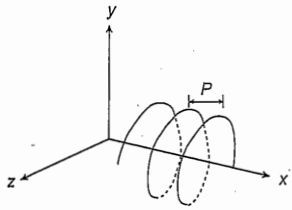
19. A charged particle (m = 2.0 g, q = −50 μC) moves in a region of uniform field along a helical path (radius = 4.0 cm, pitch = 8.0 cm) as shown. What is the angle between the velocity of the particle and the magnetic field? (A)27° (B)72° (C)63° (D)18° (E)58°
20. An inductance L, resistance R, and ideal battery of emf ε are wired in series. A switch in the circuit is closed at time 0, at which time the current is zero. At any later time t, the emf of the inductor is given by: (A)\( \varepsilon(1 - e^{-Lt/R}) \) (B)\( \varepsilon e^{-Rt/L} \) (C)\( \varepsilon(1 + e^{-Rt/L}) \) (D)\( \varepsilon(1 - e^{-Rt/L}) \)
(a)(10%) the kinetic energy of the system when the block has a speed v, and
(b)(10%) the period of oscillation. (Hint: Assume that all portions of the spring oscillate in phase and that the velocity of a segment dx is proportional to the distance x from the fixed end.)
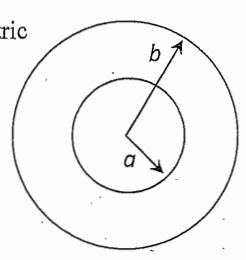
2. A long coaxial cable (as shown in Fig.) consists of two thin walled concentric conducting cylinders with radii a and b. The inner cylinder carries a steady current i, and the outer cylinder provides the return path for that current. The current sets up a magnetic field between the two cylinders. Calculate the energy stored in the magnetic field for a length l of the cable.
 阿摩線上測驗
登入
 (A)\( 2\pi\sqrt{\frac{L\cos\theta}{g}} \) (B)\( \sqrt{\frac{L\cos\theta}{g}} \) (C)\( \frac{1}{2\pi}\sqrt{\frac{L\cos\theta}{g}} \) (D)\( 2\pi\sqrt{\frac{L}{g}}\cos\theta \) (E)\( \frac{1}{2\pi}\sqrt{\frac{L}{g}}\cos\theta \)
 (A) (0,
 (B)\( (0,
 ) (C)\( (0,
 ) (D)\( (0,
 ) (E)( π0,
 )
 (A)\( \frac{4GMa}{5r^3} \) (B)\( \frac{4GMa}{r^3} \) (C)\( \frac{GMa}{r^3} \) (D)\( \frac{GMm}{r^3} \) (E)\( \frac{4GMma}{r^3} \)
 (A)\( \frac{mR_1F}{R_2} \) (B)\( \frac{mR_1R_2F}{I - mR_2^2} \) (C)\( \frac{mR_1R_2F}{I + mR_2^2} \) (D)\( \frac{mR_1R_2F}{I - mR_1R_2} \) (E)\( \frac{mR_1R_2F}{I + mR_1R_2} \)
 (A)\( L_2 > L_1 \) and \( K_2 > K_1 \) (B)\( L_2 > L_1 \) and \( K_2 = K_1 \) (C)\( L_2 = L_1 \) and \( K_2 = K_1 \) (D)\( L_2 < L_1 \) and \( K_2 = K_1 \) (E)\( L_2 = L_1 \) and \( K_2 > K_1 \)
 (B)
 (C)
 (D)
 (E)
 (A)\( k\lambda\ln[1+d/L] \) (B)\( k\lambda\ln[1+L/d] \) (C)\( k\lambda L/d \) (D)\( k\lambda d/L \) (E)\( k\lambda d(L+d) \)
 (B)
 (C)
 (D)
 (A)27° (B)72° (C)63° (D)18° (E)58°