 阿摩線上測驗
-
(15%) A small block of mass \( m \) is released from rest at the top of a frictionless, triangle-shaped wedge of mass \( M \), which sits on a horizontal surface as shown in Fig. 2. The coefficient of static friction between the wedge and horizontal surface is \( \mu_s \). The incline of the wedge makes an angle of \( \theta \) with the horizon. Find the minimum value of \( \mu_s \) so that the wedge does not move relative to the ground when the small block slides down.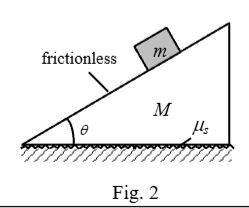
(15%) A small block of mass \( m \) is released from rest at the top of a frictionless, triangle-shaped wedge of mass \( M \), which sits on a horizontal surface as shown in Fig. 2. The coefficient of static friction between the wedge and horizontal surface is \( \mu_s \). The incline of the wedge makes an angle of \( \theta \) with the horizon. Find the minimum value of \( \mu_s \) so that the wedge does not move relative to the ground when the small block slides down.