所屬科目:研究所、轉學考(插大)◆普通物理學
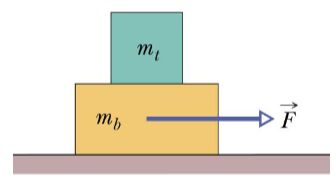
1. (15%) A block of mass \( m_t = 4.0 \text{ kg} \) is put on top of a block of mass \( m_b = 5.0 \text{ kg} \). To cause the top block to slip on the bottom one while the bottom one is held fixed, a horizontal force of at least \( 12 \text{ N} \) must be applied to the top block. The assembly of blocks is now placed on a horizontal, frictionless table as shown. Find the magnitudes of (a) the maximum horizontal force \( \vec{\mathbf{F}} \) that can be applied to the lower block so that the blocks will move together and (b) the resulting acceleration of the blocks.
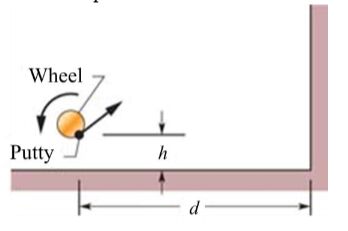
2. (15%) A lump of wet putty moves in uniform circular motion as it rides at a radius of \( 20.0 \text{ cm} \) on the rim of a wheel rotating counterclockwise with a period of \( 5.00 \text{ ms} \). The lump then happens to fly off the rim at the 5 o'clock position (as if on a clock face) as shown. It leaves the rim at a height of \( h = 1.20 \text{ m} \) from the floor and at a distance \( d = 2.50 \text{ m} \) from a wall. At what height on the wall does the lump hit?
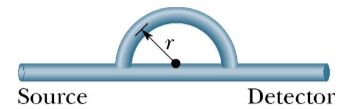
3. (10%) Sound with a 40.0 cm wavelength travels rightward from a source and through a tube that consists of a straight portion and a half-circle. Part of the sound wave travels through the half-circle and then rejoins the rest of the wave, which goes directly through the straight portion as shown. This rejoining results in interference. What is the smallest radius r that results in an intensity minimum at the detector?
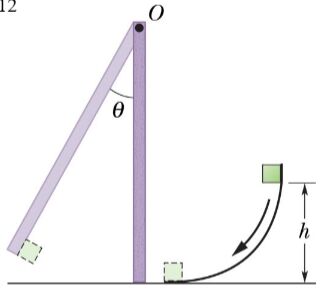
4. (15%) A small block of mass \( m \) slides down a frictionless surface through height \( h \) and then sticks to a uniform rod of mass \( M \) and length \( L \) as shown. The rod pivots about point \( O \) through angle \( \theta \) before momentarily stopping. Find \( \theta \). Hint: The rotational inertia of a uniform thin rod about axis through the center perpendicular to the length \( L \) is \( \frac{1}{12}ML^2 \).
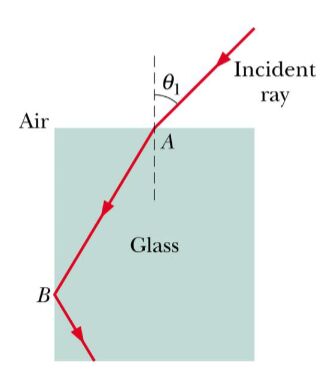
5. (10%) A light ray enters a glass slab at point \( A \) at incident angle \( \theta_1 = 45.0^\circ \) and then undergoes total internal reflection at point \( B \) as shown. What minimum value for the index of refraction of the glass can be inferred from this information?
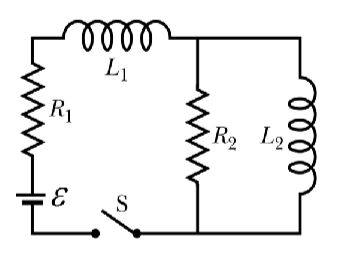
6. (15%) \( R_1 = 8.0 \, \Omega \),\( R_2 = 10 \, \Omega \),\( L_1 = 0.30 \, \text{H} \),\( L_2 = 0.20 \, \text{H} \),and the ideal battery has \( \varepsilon = 6.0 \, \text{V} \) as shown. (a) Just after switch S is closed, at what rate is the current in inductor 1 changing? (b) When the circuit is in the steady state, what is the current in inductor 1?
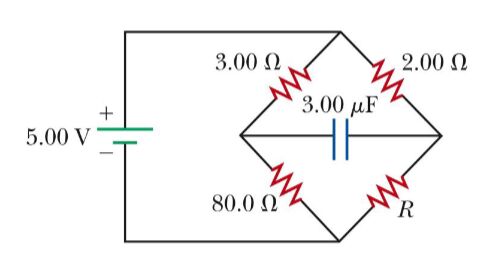
7. (20%) (a) Determine the equilibrium charge on the capacitor in the circuit (as shown) as a function of \( R \). (b) Evaluate the charge when \( R = 10.0 \, \Omega \). (c) Can the charge on the capacitor be zero? If so, for what value of \( R \)? (d) What is the maximum possible magnitude of the charge on the capacitor? For what value of \( R \) is it achieved? (e) Is it experimentally meaningful to take \( R = \infty \)? Explain your answer. If so, what charge magnitude does it imply?
 阿摩線上測驗
登入