1. (15%) A block of mass \( m_t = 4.0 \text{ kg} \) is put on top of a block of mass \( m_b = 5.0 \text{ kg} \). To cause the top block to slip on the bottom one while the bottom one is held fixed, a horizontal force of at least \( 12 \text{ N} \) must be applied to the top block. The assembly of blocks is now placed on a horizontal, frictionless table as shown. Find the magnitudes of (a) the maximum horizontal force \( \vec{\mathbf{F}} \) that can be applied to the lower block so that the blocks will move together and (b) the resulting acceleration of the blocks.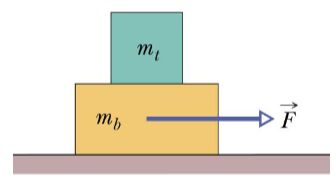
 阿摩線上測驗
登入