所屬科目:學士後西醫-普通生物及生化概論
17. What are (1), (2) and (3) for the following reaction? (A) NADH, pyruvate decarboxylase, NAD+ (B) NADH, pruvate dehydrogenase, NAD+ (C) NAD+, pyruvate decarboxylase, NADH (D) NAD+, pruvate dehydrogenase, NADH (E) None of the above is correct
67. The molecule shown here is acetylsalicylic acid (aspirin). What kind of electrical charge does aspirin carry in the stomach at a pH value of 2 and in the small intestine at a ph value of 7? (A) Negatively charged in the stomach; positively charged in the intestine (B) Negatively charged both in the stomach and the intestine (C) Uncharged in the stomach: negatively charged in the intestine (D) Uncharged both in the stomach and the intestine (E) Uncharged in the stomach; positively charged in the intestine
90. Match the co-enzyme in List I severing as the transient carrier with the specific item or functional group in List II:(A) A -III, B -I, C-II,D-V,E-IV (B) A - IV, B -I, C - II.,D - V,E -II (C) A -I, B -II, C-III, D -IV,E-V (D) A - II, B - V, C-III, D -IV,E -1 (E) A - 1, B - V, C-III, D -IV,E-II
 阿摩線上測驗
登入
 (A) NADH, pyruvate decarboxylase, NAD+ (B) NADH, pruvate dehydrogenase, NAD+ (C) NAD+, pyruvate decarboxylase, NADH (D) NAD+, pruvate dehydrogenase, NADH (E) None of the above is correct
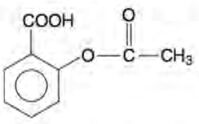 (A) Negatively charged in the stomach; positively charged in the intestine (B) Negatively charged both in the stomach and the intestine (C) Uncharged in the stomach: negatively charged in the intestine (D) Uncharged both in the stomach and the intestine (E) Uncharged in the stomach; positively charged in the intestine

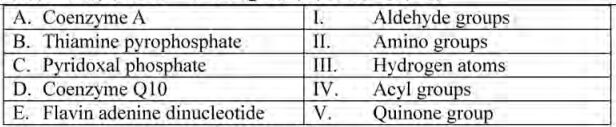 (A) A -III, B -I, C-II,D-V,E-IV (B) A - IV, B -I, C - II.,D - V,E -II (C) A -I, B -II, C-III, D -IV,E-V (D) A - II, B - V, C-III, D -IV,E -1 (E) A - 1, B - V, C-III, D -IV,E-II