所屬科目:研究所、轉學考(插大)◆普通物理學
1. Given a circuit in Fig. 1, which is composed of a battery of voltage V, six resistors of resistance R, and a voltmeter, what is the readout from the voltmeter? (A)(B)(C)(D)(E)
2. It is known that all mechanical quantities, including the universal constants G, c and ħ, can be expressed in terms of length, time, and mass. In SI units, where the base of unit of length is meter (m), time is second (s), and mass is kilogram (kg), the three universal constants are G = 6.67 × m³ ﹒s2﹒, c = 3.00 × 10⁸ m. s¯¹, and ħ = 1.05 × m². . kg. In another unit system, the base units of length, time, and, mass are denoted as lp, tp, and mp, respectively, so that G = , c = . mp. What is lp in SI units? (A) (B)(C)(D)(E)
3. A sound source emits a sound wave of frequency f. If the source is moving toward a stationary observer at one third (i.e., 1/3) of the speed of sound, what frequency does the observer observe? (A) 3f (B)(C) f (D)(E)
4. A string with two ends fixed has 12 Hz, 30 Hz, 33 Hz, and 45 Hz as harmonic frequencies. Which of the following is a possible fundamental frequency (first harmonic) of the string? (A) 2 Hz (B) 3 Hz (C) 5 Hz (D) 12 Hz (E) 18 Hz
5. Two blocks with masses ma and me are attached to two identical springs. The block with mass ma oscillates with amplitude and frequency , while the block with mass me oscillates with amplitude and frequency . What is the ratio between ma and me, i.e., ? (A)(B)(C)(D)(E)
6. Two 5-kg objects with velocities in the unit of m/s collide and stick together. How much energy is lost in the process? (A) 5 J (B) 24 J (C) 78 J (D) 132 J (E) 247 J
7. On July 16, 1945, in the Manhattan Project led by Robert Oppenheimer, a physicist named Richard Feynman was observing the nuclear test. After the bomb was detonated (引爆), Feynman saw the flash of the bomb explosion roughly 40 seconds before he heard the sound of the explosion. Given the speed of light is 3.0 × 10⁸ m/s and the speed of sound is 3.4 × 10² m/s, estimate the distance between Feynman and the place of detonation. (A) 1.6 km (B) 1.4 x 10 km (C) 3.1 × 10² km (D) 7.0 × 10² km (E) 1.2 × 10⁷ km
8. According to the second law of thermodynamics, which of the statements below is correct? (A) Heat can never pass from a colder to a warmer body. (B) Heat cannot be converted into work. (C) Heat can flow spontaneously from hotter to colder regions. (D) It is derived from the first law of thermodynamics. (E) The entropy of a closed system always remains unchanged.
9. Two identical satellites, A and B, are circling around Earth in circular orbits. Given the orbital radius of A is twice that of B, what is the ratio of the speed of A to the speed of B? (A) 1 (B) √2 (C) 1/√2 (D) 2 (E) 1/2
10. If the period of a simple pendulum on Earth is T what would be the period of the same pendulum on the Moon, where the gravitational acceleration is 1/6 of that on Earth? (A) √6T (B) √3T (C) T (D) T/√3 (E) T/√6
11. Two spherical shells, A and B, surround an isolated charged point particle. Given that the radius of shell A is twice that of the radius of shell B, what is the ratio between the electric flux through shell A and the electric flux through shell B? (A) 4 (B) 2 (C) 1 (D) 1/2 (E) 1/4
12. A thin hoop rolls without sliding on a level surface (see Fig. 2). What is the ratio between the rotational energy and the translational energy? (A) 2 (B) √2 (C) 1 (D) 1/√2 (E) 1/2
13. A combination of pulleys is shown in Fig. 3, where a weight of mass m₁ is hung on the leftmost pulley, and a weight of mass m₂ is attached to the right end of the string. What is m₂ in terms of m₁ so that the system is in equilibrium? (A) m₁ (B) m₁/2 (C) m₁/3 (D) m1/8 (E) m₁/16
14. The heat capacities of objects A, B, and Care , respectively. If the temperatures of objects A, B, and C are 60°C, 30°C, and 20°C, what is the equilibrium temperature after objects A, B, and C are in touch? (A) 30°C (B) 35°C (C) 40°C (D) 45°C (E) 50°C
15. About two-thirds of a solid wooden ball of density 0.53 g/ml is floating in an unknown liquid. Which of the following liquids could be the unknown liquid? (A) Ethyl alcohol (density 7.89 × 10² kg/m³) (B) Water (density 1.00 × 10³ kg/m³) (C) Mercury (density 1.36 × 10⁴ kg/m³) (D) Hexane (density 6.54 × 10² kg/m³) (E) Olive oil (density 9.11 × 10² kg/m³)
16. A rocket weighs 1.7 × 10⁶ kg, where 80% of it is the fuel, and exhausts fuel with a relative speed of 2000 m/s. If the rocket is initially at rest in space, what is its speed after consuming all the fuel? (A) 1.0 × 10⁴ m/s (B) 2.5 × 10³ m/s (C) 3.2 x 10³ m/s (D) 1.6 × 10³ m/s (E) 4.0 × 10² m/s
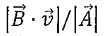
17. A coil with a constant cross-section is moving with velocity in a constant and uniform magnetic field . What is the voltage in the coil generated by the magnet? (A)(B) (C) 0 (D)(E)
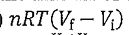
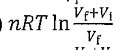
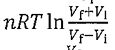
18. How much work is done by an ideal gas in an isothermal expansion from volume ? (Let n be the amount of the gas, R be the gas constant, and T be the absolute temperature.) (A) (B)(C)(D)(E)
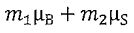
19. A block of mass m₁ is stacked on top of another block of mass m2 and attached via a massless string (see Fig. 4). The coefficient of static friction between the blocks is µg, and the coefficient of static friction between the block and the surface is us. The pullies are massless and frictionless. What is the maximal mass W of a weight attached to the bottom block that still makes the system stationary? (A)(B) (C)(D)(E)
20. After heating a metal annular disc with inner radius r and outer radius r0 (see Fig. 5), which of the following statements is not true? (A) The outer radius r0 increases. (B) The inner radius rĄ increases. (C) The total area of the annular disc increases. (D) The width w, where w = , of the annular disc remains the same. (E) The sum of the areas of the annular disc and the hole increases.
 阿摩線上測驗
登入
 (A)
 (B)
 (C)
 (D)
 (E)

 m³ ﹒s2﹒
 , c = 3.00 × 10⁸ m. s¯¹, and ħ = 1.05 ×
 m².
 . kg. In another unit system, the base units of length, time, and, mass are denoted as lp, tp, and mp, respectively, so that G =
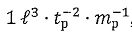 , c =
 . mp. What is lp in SI units? (A)
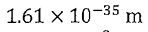 (B)
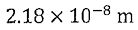 (C)
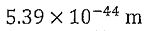 (D)
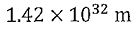 (E)
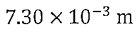
 (C) f (D)
 (E)

 and frequency
 , while the block with mass me oscillates with amplitude
 and frequency
 . What is the ratio between ma and me, i.e.,
 ? (A)
 (B)
 (C)
 (D)
 (E)

 in the unit of m/s collide and stick together. How much energy is lost in the process? (A) 5 J (B) 24 J (C) 78 J (D) 132 J (E) 247 J
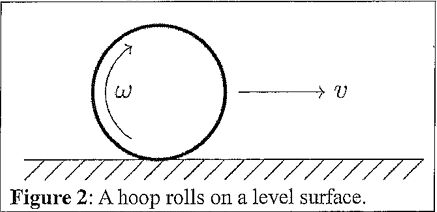 (A) 2 (B) √2 (C) 1 (D) 1/√2 (E) 1/2
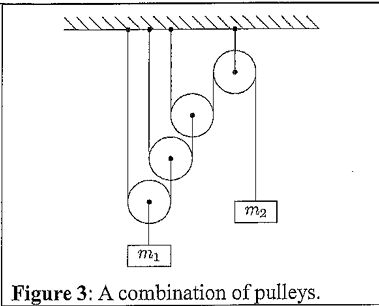 (A) m₁ (B) m₁/2 (C) m₁/3 (D) m1/8 (E) m₁/16
 , respectively. If the temperatures of objects A, B, and C are 60°C, 30°C, and 20°C, what is the equilibrium temperature after objects A, B, and C are in touch? (A) 30°C (B) 35°C (C) 40°C (D) 45°C (E) 50°C
 is moving with velocity
 in a constant and uniform magnetic field
 . What is the voltage in the coil generated by the magnet? (A)
 (B)
 (C) 0 (D)
 (E)

 ? (Let n be the amount of the gas, R be the gas constant, and T be the absolute temperature.) (A)
 (B)
 (C)
 (D)
 (E)

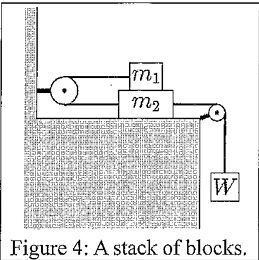 (A)
 (B)
 (C)
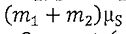 (D)
 (E)
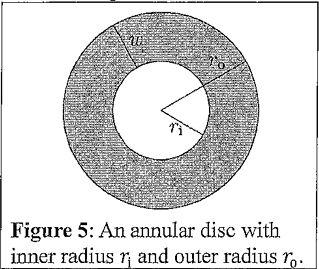 (A) The outer radius r0 increases. (B) The inner radius rĄ increases. (C) The total area of the annular disc increases. (D) The width w, where w =
 , of the annular disc remains the same. (E) The sum of the areas of the annular disc and the hole increases.