所屬科目:研究所、轉學考(插大)◆普通物理學
1. In Figure 1, the observer at O views two closely spaced lines through an angled piece of plastic. How do the lines appear to the observer?
(A) shifted to the right. (B) shifted to the left. (C) spaced farther apart. (D) spaced closer together. (E) exactly as they do without the piece of plastic.
2. In Figure 2, monochromatic light with a wavelength in air of λ= λ0 = 500 nm shines normally on a pair of identical glass microscopic slides (I= 10.0 cm in length) that form a very narrow wedge (with thickness h = 0.0200 mm). The top surface of the upper slide and the botton surface of the lower slide have special coatings on them so that they reflect no light. In the following, which position corresponds to a dark fringe? (A) x = 1.75 mm, (B) x = 1.00 mm, (C) x = 1.25 mm, (D) x = 2.20 mm, (E) x = 2.15 mm. A periodic transverse wave travels along an x-axis. Figure 3(a) gives the displacements of elements as a function of x at time t = 0. Figure 3(b) gives the displacements of elements at x = 0 as a function of time t.
4. At t = 0, what is the transverse velocity of the element at x = 9 cm?(A) +2 cm/s, (B) -2 cm/s, (C) +10 cm/s,(D)-10 cm/s, (E) 0 cm/s.
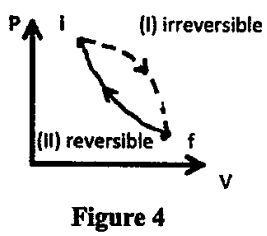
5. Consider a heat engine operating in a closed cycle, as illustrated in Figure 4. The cycle begins at initial state i and involves a irreversible process leading to final state f, followed by an reversible process returning the system from state f back to i Choose the correct description from the following options, based on this cycle that commences from state i:
(A) (B) (C) In the entire cycle i → f →i the cyclic integral (D) the integral(E) In the process from i to f, the system releases heat.
9. A mass m object moves along a circular path with radius R in a vertical plane . At the beginning it locates at the bottom with an initial speed , Ignoring air resistance, the speed v of the object at the top of the path is: (A) (B)(C)(D)(E) V..
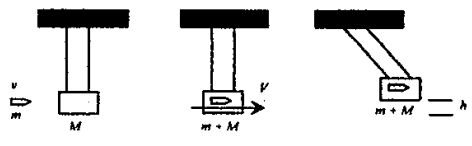
10. A ballistic pendulum, a device for measuring the speed of a bullet, consists of a block of wood suspended by cords. When the bullet is fired into the block, the block is free to rise. How high does a 5.0 kg block rise when a 12 g bullet traveling at 350 m/s is fired into it?
(A) 5.4 cm, (B) 24 cm, (C) 3.6 cm, (D) 36 cm, (E) 12cm.
11. In a binary star system, Star A, which has triple the mass of Star B, orbits their common center of mass in circular patbs. Without external forces, what is the relationship between their orbital periods according to Newton's law of universal gravitation? (A) Star A's period is 1/ of Star B's. (B) Star A's period is the same as Star B's. (C) Star A's period is times Star B's. (D) Star A's period is twice Star B's. (E) Star A's period is half of Star B's.
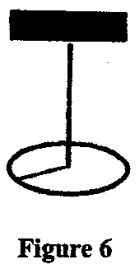
12. What is the restoring constant (torsional constant) for a disk of mass 3.0 kg and radius 0.20 m oscillating with a period of 2.0 s? (A) 7.87 Nㆍm, (B) 0.24 Nㆍm, (C) 0.59 Nㆍm, (D) 1.12 Nㆍm, (E) 3.56 N ㆍm.
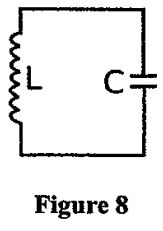
15. An LC circuit, as shown in the diagram, reaches a certain state a moment after being energized. The circuit bas an inductance value of L = 4 Wb/A and a capacitance value of C= 4 A . s/V, with the assumption that the circuit's resistance can be ignored. Under these conditions, the circuit will ultimately exhibit:
(A) no current flow. (B) oscillating current with a period of 16 seconds. (C) oscillating current with a period of 3.14 seconds. (D) oscillating current with a period of 12.56 seconds. (E) oscillating current with a period of 25.12 seconds.
16. A circular ring with a diameter of 20 cm and a resistance of 0.01 Ω is subject to a uniform magnetic field of 2.0 T. Calculate the amount of chatge that will flow through the ring when it is rotated from a position perpendicular to the magnetic field to one that is parallel to the field. (A) 3.14 C, (B) 6,.28 C, (C) 2.50 C, (D) 4.62 C, (E) 10 C.
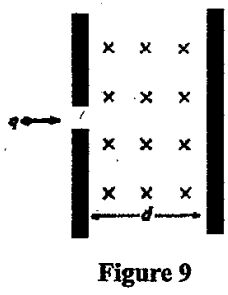
18. A particle with charge 9 and mass m is shot with kinetic energy K into the region between two plates as shown in Figure 9. If the magnetic field between the plates is B and as shown, how large must B be if the particle is to miss collision with the opposite plate?
(A) B = (2mK)1/2/qd, (B) B = (2mK)1/2/2qd, (C) B=(4mK)1/2/3qd,(D)B=(3mK)1/2/2qd,(E) B=(mK)1/2/qd.
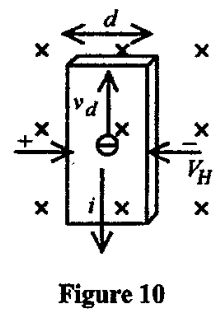
19. In a Hall effect experiment, the cutrent is 2.0 x 10⁻³ A when 2.0 V is applied to a semiconductor of length 6.0 cm, width 3.0 cm, and depth 0.20 cm. A magnetic field of 2.0 T produces a Hall voltage of 2.0 x 10⁴ V.
(A) cutrent density j = 3.3 A/m2, (B) number carrier density 6.0 X 10²⁰/m3, (C) Hall Field EH =6.7x10⁻⁴ V/im, (D) resistivity ρ = 1.0 Ωㆍm, (E) All of the above are correct.
 阿摩線上測驗
登入
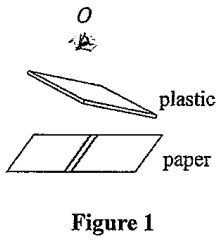 (A) shifted to the right. (B) shifted to the left. (C) spaced farther apart. (D) spaced closer together. (E) exactly as they do without the piece of plastic.
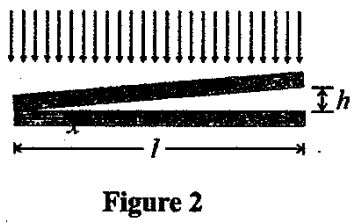 (A) x = 1.75 mm, (B) x = 1.00 mm, (C) x = 1.25 mm, (D) x = 2.20 mm, (E) x = 2.15 mm.
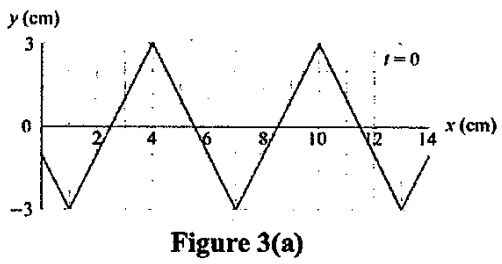
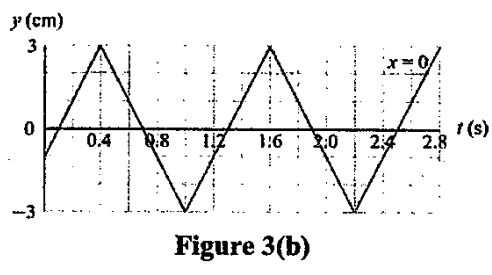 (A) +2 cm/s, (B) -2 cm/s, (C) +10 cm/s,(D)-10 cm/s, (E) 0 cm/s.
 (A)
 (B)
 (C) In the entire cycle i → f →i the cyclic integral
 (D) the integral
 (E) In the process from i to f, the system releases heat.
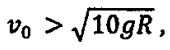 , Ignoring air resistance, the speed v of the object at the top of the path is: (A)
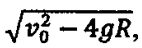 (B)
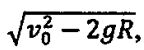 (C)
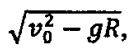 (D)
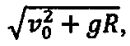 (E) V..
 (A) 5.4 cm, (B) 24 cm, (C) 3.6 cm, (D) 36 cm, (E) 12cm.
 of Star B's. (B) Star A's period is the same as Star B's. (C) Star A's period is
 (A) 7.87 Nㆍm, (B) 0.24 Nㆍm, (C) 0.59 Nㆍm, (D) 1.12 Nㆍm, (E) 3.56 N ㆍm.
 (A) no current flow. (B) oscillating current with a period of 16 seconds. (C) oscillating current with a period of 3.14 seconds. (D) oscillating current with a period of 12.56 seconds. (E) oscillating current with a period of 25.12 seconds.
 (A) B = (2mK)1/2/qd, (B) B = (2mK)1/2/2qd, (C) B=(4mK)1/2/3qd,(D)B=(3mK)1/2/2qd,(E) B=(mK)1/2/qd.
 (A) cutrent density j = 3.3 A/m2, (B) number carrier density 6.0 X 10²⁰/m3, (C) Hall Field EH =6.7x10⁻⁴ V/im, (D) resistivity ρ = 1.0 Ωㆍm, (E) All of the above are correct.