所屬科目:研究所、轉學考(插大)◆普通物理學
1. A physical equation A =5-sin(BC), where A has the dimensions L/M, and C has the dimensions L/T. So B has the dimensions ______
2. A 18-N horizontal force is applied to a 40-N block initially at rest on a rough horizontal surface. If the coefficients of friction are = 0.5 (static) and = 0.4 (kinetic), the magnitude of the frictional force on the block is ______
3. A force varies as = xy²î. What is the work done by the force along the paths OB?
4. Same conditions as the above question, does the force = xy²î satisfy the criterion for being conservative (yes or no)? ______
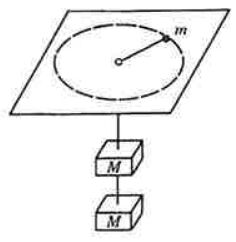
5. A particle of mass m travels in a horizontal circle on a frictionless table. The centripetal force is provided by a string, attached to two bodies of equal mass M, which passes through a hole in the table. The radius of the circle is r. If one of the hanging masses is removed, the new radius will be ______
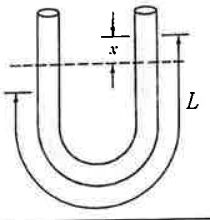
6. Water fills a length L of a U tube. The water is slightly displaced and then allowed to move freely. The liquid will then execute a simple harmonic motion. What is the angular frequency (ω) of the oscillation?
7. One mole of an ideal monatomic gas is taken around the reversible cycle as shown in the figure. The isothermals are at 500 K and 300 K. Find the efficiency of the engine.
8. Same conditions as the above question, find the total entropy change of the heat engine from b to a through the process of b→ c → d → a.
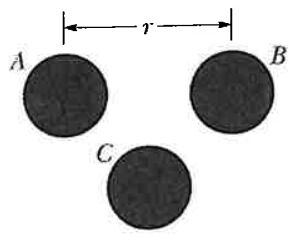
9. The figure shows three identical conducting spheres with these initial charges: A, -12Q, B, +8Q, C, 0. Here is the procedure for connecting and then disconnecting spheres with wire:
Step 1: connect A and C and then disconnect;
Step 2: connect B and C and then disconnect, moving C far away;
Step 3: connect A and B and then disconnect.
A and B have a center-to-center separation r. What is the magnitude of the final force between those two spheres? Answer by writing what goes in the blank in this equation: F = _kQ² / r².
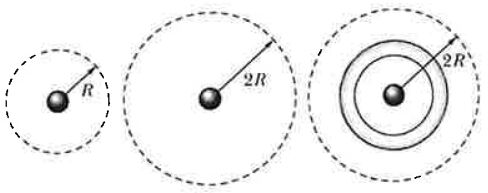
10. The figure shows three situations in which the same charged particle is surrounded by a concentric Gaussian sphere.
(1) sphere has radius R
(2) sphere has radius 2R
(3) sphere has radius 2R and also surrounds a neutral metal spherical shell
Rank the three situations according to the magnitude of the electric flux through the surface of the Gaussian sphere, greatest first. NOTE:請依序排列,並加註大於、小於、或等於符號(>, <, or =)。
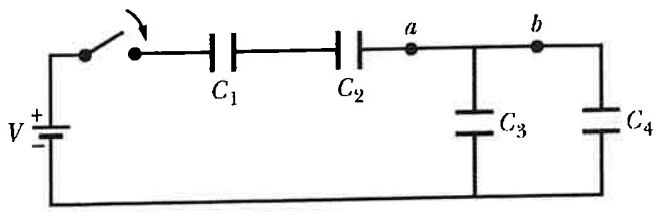
11. In the following figure, we have V = 9.0 V, C2 = 3.0 µF, and C4 = 4.0 µF, and all the capacitors are initially uncharged. When switch S is closed, a total charge of 20 µC passes through point a and a total charge of 8.0 µC passes through point b. What is capacitance C3 (uF)?
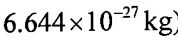
12. An alpha particle (q = +2e, m = ) travels in a circular path of radius 4.50 cm in a uniform magnetic field with B = 1.20 T. Through what potential difference (volts) was it accelerated (from rest) to have the kinetic energy required for this path?
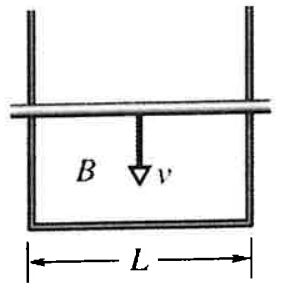
13. The figure shows a conducting bar sliding at speed along a wire in the shape of "U" through a uniform magnetic field that is perpendicular to the wire and bar: speed = 3.0 m/s, left-right width L = 5.0 m, induced emf = 360 V counterclockwise. What is the magnitude (T) of the magnetic field?
14. The large space telescope that has been placed into Earth orbit has an aperture diameter of 2.40 meters. What angular resolution will this telescope achieve for visible light with a wavelength of m? Please show the unit in radians.
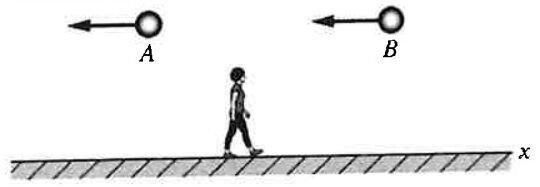
15. The figure shows two particles moving in the negative direction of an x axis past an observer. Relative to the observer, particle A moves at speed 0.950c and particle B moves at speed 0.900c. What speed will A measure for B?
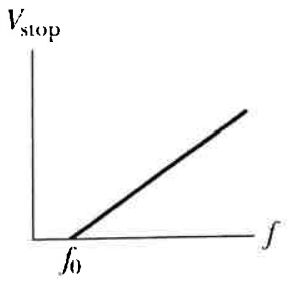
16. The following figure is a plot of stopping voltage versus light frequency f in a photoelectric experiment with a certain metal with a work function Ф. What is the slope?
(a) Find the angular acceleration of the pulley.
(b) Assuming that the system starts from rest, find the speed of m₁ after it has fallen by H.
(a) What is the energy of the photon emitted as a result of the transition?
(b) What are the higher quantum number and lower quantum number of the transition producing this emission?
 阿摩線上測驗
登入
 = 0.5 (static) and
 = 0.4 (kinetic), the magnitude of the frictional force on the block is ______
 = xy²î. What is the work done by the force along the paths OB?
 = xy²î satisfy the criterion for being conservative (yes or no)? ______
 ) travels in a circular path of radius 4.50 cm in a uniform magnetic field with B = 1.20 T. Through what potential difference (volts) was it accelerated (from rest) to have the kinetic energy required for this path?
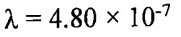 m? Please show the unit in radians.
 versus light frequency f in a photoelectric experiment with a certain metal with a work function Ф. What is the slope?