所屬科目:研究所、轉學考(插大)◆普通物理學
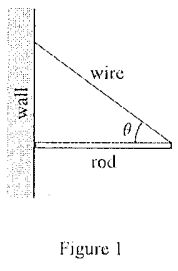
1. As shown in Fig. 1, a solid rod is hanged by a wire attached to its right. The left of the rod contacts the wall with force of friction. If the coefficient of static friction is μ_s, what is the maximum value of θ that the rod can keep stable?
(A) θ = tan⁻¹ μ_s (B) θ = cot⁻¹ μ_s (C) θ = sin⁻¹ μ_s (D) θ = cos⁻¹ μ_s (E) θ = sec⁻¹ μ_s
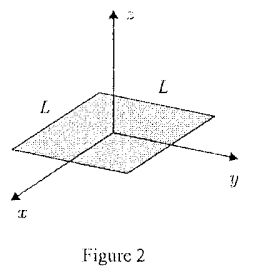
2. As shown in Fig. 2, a thin square plate with mass m and sides of length L is lain on the x-y plane. The center of the plate is put on the origin. Find the moment of inertia along the x-axis.
(A) (B) (C) (D) (E)
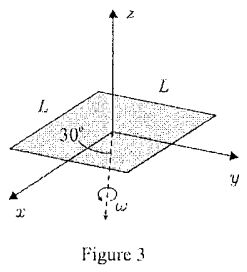
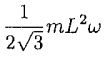
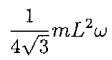
3. Continued from question 2, consider the plate rotates with another axis lain on the x-y plane as shown in Fig. 3. The angle between the axis and x-axis is 30°. The angular frequency of rotation is ω. What is the magnitude of the angular momentum?
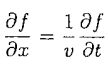
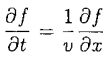
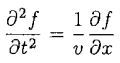
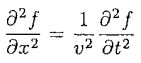
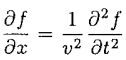
4. What is the correct form of the 1-dimensional wave equation?_______
where f is dynamic variable, x is position, t is time, and v is wave velocity. (A)(B) (C) (D) (E)
5. In general, the resistivity of a conductor increases as the temperature increases. However, the resistivity of a pure semiconductor may decreases as the temperature increases. What is the possible reason of this unusual behavior of semiconductor? (A) The collisions between free electrons and atoms are reduced as the temperature increases. (B) The collisions between free electrons and atoms are enhanced as the temperature increases. (C) The drift velocity of electrons is increased as the temperature increases. (D) The electron density is decreased as the temperature increases. (E) The electron density is increased as the temperature increases.
6. A radio station broadcasts electromagnetic waves with a power of 2000 W. Assume the station acts as a point source. What is the amplitude of the electric field at a position 860-m away from the station? (A) 0.8 V/m (B) 0.7 V/m (C) 0.6 V/m (D) 0.5 V/m (E) 0.4 V/m
7. A parallel plate capacitor has circular plates of radius r = 2 cm separate by a distance d = 1 mm. If the potential difference between the plates changes at 10⁴ (volt/sec), what is its displacement current? (A) 4.0 × 10⁻¹⁰ amp (B) 2.0 × 10⁻⁹ amp (C) 1.0 × 10⁻⁸ amp (D) 5.0 × 10⁻⁸ amp (E) 2.5 × 10⁻⁷ amp
8. An observer A stands on the ground with clock CA and an observer B sits on a train with clock CB. The train moves with a velocity v with respect to the ground. Consider the relativistic time dilation effect, which one of the following descriptions is correct? (A) Both A and B find that CA counts slower than CB. (B) Both A and B find that CA counts as fast as CB. (C) Both A and B find that CA counts faster than CB. (D) The observer A finds that CA counts slower than CB, but the observer B finds that CB counts slower than CA. (E) The observer A finds that CA counts faster than CB, but the observer B finds that CB counts faster than CA.
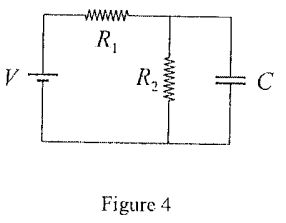
9. The circuit in Fig. 4 has reached steady-state condition. Find the potential difference across the first resistor R₁. Take V = 12 volt, R₁ = 3 Ω, R₂ = 1 Ω, and C = 1 μF.
(A) 3 volt (B) 6 volt (C) 9 volt (D) 10 volt (E) 12 volt
10. A positron collides head on with an electron and both are annihilated. Each particle had a kinetic energy of 1.5 MeV. What is the wavelength of the resulting photons? (A) 3.09 × 10⁻¹³ m (B) 6.18 × 10⁻¹³ m (C) 1.24 × 10⁻¹² m (D) 2.48 × 10⁻¹² m (E) 1.24 × 10⁻¹¹ m
1. Which ones of the following principles can be used to explain the propagation of light? (A) Heisenberg's uncertainty principle (B) Fermat's principle of least time (C) Huygens' principle of wave (D) Pauli's exclusion principle (E) Newton's law of motion
2. Consider the second law of thermodynamics. Which ones of the following statements are correct? (A) It is possible for a heat engine that operates in a cycle to convert its heat input completely into work. (B) In a reversible process the entropy of an isolated system increases; in an irreversible process the entropy stays constant. (C) In a reversible process the entropy of an isolated system stays constant; in an irreversible process the entropy decreases. (D) No cyclical heat engine has a greater efficiency than a reversible engine operating between the same two pressures. (E) It is possible for a heat engine that operates in a cycle to transfer heat continuously from a hot body to a cold body without the input of work.
3. Consider an ideal gas is initially confined to part of a thermally insulated box with a thin membrane. When the membrane is punctured, the gas rapidly expands to fill the whole box. Compare the initial and final states of the system. Which ones of the following quantities are not varied? (A) temperature of the gas (B) internal energy of the gas (C) pressure of the gas (D) entropy of the gas (E) entropy of the box
4. Consider the single-slit diffraction of light. Which ones of the following actions can broaden the diffraction pattern? (A) Increase the width of slit. (B) Increase the intensity of light. (C) Increase the frequency of light. (D) Increase the wavelength of light. (E) Increase the distance between the slit and the screen.
5. Which ones of the following statements are the postulates of the Bohr model of hydrogen atom? (A) The electron moves only in certain circular orbits, called stationary states. (B) The electron must be treated as a matter wave that each stationary state corresponds to a standing wave. (C) The momentum of the electron is restricted to integer multiples of ℏ. (D) The angular momentum of the electron is restricted to integer multiples of ℏ. (E) Radiation occurs only when an electron goes from one allowed orbit to another of lower energy. The emitted photon energy must equal to the total energy of these two orbits.
6. To give a correct interpretation of the Compton scattering effect, which ones of the following quantities should be quantized? (A) photon energy (B) photon momentum (C) photon angular momentum (D) electron energy (E) electron angular momentum
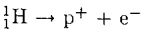
7. Which ones of the following reactions are nuclear reactions? (A) p⁺ → n⁰ + e⁺ + ν_e (B) (C) (D) 2 H₂ + O₂ → 2 H₂O (E)
Part III: Explanation (35 points, You may use English or Chinese in your answer. The whole answer must be less than 500 words.)
It is known that both the matter and energy exhibit wave-particle duality. Please explain what are the "wave property" and the "particle property". Furthermore, take "light" (electromagnetic wave) as an example and discuss that in what condition it behaves more like an ideal wave and in what condition it behaves more like an ideal particle. Give a real phenomenon to support your discussion. (35 points, answer must be less than 500 words.)
 阿摩線上測驗
登入
 (A) θ = tan⁻¹ μ_s (B) θ = cot⁻¹ μ_s (C) θ = sin⁻¹ μ_s (D) θ = cos⁻¹ μ_s (E) θ = sec⁻¹ μ_s
 (A)
 (B)
 (C)
 (D)
 (E)

 (A)
 (B)
 (C)
 (D)
 (E)
 (B)
 (C)
 (D)
 (E)
 (A) 3 volt (B) 6 volt (C) 9 volt (D) 10 volt (E) 12 volt
 (C)
 (D) 2 H₂ + O₂ → 2 H₂O (E)
