所屬科目:研究所、轉學考(插大)◆普通物理學
1. Which one of the following physical quantities is a pseudo-vector? (A) position (B) velocity (C) electric field (D) kinetic energy (E) angular momentum
2. A hanged ball moves in a horizontal circle, as shown in the right figure. The length of the string is L, and the gravitational acceleration is g. What is the period of this circular motion?
(A) (B) (C)(D)(E)
3. What is the work-energy theorem in particle kinematics? (A) The net work done on a particle is equal to the resulting change in its kinetic energy. (B) The net work done on a particle is equal to the resulting change in its potential energy. (C) The net work done on a particle is equal to the resulting change in its total energy. (D) The change of kinetic energy of a particle results in a net work done on its surroundings. (E) The change of potential energy of a particle results in a net work done on its surroundings.
4. Consider a collision between two objects. Which one of the following statements is wrong? (A) If the collision is elastic, the total kinetic energy is conserved after the collision. (B) If the collision is elastic, the total momentum is conserved after the collision. (C) If the collision is inelastic, the internal energy of these two objects may increase. (D) If the collision is inelastic, the total momentum is not conserved after the collision. (E) If the collision is inelastic, the total kinetic energy is not conserved after the collision.
5. Consider a uniform solid sphere with radius R. The gravitational field strength f is determined by the distance r from the center. What is the correct dependence of r inside the sphere (r < R)? (A) f ∝ 1/r² (B) f ∝ 1/r (C) f ∝ r⁰ (D) f ∝ r¹ (E) f ∝ r²
6. Consider a thermodynamic system and its surroundings. What is the correct description of a reversible process? (A) A reversible process must be a quasi-static process. (B) During a reversible process, the temperature of the system must keep constant. (C) During a reversible process, the temperature of its surroundings must keep constant. (D) During a reversible process, the entropy of the system must keep constant. (E) During a reversible process, the entropy of its surroundings must keep constant.
7. The equation of motion of a driven oscillator is written as
where m is the mass of the oscillator, kx is the restoring force, F is the amplitude of the driven force, and ω is the angular frequency of the driven force. In what condition the oscillation becomes out of phase?
(A) (B) (C) (D) (E)
8. The wave function of a transverse string wave is written as
y(x, t) = y₀ sin(kx - ωt)
where y₀, k, and ω are amplitude, wave number, and angular frequency, respectively. Consider the cycle-averaged power P transmitted by the wave. What is the correct relation between P and y₀? (A) P ∝ 1/y₀² (B) P ∝ 1/y₀ (C) P ∝ y₀⁰ (D) P ∝ y₀¹ (E) P ∝ y₀²
9. The pressure(P)-volume(V) diagram of a thermodynamic cycle is shown in the right figure (solid line). What area in the P-V diagram represents the work done by the system in each cycle?
(A) α (B) β (C) γ (D) α + β (E) β + γ
10. What is the microscopic interpretation of the temperature of an ideal gas? (A) average potential energy of the gas particles (B) average kinetic energy of the gas particles (C) average momentum of the gas particles (D) average angular momentum of the gas particles (E) average mass of the gas particles
11. A charge q sits at the back corner of a cube, as shown in the right figure. The length of the edge of the cube is L. The permittivity constant is ε₀. What is the flux of electric field through the shaded surface of the figure?
(A) (B)(C)(D)(E)
12. Which one of the following formulas is not the unit of electric field? (A) (B)(C)(D) (E)
13. The electric field of an electromagnetic wave is written as E(x, y, z, t) = E₀ cos(ky - ωt) eₓ, where E₀ is the amplitude, eₓ is the unit vector of z-axis, k is the wave number, and ω is the angular frequency. What is the magnetic field of this wave? (A) B(x, y, z, t) = (E₀/c) cos(ky - ωt) eₓ (B) B(x, y, z, t) = -c E₀ cos(ky - ωt) eₓ (C) B(x, y, z, t) = -(E₀/c) cos(ky - ωt) eᵧ (D) B(x, y, z, t) = (E₀/c) cos(kz - ωt) eₓ (E) B(x, y, z, t) = c E₀ cos(kx - ωt) eᵧ
14. Consider electric capacitors made by parallel metallic plates. Which one of the following configurations stores maximum energy in the capacitors? Assume all metallic plates are identical, and the gray areas represent dielectric media. (A) (B)(C) (D) (E)
15. There is a current I passing through an inductor with inductance L. How much energy is stored in the inductor? (A) (B) (C) (D) (E)
16. Consider two observers A and B sit on two trains Tₐ and TB, respectively. These two trains have the same proper length. If Tₐ stays in a station and TB moves with a velocity v with respect to the station. When they overlap in the station, which one of the following statements is correct? (A) The observer A finds that Tₐ is shorter than TB, but the observer B finds that TB is shorter than Tₐ. (B) The observer A finds that TB is shorter than Tₐ, but the observer B finds that Tₐ is shorter than TB. (C) Both A and B find that Tₐ is shorter than TB. (D) Both A and B find that TB is shorter than Tₐ. (E) Both A and B find that TB and Tₐ have the same length.
17. Consider the nuclear activity. Which one of the following elements is the most unstable one? (A) He² (B) Na¹¹ (C) Xe⁵⁴ (D) Pb⁸² (E) Ra⁸⁸
18. Which one of the following description of the matter wave Ψ(x, t) is correct? (A) The probability of finding a particle at position x and time t is proportional to the value of |Ψ(x, t)|². (B) The probability of finding a particle at position x and time t is proportional to the value of |Ψ(x, t)|. (C) The probability of finding a particle at position x and time t is proportional to the value of Ψ(x, t). (D) The mass distribution of a particle at position x and time t is proportional to the value of |Ψ(x, t)|². (E) The mass distribution of a particle at position x and time t is proportional to the value of |Ψ(x, t)|.
19. According to the Bohr model of hydrogen atom, the wave function of the electron forms a standing wave inside the atom. This result is derived from what postulate? (A) quantization of energy of the electron (B) quantization of velocity of the electron (C) quantization of momentum of the electron (D) quantization of angular momentum of the electron (E) quantization of charge of the electron
20. Which one of the following statement of superconductor is wrong? (A) The resistivity goes to zero. (B) When temperature increases higher than its critical temperature, the superconductivity will disappear. (C) The electric field inside a superconductor must be zero. (D) The magnetic field inside a superconductor must be zero. (E) The conductivity goes to infinity.
21. A solid rod is hanged by a wire attached to its right, as shown in the figure. The left of the rod contacts the wall with friction force. If the coefficient of static friction is μs, what is the maximum value of θ that the rod can keep stable? (A) θ = tan⁻¹ μs (B) θ = cot⁻¹ μs (C) θ = sin⁻¹ μs (D) θ = cos⁻¹ μs (E) θ = sec⁻¹ μs
22. As shown in the figure, a copper strip of width d = 2 (cm), carrying a current I = 100 (mA), is put in an external magnetic field B = 0.02 (tesla). A potential difference ΔV = VL - VR is measured to be 5 (mV). What is the drift velocity of the charge carrier?
(A) 12.5 (m/sec) (B) 20 (m/sec) (C) 25 (m/sec) (D) 40 (m/sec) (E) 50 (m/sec)
23. 2-kg ice at -10°C is added to 5-kg water at 45°C. What is the final temperature of the system? The specific heat of ice and water are 2100 J/kg-K and 4190 J/kg-K, respectively. The latent heat of ice-water transition is 334000 J/kg. (A) 7.5 °C (B) 7.7 °C (C) 7.9 °C (D) 8.1 °C (E) 8.3 °C
24. Find the lower limit of γ-ray frequency for pair production (electron-positron creation).
Note: electron and positron mass mₑ = 9.1 × 10⁻³¹ kg
speed of light c = 3 × 10⁸ m/sec
Planck's constant h = 6.6 × 10⁻³⁴ J-sec (A) 2.0 × 10²⁰ Hz (B) 2.5 × 10²⁰ Hz (C) 3.0 × 10²⁰ Hz (D) 3.5 × 10²⁰ Hz (E) 4.0 × 10²⁰ Hz
25. Consider a quantum harmonic oscillator with mass m = 10⁻³¹ kg and resonance frequency f = 10²⁰ Hz. The ground state wave function is written as Ψ₀(x) = (4πmf/h)^(1/4) exp[-(2π²mf/h)x²]
Find the expectation value of the position <x>.(A) 2.4 nm (B) 1.8 nm (C) 1.2 nm (D) 0.6 nm (E) 0 nm
 阿摩線上測驗
登入
 (A)
 (B)
 (C)
 (D)
 (E)


 (B)
 (C)
 (D)
 (E)

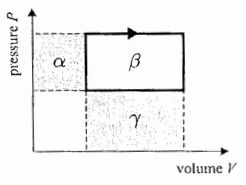 (A) α (B) β (C) γ (D) α + β (E) β + γ
 (A)
 (B)
 (C)
 (D)
 (E)

 (B)
 (C)
 (D)
 (E)

 (B)
 (C)
 (D)
 (E)

 (B)
 (C)
 (D)
 (E)

 (A) θ = tan⁻¹ μs (B) θ = cot⁻¹ μs (C) θ = sin⁻¹ μs (D) θ = cos⁻¹ μs (E) θ = sec⁻¹ μs
 (A) 12.5 (m/sec) (B) 20 (m/sec) (C) 25 (m/sec) (D) 40 (m/sec) (E) 50 (m/sec)
